Factors Affecting Lattice Enthalpy and Hydration (OCR A-Level Chemistry A): Revision Notes
📚Revision Notes
Factors Affecting Lattice Enthalpy and Hydration
Introduction to ionic compounds
Ionic compounds have several characteristic properties that arise from their giant ionic lattice structure. These compounds typically display high melting and boiling points, are soluble in polar solvents like water, and conduct electricity when molten or dissolved in aqueous solution.
However, there is actually considerable variation in the physical properties of different ionic compounds. Some ionic compounds melt easily with a Bunsen burner flame, whilst others require such extreme temperatures that they can line the interior of industrial furnaces. Similarly, while many ionic compounds dissolve readily in water, others are completely insoluble.
Note
The wide variation in properties of ionic compounds—from easily melted salts to ultra-high temperature ceramics, from highly soluble substances to completely insoluble compounds—demonstrates that not all ionic compounds behave the same way despite sharing the same basic structure.
The key to understanding these differences lies in examining two important energy quantities: lattice enthalpy and hydration enthalpy. The relative magnitudes of these values help explain the variety of melting points, boiling points, and solubility trends observed in ionic compounds.
Factors affecting lattice enthalpy
Lattice enthalpy is the enthalpy change when one mole of an ionic compound is separated into gaseous ions. The magnitude of lattice enthalpy depends primarily on two factors: ionic size and ionic charge.
Effect of ionic size on lattice enthalpy
The size of ions has a significant impact on lattice enthalpy values. This can be clearly demonstrated by comparing Group 1 chlorides, where the cation size increases down the group whilst the anion remains constant.
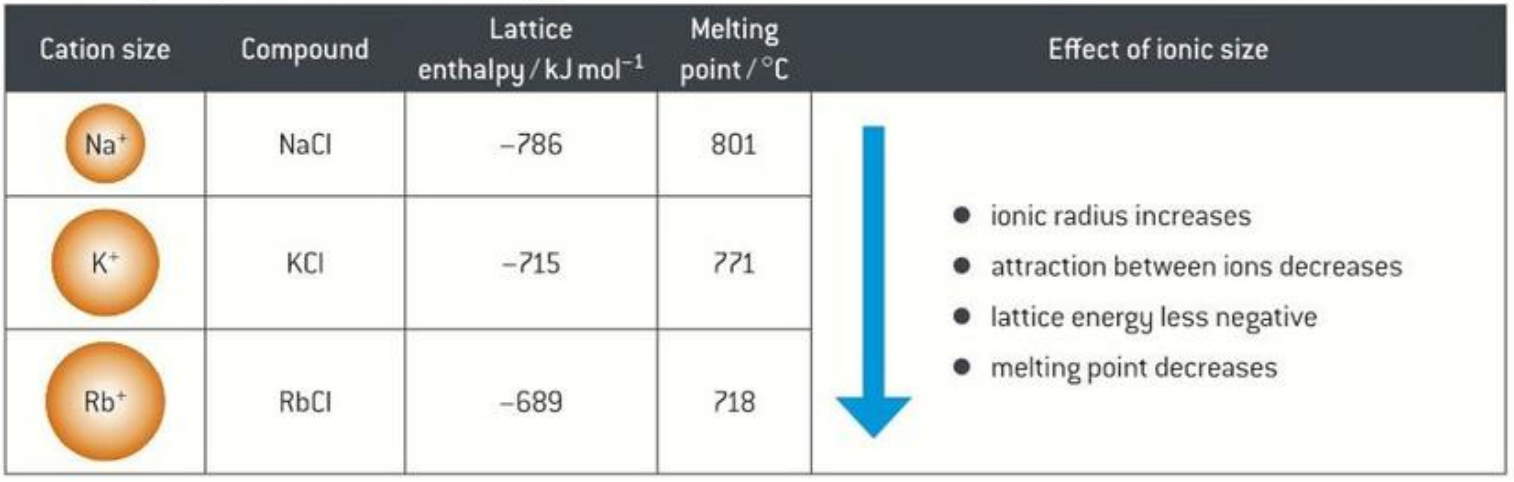
When we examine the data for sodium chloride, potassium chloride, and rubidium chloride, several clear trends emerge:
- As we move down Group 1, the ionic radius of the cation increases ()
- The electrostatic attraction between the positive and negative ions decreases as they become further apart
- The lattice enthalpy becomes less negative (less exothermic): for NaCl compared to for RbCl
- The melting point decreases: for NaCl compared to for RbCl
Important
Larger ions cannot pack as closely together in the lattice structure, which weakens the electrostatic forces of attraction between oppositely charged ions. This inverse relationship between ionic size and lattice enthalpy is fundamental to understanding ionic compound properties.
Effect of ionic charge on lattice enthalpy
Ionic charge has an even more dramatic effect on lattice enthalpy than ionic size. This can be illustrated by comparing sodium oxide () with calcium oxide (), where the cations have similar sizes but different charges.
Example
Worked Example: Effect of Ionic Charge on Lattice Enthalpy
Consider the comparison between and ions:
- The lattice enthalpy of is
- The lattice enthalpy of is
- The melting point increases from for to for
Observation: Despite having similar ionic radii, the ion produces a lattice enthalpy that is nearly 1000 kJ mol more negative than , demonstrating the powerful effect of ionic charge.
When ionic charge increases:
- The electrostatic attraction between ions increases significantly
- The lattice enthalpy becomes more negative (more exothermic)
- The melting point increases substantially
Note
Although there are more ions in one mole of than in one mole of , this does not outweigh the increased attraction from the charge on , which is much more significant in determining the overall lattice enthalpy.
Combined effects across Period 3
When we examine trends across Period 3 of the periodic table, both ionic size and charge change simultaneously, creating either reinforcing or opposing effects.
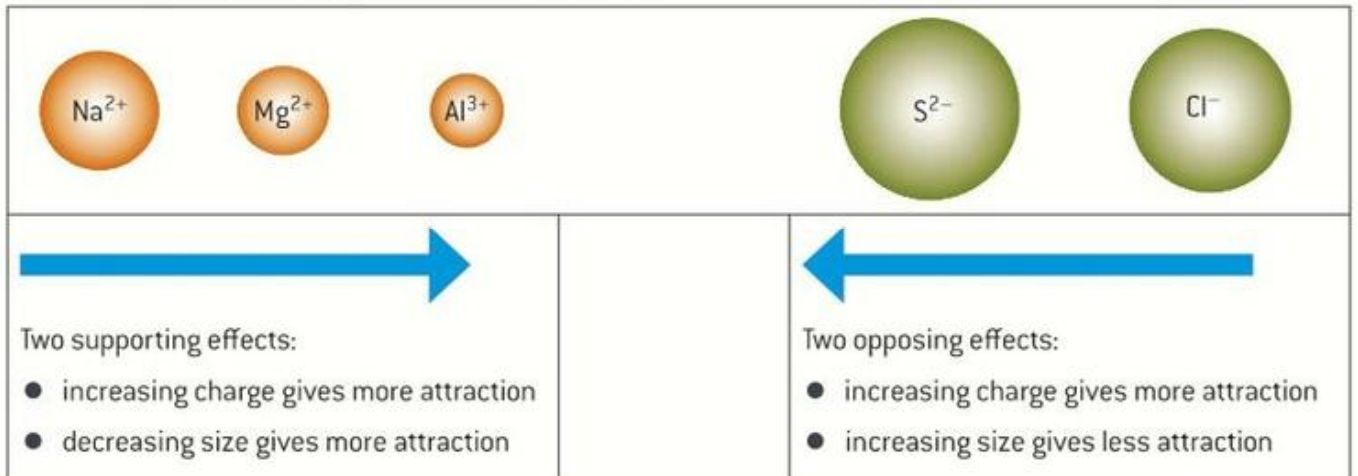
For the cations across Period 3 (, , ), we observe two supporting effects:
- Increasing charge provides greater electrostatic attraction
- Decreasing ionic size allows ions to pack more closely, increasing attraction
Both effects work together to create increasingly negative lattice enthalpies across the period.
For the anions (, ), we encounter two opposing effects:
- Increasing charge would increase attraction
- Increasing ionic size decreases attraction
Important
These competing factors mean predictions are less straightforward when comparing compounds with different anions. You must carefully consider whether the effects of size and charge are working together or against each other.
Predicting melting points
The magnitude of lattice enthalpy provides a reliable indicator of an ionic compound's melting point. Metal oxides such as , , and have extremely exothermic (very negative) lattice enthalpies and correspondingly very high melting points. These stable metal oxides are used as refractory materials for lining furnaces and industrial equipment.
Note
Real-World Application: Gemstones
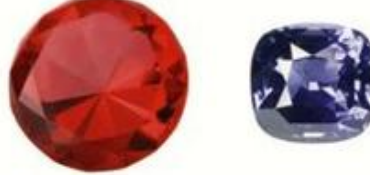
Rubies and sapphires are primarily composed of aluminium oxide (), with trace elements providing their distinctive colours. The very exothermic lattice enthalpy of ensures that these gemstones are extremely durable and long-lasting.
Lattice enthalpy is the primary indicator of melting point, but other structural factors, such as how ions pack together in the lattice, must also be considered when making precise predictions.
Factors affecting hydration
Hydration enthalpy is the enthalpy change when one mole of gaseous ions dissolves in water and becomes surrounded by water molecules. Hydration enthalpies follow similar trends to lattice enthalpies, being affected by both ionic size and ionic charge.
Effect of ionic size on hydration enthalpy
The size of an ion significantly influences its hydration enthalpy. This trend can be observed by examining Group 1 cations, where ionic radius increases down the group.
For the Group 1 cations:
- :
- :
- :
As ionic radius increases down the group:
- The attraction between the ion and surrounding water molecules decreases
- The hydration enthalpy becomes less negative (less exothermic)
Important
Understanding Charge Density
Larger ions have their charge distributed over a greater volume, resulting in a lower charge density. Water molecules are therefore less strongly attracted to larger ions. This concept of charge density is crucial for understanding both hydration and lattice enthalpy trends.
Effect of ionic charge on hydration enthalpy
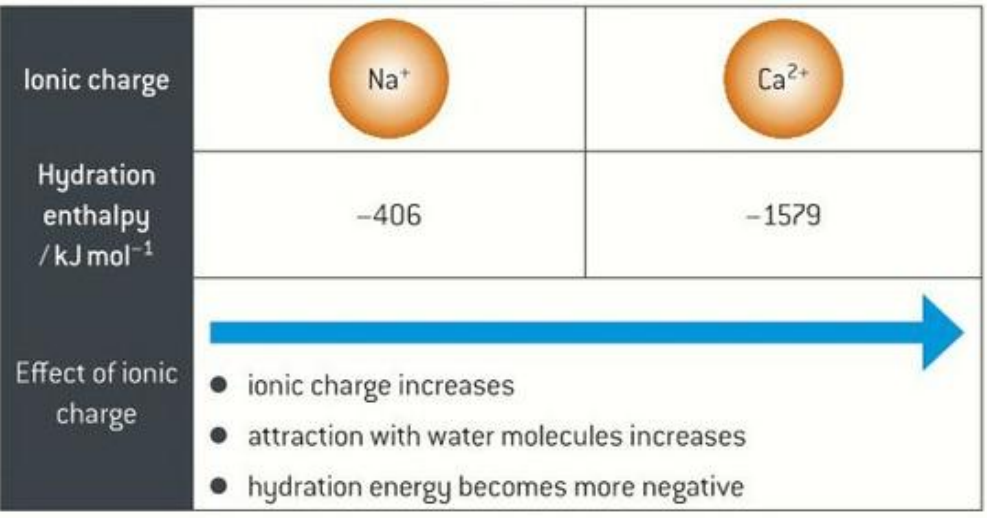
Ionic charge has a pronounced effect on hydration enthalpy, similar to its effect on lattice enthalpy.
Example
Worked Example: Effect of Ionic Charge on Hydration Enthalpy
Comparing sodium and calcium ions with similar sizes:
- :
- :
Analysis: The charge on calcium creates much stronger ion-dipole interactions with the polar water molecules compared to the charge on sodium. The hydration enthalpy is nearly four times more negative for calcium, demonstrating the dramatic effect of ionic charge.
When ionic charge increases:
- The attraction between the ion and water molecules increases dramatically
- The hydration enthalpy becomes significantly more negative (more exothermic)
Predicting solubility
The solubility of an ionic compound in water depends on the balance between lattice enthalpy and hydration enthalpy. When an ionic compound dissolves, the ionic lattice must first be broken apart (requiring energy equal to the lattice enthalpy), and then the separated ions become hydrated (releasing energy equal to the hydration enthalpy).
Note
The Dissolution Process
For an ionic compound to dissolve, the attraction between ions in the lattice must be overcome. This requires energy equal to the lattice enthalpy. Water molecules then surround the positive and negative ions, releasing energy equal to the hydration enthalpy.
Predicting dissolution:
If the sum of the hydration enthalpies (for both cation and anion) is larger in magnitude than the lattice enthalpy, the overall enthalpy change of solution will be exothermic and the compound should dissolve.
Important
The Role of Entropy
This is not the complete picture. Many compounds with endothermic enthalpy changes of solution are still soluble. The reasons for solubility also depend on temperature and another thermodynamic property called entropy, which relates to the disorder or randomness of a system. These factors determine whether dissolution processes can occur spontaneously at room temperature.
Even when the enthalpy change suggests a compound should dissolve, other factors including entropy changes must be considered for a complete understanding of solubility. These concepts are explored in greater depth in related topics on free energy and spontaneous processes.
Remember!
Summary
Key Points to Remember:
-
Ionic size effect: Larger ions → weaker electrostatic attraction → less negative lattice enthalpy and hydration enthalpy → lower melting points
-
Ionic charge effect: Higher charge → stronger electrostatic attraction → more negative lattice enthalpy and hydration enthalpy → higher melting points
-
Lattice enthalpy is a good indicator of melting point - compounds with very exothermic (highly negative) lattice enthalpies have very high melting points
-
Solubility depends on the balance between lattice enthalpy (energy required to break the lattice) and hydration enthalpy (energy released when ions are hydrated)
-
For a compound to dissolve, the total hydration enthalpy should ideally be larger in magnitude than the lattice enthalpy, though entropy effects also play a crucial role in determining solubility
Exam focus checklist
✓ Be able to explain how ionic size affects lattice enthalpy and hydration enthalpy with reference to electrostatic attraction
✓ Be able to explain how ionic charge affects lattice enthalpy and hydration enthalpy
✓ Understand that both factors can work together (supporting effects) or against each other (opposing effects)
✓ Be able to use lattice enthalpy values to predict relative melting points of ionic compounds
✓ Understand the energy changes involved when an ionic compound dissolves in water
✓ Remember that solubility predictions require consideration of both enthalpy and entropy factors