Redox and Electrode Potentials (OCR A-Level Chemistry A): Revision Notes
📚Revision Notes
Predictions from electrode potentials
Introduction
Standard electrode potentials provide a powerful tool for predicting whether redox reactions are thermodynamically feasible. By comparing the electrode potential values () of different redox systems, we can determine which species will act as oxidising agents, which will act as reducing agents, and whether a reaction between them is likely to occur under standard conditions.
Note
It's crucial to understand the distinction between thermodynamic feasibility and practical occurrence. Electrode potentials tell us whether a reaction is energetically favorable, but they cannot predict the reaction rate or whether the reaction will actually happen in the time frame we observe.
However, these predictions have important limitations that you must understand for the exam. While electrode potentials tell us if a reaction is thermodynamically possible, they cannot tell us how fast the reaction will occur or whether it will proceed under non-standard conditions.
Understanding the electrochemical series
Standard electrode potentials are measured under specific conditions: solutions at 1 mol dm⁻³ concentration, temperature of 298 K, and pressure of 100 kPa. These values are arranged in the electrochemical series, which allows us to make predictions about redox behaviour.
Note
Patterns in the Electrochemical Series
When redox systems are arranged in order of their standard electrode potentials, clear patterns emerge that help us predict redox behaviour:
Systems with more negative values:
- Have a greater tendency to be oxidised (lose electrons)
- Act as stronger reducing agents
- The reduced form (on the right side of the half-equation) is the reducing agent
Systems with more positive values:
- Have a greater tendency to be reduced (gain electrons)
- Act as stronger oxidising agents
- The oxidised form (on the left side of the half-equation) is the oxidising agent
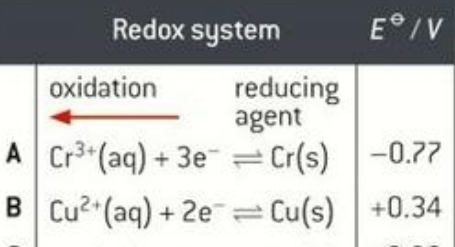
Consider the three redox systems shown in the table above:
| Redox system | Half-equation | / V |
|---|---|---|
| A | ||
| B | ||
| C |
From this arrangement:
- The strongest reducing agent is (top right, most negative system)
- The strongest oxidising agent is (bottom left, most positive system)
Predicting feasible redox reactions
A redox reaction will be thermodynamically feasible when an oxidising agent from one system reacts with a reducing agent from another system, provided that:
Important
The Key Rule for Predicting Feasibility
The oxidising agent must come from a redox system with a more positive value than the redox system of the reducing agent.
In other words, for a reaction to occur:
- Take the oxidising agent from the left side of the more positive system
- React it with the reducing agent from the right side of the more negative system
Comparing redox systems
Let's examine how to predict reactions between different systems:
Comparing system C with systems A and B:
System C has the most positive value ( V), so is a strong oxidising agent. This should react with reducing agents from systems with less positive electrode potentials.
Therefore, should react with:
- from system A (with V)
- from system B (with V)
Comparing system B with systems A and C:
System B has an value of V, which is more positive than system A but less positive than system C.
Therefore, (the oxidising agent from B) should react with:
- from system A only
The reaction between and is not predicted because system B has a less positive value than system C.
Comparing system A with systems B and C:
System A has the most negative value, so will not act as an oxidising agent with either system B or C. There are no redox systems with less positive electrode potentials for it to oxidise.
Note
Quick Method for Comparing Systems
When comparing any two redox systems, the system with the more positive electrode potential will have its oxidising agent (left side) react with the reducing agent (right side) from the system with the more negative electrode potential.
Writing overall equations for redox reactions
Once you have predicted that a reaction is feasible, you need to be able to write the balanced overall equation. This involves combining the two relevant half-equations.
Method for combining half-equations:
- Write the reduction half-equation exactly as shown (this is the system with the more positive value)
- Reverse the oxidation half-equation (this is the system with the more negative value)
- Balance the electrons by multiplying each half-equation by appropriate factors
- Add the two half-equations together, canceling out the electrons
Example
Worked Example: Combining Half-Equations
Using systems from our table, let's write the equation for the reaction between and :
Step 1: Reduction half-equation (system C, more positive):
Step 2: Oxidation half-equation (system A reversed, more negative):
Step 3: Balance electrons (multiply system C by 3):
Step 4: Add and cancel electrons:
The same principle applies to any pair of redox systems:
- The system with the more positive (less negative) value reacts from left to right and gains electrons
- The system with the less positive (more negative) value reacts from right to left and loses electrons
Limitations of predictions using standard electrode potentials
While standard electrode potentials are useful for predicting feasibility, they have important limitations that you must understand. Predictions based on values can fail under certain circumstances.
Limitation 1: Reaction rate (kinetics)
Important
Thermodynamics vs Kinetics
Standard electrode potentials indicate whether a reaction is thermodynamically feasible, but they provide no information about the rate at which the reaction will occur.
A reaction may have favorable electrode potentials suggesting it should occur, but if there is a very large activation energy, the reaction rate will be extremely slow. In practice, the reaction may appear not to happen at all.
This limitation mirrors a similar issue with using Gibbs free energy () to predict feasibility. Both and are thermodynamic quantities that tell us about the energy changes in reactions, but neither gives kinetic information about reaction rates.
Note
Exam Tip
If asked about limitations of electrode potential predictions, always mention that values indicate thermodynamic feasibility only and give no indication of reaction rate.
Limitation 2: Concentration effects
Standard electrode potentials are measured using solutions with concentrations of 1 mol dm⁻³. Many reactions in practice involve either concentrated or dilute solutions with concentrations that differ significantly from this standard value.
When the concentration changes, the position of equilibrium in the redox system shifts according to Le Chatelier's principle, which affects the electrode potential value.
Example
Example: Effect of Concentration on Electrode Potential
Consider the zinc redox system:
If the concentration of is greater than 1 mol dm⁻³:
- The equilibrium shifts to the right
- More electrons are removed from the system
- The electrode potential becomes less negative than the standard value
If the concentration of is less than 1 mol dm⁻³:
- The equilibrium shifts to the left
- More electrons enter the system
- The electrode potential becomes more negative than the standard value
Any change to the electrode potential of individual systems will affect the overall cell potential and therefore the predicted feasibility of reactions.
Limitation 3: Other non-standard factors
Several other factors can cause actual electrode potentials to differ from standard values:
Important
Non-Standard Conditions
Temperature and pressure: Standard electrode potentials assume a temperature of 298 K and pressure of 100 kPa. Reactions carried out at different temperatures or pressures will have different electrode potential values, which may affect predictions.
Non-aqueous systems: Standard electrode potentials are measured for aqueous equilibria. Many redox reactions occur in non-aqueous solvents or involve species that are not in aqueous solution. The standard electrode potential values may not apply to these systems, making predictions unreliable.
Note
Exam Tip
When asked about limitations in exam questions, you can explain the issue in terms of either oxidising agents (more common) or reducing agents (both approaches are valid and give the same answer).
Relationship between electrode potentials and free energy
Standard electrode potentials are mathematically related to Gibbs free energy change (), providing a connection between electrochemistry and thermodynamics.
Note
The Key Equation
The relationship is given by:
Where:
- = standard Gibbs free energy change (J mol⁻¹)
- = number of moles of electrons transferred in the balanced equation
- = Faraday constant = 96,500 C mol⁻¹
- = standard cell potential (V)
The cell potential is calculated from:
Or equivalently:
Understanding the relationship
When is positive:
- will be negative (because of the negative sign in the equation)
- A negative indicates a thermodynamically feasible (spontaneous) reaction
This confirms that for a feasible redox reaction, the oxidising agent must come from a system with a more positive electrode potential.
The smaller the value of (i.e., the less positive), the less negative the value of , indicating the reaction is less favorable thermodynamically.
Example
Worked Example: Calculating Cell Potential and Free Energy
Consider a standard cell constructed from and half-cells:
Given:
- for is V
- for is V
Calculate :
Calculate :
2 mol of electrons are transferred, so
Interpretation: The positive and negative confirm that this reaction is thermodynamically feasible.
Note
Note on Significant Figures
When calculating , round your final answer to match the least number of significant figures in your data. In this example, the electrode potential value of 1.10 V has three significant figures, so the final answer should also be given to three significant figures.
Remember!
Summary
Key Points to Remember
-
Thermodynamics vs Kinetics: Standard electrode potentials predict thermodynamic feasibility, not reaction rate. A positive cell potential indicates a feasible reaction, but gives no information about how fast it will occur.
-
Finding the Strongest Agents: The strongest oxidising agents are found at the bottom left of the electrochemical series (most positive values), while the strongest reducing agents are at the top right (most negative values).
-
Predicting Feasibility: For a reaction to be feasible, the oxidising agent must come from a system with a more positive electrode potential than the system providing the reducing agent.
-
Three Key Limitations of Predictions:
- No information about reaction rate/kinetics
- Measured at 1 mol dm⁻³ concentration which may not apply to real reactions
- Assume standard conditions and aqueous systems which may not be used in practice
-
The Mathematical Link: The relationship connects electrode potentials to free energy changes. A positive gives a negative , confirming thermodynamic feasibility.