International trade (OCR A-Level Economics): Revision Notes
📚Revision Notes
4.4 Trade policies and negotiations
DEFINITIONS:
- Protectionism: actions taken to impose restrictions on trade in goods and services
- Tariff: tax on imported goods designed to raise price of import so that people buy domestically
- Quota: physical limit on the quantity of imported goods and usually on industries important to a country's structure
- Economic integration: an agreement between countries in a geographic region to reduce and ultimately remove both tariff and non-tariff barriers, to enable the free flow of goods and services and factors of production between countries
- Free trade areas: a group of countries that agree not to use any protectionist policies between them
- Customs Unions: groups of countries that agree to remove restrictions on trade member countries, and set a common set of restrictions - most commonly tariffs and embargoes - against non-member states
- Common (Single) Markets: where countries have free trade, not just in goods and services, but also factor markets
- Monetary Union: a set of trading arrangements, the same as a common market, with the additional step of sharing a single shared currency
- Economic Union: when economies of member countries are as fully integrated as different regions within a country. The economic union, implies that there is some degree of fiscal union with a central body having some powers over taxation and spending and also a monetary union, where all member countries share the same currency
- World Trade Organisation (WTO): encourages and promotes free trade by removing protectionism , especially tariffs
Explain:
4.4.1 Protectionism
Protectionism refers to government policies that restrict international trade to protect domestic industries from foreign competition. These policies can include:
Note
- Tariffs: Taxes on imported goods, making them more expensive and less competitive compared to domestic products.
- Quotas: Limits on the quantity of goods that can be imported, restricting supply and potentially raising prices for consumers.
- Subsidies: Financial assistance given to domestic producers to lower their costs and make their products cheaper compared to imports.
- Import Licensing: Requirements for importers to obtain authorisation before bringing goods into the country, which can limit the volume of imports.
- Standards and Regulations: Strict quality or safety standards that foreign goods must meet, which can act as barriers to trade.
Purpose: The main goals of protectionism are to safeguard domestic jobs, protect emerging industries, ensure national security, and reduce trade deficits. However, it can also lead to higher prices for consumers, reduced choice, and potential trade wars.
4.4.2 Economic integration through free trade areas, customs unions, monetary union, economic union
Note
Free Trade Areas (FTAs):
Note
Customs Unions:
Example: The European Union (EU) Customs Union is a well-known example.
- Purpose: The aim is to harmonise trade policies and regulations among member countries and to create a unified external trade policy.
:::
Note
Monetary Union:
Note
Economic Union:
Explanation with the aid of a diagram
4.4.3 The Impact of Tariffs and Quotas on Trade Creation and Trade Diversion
Tariffs and quotas are tools used in trade policy to protect domestic industries from foreign competition. While they serve similar purposes, they have distinct impacts on trade creation and trade diversion.
Definitions:
- Tariffs: Taxes imposed on imported goods, making them more expensive and less competitive compared to domestic products.
- Quotas: Limits on the quantity of a good that can be imported, restricting the supply of foreign goods in the domestic market.
Trade Creation and Trade Diversion:
Note
- Trade Creation: Occurs when the removal or reduction of trade barriers (like tariffs) leads to the replacement of higher-cost domestic production with lower-cost imports from member countries within a trade agreement.
- Trade Diversion: Happens when trade barriers cause imports to shift from a lower-cost supplier outside a trade agreement to a higher-cost supplier within the agreement due to preferential treatment.
Impact of Tariffs and Quotas:
Note
Tariffs:
Note
Quotas:
Diagram Explanation:
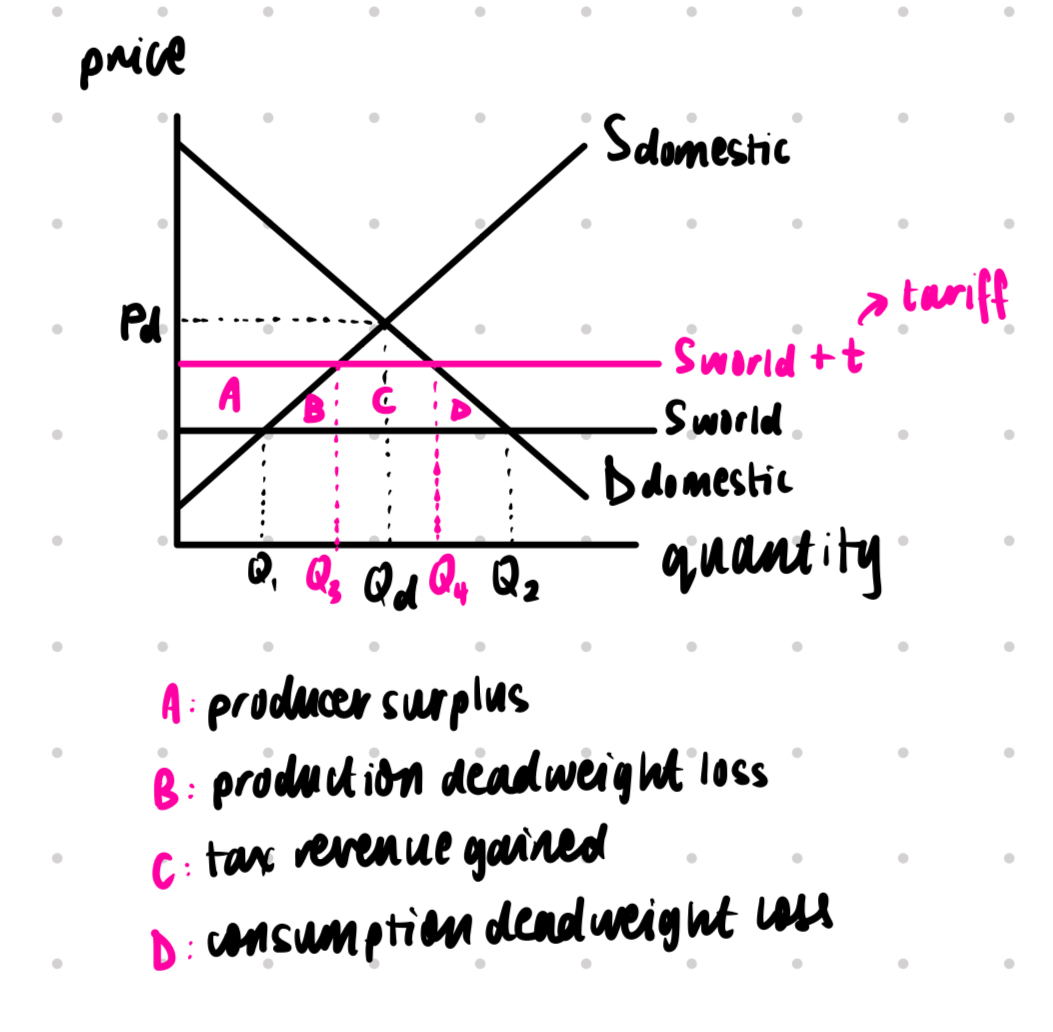
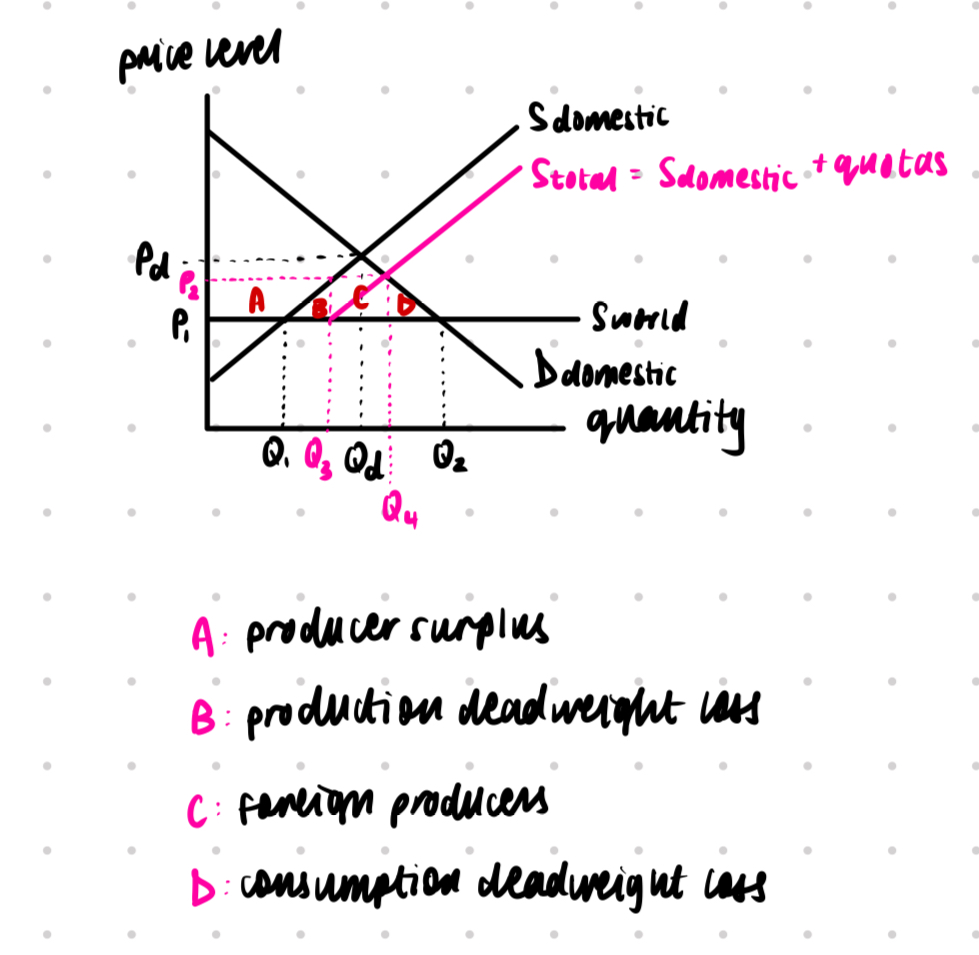
The diagrams below illustrate the impact of tariffs and quotas on trade creation and trade diversion.
1. Tariffs:
- S: Domestic supply curve.
- World Price: The price of the good without tariffs.
- World Price + Tariff: The price of the good with the tariff imposed.
- Trade Creation: Not directly depicted but implies increased domestic production replacing higher-cost imports.
- Trade Diversion: Shifts imports from a more efficient foreign producer to a less efficient domestic one.
2. Quotas:
- S: Domestic supply curve.
- World Price: The price of the good without the quota.
- Quota Limit: The maximum quantity of imports allowed.
- Trade Creation: Limited as quotas restrict the overall supply.
- Trade Diversion: Implies increased reliance on higher-cost domestic production or alternative sources within the quota.
Summary:
Note
Both tools aim to protect domestic industries but can lead to trade diversion, where less efficient domestic production or higher-cost imports replace more efficient international trade, ultimately reducing overall economic welfare.