Social Cognition (OCR A-Level Psychology): Revision Notes
📚Revision Notes
11.4.3 Mirror Neurons
The role of mirror neurons in social cognition:
Mirror neurons are a set of specialised neurons. These neurons are activated when we observe the motor actions of others but are also activated when we perform motor actions ourselves.
Rizzolatti et al - discovered that when a researcher reached for food, a monkey's motor cortex became active in the same way it did when the monkey reached for the food itself
There is a strong link between mirror neurons and understanding intention in others.
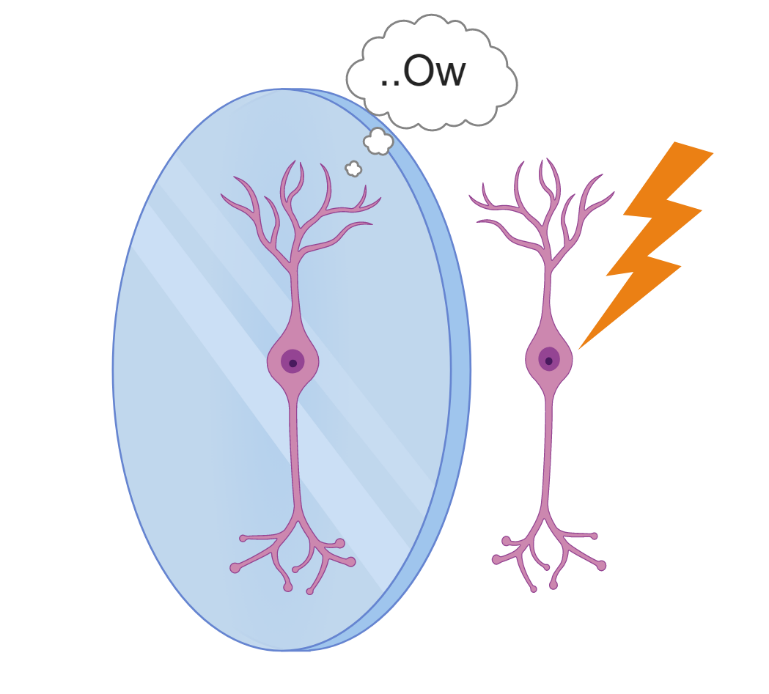
Neurological deficits involving mirror neurons as a potential explanation for autistic spectrum disorders. A faulty mirror neuron system may result in an inability to understand the intentions and emotions of others.
This leads to problems in social communication, and awkwardness and manifests itself as adults who struggle to 'read' others i.e. in terms of their intentions, goals, emotions and perspectives.
Evaluation:
Note
P: Many studies on mirror neurons involve highly controlled, artificial tasks that may not fully capture the complexity of social interactions in real-world settings.
Note
E: Laboratory conditions often simplify social scenarios, which may not reflect how mirror neurons function in everyday life.
Note
E: Future research should aim to study mirror neuron activity in more naturalistic contexts to enhance the ecological validity of the findings.