Liberation Theology context (OCR A-Level Religious Studies): Revision Notes
📚Revision Notes
Liberation Theology- Context
Liberation theology is a societal movement driven by theology.
Note
It goes against the traditional understanding of theology, whereby theological explanation comes first and action second, as for liberation theologians; action comes first, then the theology. It focuses on the experiences of the poor and interprets Christianity as a response to poverty and other examples of exploitation and alienation.
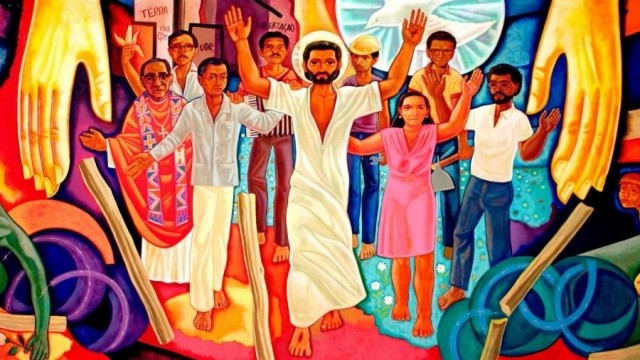
It looks at the idea that bringing about the Kingdom of God is not something that only happens after death instead it is part of the physical struggle in this world to make the lives of the poor better.
Liberation theology links to Karl Marx's analysis of capitalism. Marx argues that capitalism created a world in which wealth and power are concentrated in the hands of the few at the expense of the many.
Liberation theology has been criticized for its reliance on Marxism, a non-Christian viewpoint, but it has also contributed to a renewed emphasis on the importance of the poor in Christian thought
How Liberation Theology was founded
Note
Liberation theology was born in 1964 when a group of young Catholics met in Brazil and pledged to find the truth of the Christian message in the poverty of Latin America.
Prominent members of the group were Jon Sobrino and Gustavo Gutierrez.
The meeting of Latin American Bishops at Puebla (1979), is thought to be the beginning of action that was taken by liberation theologians, as at this meeting the Bishops came up with the idea of integral liberation, which means liberation is not 'extra' it's fundamental to all aspects of church life.
It was at this meeting that the controversial idea of the People's Church was first born, stating that the essential duty of the church was to deal with external economic conditions. In 1980, while El Salvador was in the midst of a civil war, Oscar Romero a priest, was assassinated while giving mass.
Note
This was due to his message of liberation for the poor as he spoke out against the government and army soldiers telling them to stop the killing and exploitation of the poor. His actions are based on the ideas of a liberation theologian.
What do Liberation Theologians argue?
Liberation theologians hold that liberation must happen in two ways for there to be true freedom:
- Liberation from social and economic oppression.
- Then liberation from sin. This is a highly controversial viewpoint as Christians typically hold that the most important thing is that you liberate yourself from sin.
As part of this theology, Christians formed 'based communities' where they shared their views and practical solutions.
Liberationists said the church should act to bring about social change, and should ally itself with the working class to do so.
Note
A common way in which priests and nuns showed their solidarity with the poor was to move from religious houses into poverty-stricken areas to share the living conditions of their flock – this approach is referred to by some as 'Bottom up' Theology.
Some radical priests became involved in politics and trade unions; others even aligned themselves with violent revolutionary movements. Many Biblical references support the concepts behind liberation theology (and some people use this as an argument to say that it is not a Marxist-inspired concept, but a Biblical one.)
Biblical support includes:
Moses
- People of Israel were liberated by God and then he made a new covenant with them and they became new people – in the same way people now believe that God's love involves both creation and liberation
Jesus denounced the rich and Pharisees
- "you can't serve two masters – money and God"
- "It is easier for a camel to go through the eye of a needle than for a rich man to make it to heaven"
- "Blessed are you who are poor, for yours is the kingdom of God."
- Matthew 25, "Whatever you did for the least of these, you did for me."
Parable of the Rich Man and Lazarus (Luke 16:19-31)
- In this parable, Jesus contrasts the fate of a rich man who lived in luxury with that of Lazarus, a poor beggar who suffered in life but was rewarded in heaven. The parable demonstrates Jesus' concern for the poor and the consequences of neglecting them.
Context: Who is Marx?
Karl Marx was a 19th century German economic theorist best known for laying the foundations of communism and socialism and a revolutionist.
He published (with Friedrich Engels) The Communist Manifesto, the most celebrated pamphlet in the history of the socialist movement. Marx highlights two key ideas:
Alienation & exploitation stating that these occur due to historical materialism.
This movement was massively influential because at a time when capitalism was accepted and seen to be what is driving growth; change and power in society, Marx and his colleagues were totally against the movement.
He was heavily critical of a capitalist society, which he called the "dictatorship of the bourgeoisie", believing society to be run by the wealthy middle and upper classes purely for their benefit.
Note
Karl Marx believed that one day there would be a revolution of the working class.
What makes society so bad?
Karl Marx viewed society as Bad – He took a conflicting Sociological viewpoint and stated that the Bourgeoisie treat the proletariat unfairly to benefit
Liberation Theology and Marx
from their work, which is wrong because it causes class reproduction, closed societies, and alienation due to ideologies.
Note
Capitalism is an economic and political system in which a country's trade and industry are controlled by private owners for profit, rather than by the state. Marx argued that the key to capitalism as a social system is: 1. Workers 2. The means of production (factories, machines, tools) 3. Those who own or control the means of production.
Capitalism is the driving force of the 'badness 'of society.
The worsening of conditions for the proletariats, or the fact that they become aware of their class position and the pauperisation that has occurred, results in the proletariat becoming aware of their class position and that they could be better off. Through political organisations, they unite in a state of revolutionary consciousness and liberate the economy.
Historical Materialism
Note
He believed in the concept of Historical Materialism: A theory that asserts that the material conditions of a society's mode of production determine society's organisation and development.
This means that you make/produce and how you do it sets the tone for the social structures in your society.
Historical materialism states that social classes and the relationship between them, along with the political structures and ways of thinking in society, are based on economic activity. Marx states:
Note
The mode of production of material life conditions the general process of social, political, and intellectual life. It is not the consciousness of men that determines their existence, but their social existence that determines their consciousness.
Historical materialism came about during the Enlightenment era, which asserted that the development of human society has progressed through a series of stages, from hunting and gathering, through pastoralism and cultivation, to commercial society.
Historical materialism rests on the idea of metaphysical materialism – this means that consciousness and human ideas about the universe result from their material conditions rather than vice versa.
Theory and practise
Aristotle, who distinguishes between theory and practice, influenced Marx's writing. In theory, human beings think, and their goal is truth. In praxis, human beings do, and their goal is action.
Note
For Marx, the point is to change it and to engage in praxis. In praxis, you are engaged in trying to understand the world and in trying to act in the world in order to change it – hence his need for a revolution.
For Marx, ideology is a belief system that distorts people's perception of reality in the interests of the ruling class.
Note
In Marx's view, religion is an ideological weapon by the ruling class to justify the suffering of the poor as something inevitable and God-given.
Liberation Theology and Marx
Liberation theology has used and been influenced by Marx in several ways including:
- Liberation theologians have adopted the Marxist tool of 'praxis' (action) to analyse the causes of poverty and then act to change society
- Both systems reject using the patterns of alienation, which dehumanise people and prevent them from living fulfilling lives
- Both challenge the injustices of capitalism, which can be a cause of exploitation when people are treated as a 'means to an end'. This can result in corruption, which gives wealth to the rich at the expense of the poor
- Marxism has been used to refocus theology from abstract principles to the daily struggles of ordinary people.
- Liberation theology also challenges the Church to use its wealth and power more effectively to tackle issues of poverty and inequality.
Should Liberation Theology be influenced by Marx?
Yes
- Marx provides a helpful analysis of the economic state, despite his ideas on religion, his analysis deems helpful to understand what is wrong with the economic state and how we can reform it.
- We can listen to Marx's economic views without listening to his views on religion, the two are distinct.
- Arguably, if we reform religion along the lines of Liberation Theology, using a Marxist critique of the economy then religion would no longer be subject to the criticisms imposed by Marx.
- Adopting Marxist analysis of the economy is the only way to see real change within society.
No
- Marxist views on the economy and religion are inextricably linked, Marx believes that religion is the "opiate of the people" and is therefore a powerful force in suppressing people's demands for change.
- Christians should not be influenced by atheist moral frameworks.