Genetic Inheritance (AQA GCSE Biology Combined Science): Revision Notes
📚Revision Notes
6.1.6 Genetic Inheritance
Key Terms
| Term | Definition |
|---|---|
| Gamete | A reproductive cell (egg in females, sperm in males) containing half the number of chromosomes, i.e., 23 in humans. Gametes are haploid cells, meaning they carry only one set of chromosomes. |
| Chromosome | A thread-like structure located in the nucleus of a cell, composed of a long strand of DNA tightly coiled around proteins called histones. Chromosomes carry the genetic information needed for the growth, development, and reproduction of an organism. |
| Gene | A segment of DNA that contains the instructions for building a specific protein, contributing to a particular characteristic or function. Some traits, like fur colour in mice or red-green colour blindness in humans, are controlled by a single gene, while most traits result from the interaction of multiple genes. |
| Allele | Different versions or forms of a gene. Since humans inherit one allele from each parent, they have two alleles for each gene. These alleles can be the same or different, leading to variations in traits. |
| Dominant Allele | An allele that is expressed in the phenotype even if only one copy is present. In other words, the trait associated with this allele will appear in the organism even if it is heterozygous (has one dominant and one recessive allele). |
| Recessive Allele | An allele that is only expressed in the phenotype if two copies are present (i.e., the organism is homozygous for the recessive allele). If only one copy is present, the dominant allele will mask the expression of the recessive allele. |
| Homozygous | A genotype in which both alleles for a gene are the same, either both dominant (AA) or both recessive (aa). |
| Heterozygous | A genotype in which the two alleles for a gene are different, one dominant and one recessive (Aa). |
| Genotype | The genetic makeup of an organism in terms of the alleles it carries (e.g., AA, Aa, or aa). The genotype determines potential traits that may be passed on to offspring. |
| Phenotype | The observable physical or physiological traits of an organism, which result from the interaction of its genotype with the environment (e.g., eye colour, blood type). |
Inheritance Patterns
-
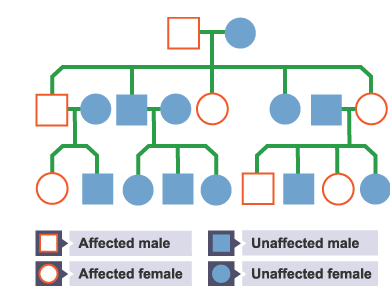
Family Trees: These diagrams illustrate the inheritance of specific traits or phenotypes across multiple generations within a family. They help trace the transmission of genetic disorders or traits.
-
Monohybrid Cross (Single Gene Cross): This is a method used to predict the possible genotypes and phenotypes of offspring from a genetic cross involving a single gene. The Punnett square diagram is commonly used to visualise these crosses.
Punnett Square Diagram
- A Punnett square is a grid that allows you to determine the probability of offspring inheriting particular combinations of alleles based on the genotypes of the parents.
- Dominant traits are represented by uppercase letters (e.g., A), while recessive traits are represented by lowercase letters (e.g., a). For simplicity, the same letter is often used to represent different alleles of the same gene.
Example: Punnett Square Diagram
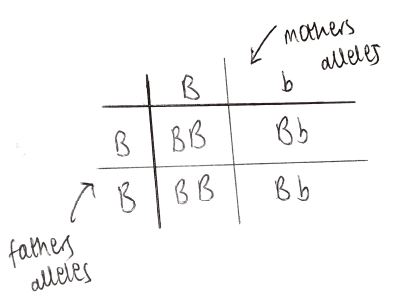
The Punnett square shows a cross between two parents, both with the genotype Bb (heterozygous) for a trait, where "B" is dominant and "b" is recessive.
- BB: 25% chance (dominant trait)
- Bb: 50% chance (dominant trait)
- bb: 25% chance (recessive trait) This means 75% of the offspring will show the dominant trait, while 25% will show the recessive trait.