Plant Hormones (AQA GCSE Biology): Revision Notes
📚Revision Notes
5.4.1 Plant Hormones
Note
Plants need hormones to coordinate and control growth. They are needed for tropisms. Examples of these include phototropism, the response to light, and gravitropism or geotropism, the response to gravity. Hormones move from the place they are made to where they are needed in order to produce the appropriate response.
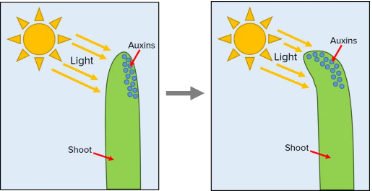
Most plants show positive phototropism because they grow towards the light source.
- The plant is exposed to light on one side.
- Auxin, a hormone, moves to the shaded side of the shoot.
- Auxin stimulates cells to grow more here.
- This means the shoot bends towards the light.
- The plant receives more light, meaning photosynthesis can occur at a faster rate.
Most shoots show negative gravitropism as they grow away from gravity. If a shoot is horizontal:
- Auxin moves to the lower side.
- The cells of the shoot grow more on the side with most auxin, so it stimulates cells to grow more here.
- This makes the shoot bend and grow away from the ground.
- This is beneficial as light levels are likely to be higher further away from the ground.
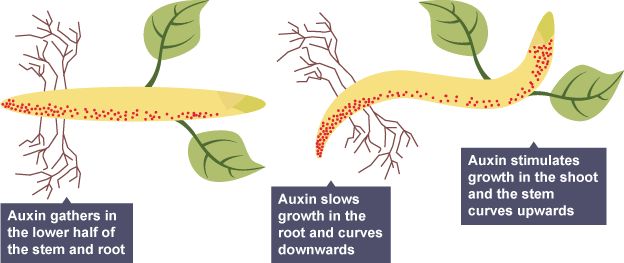
Most roots show positive gravitropism as they grow towards gravity. If a root is horizontal:
- Auxin moves to the lower side.
- The cells of the root grow more on the side with less auxin, so it stimulates cells to grow on the upper side.
- This makes the root bend and grow downwards.
- This is beneficial as there are more likely to be increased levels of water and nutrients lower down, and it provides stability for the plant.
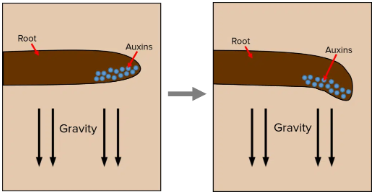
When the auxin distribution becomes equal on both sides it grows straight in that directions.
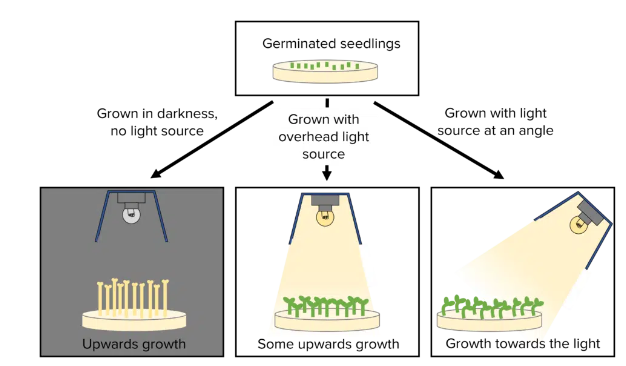
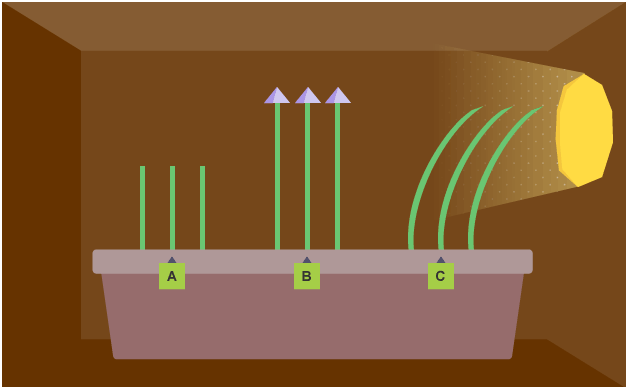
You can investigate the effect of light or gravity on newly germinated seedlings by varying conditions.
- Placing in cardboard box and shining light from one side
- Attaching a petri dish containing the seedlings to a wall (effects of gravity)
Two other plant hormones are gibberellins and ethene.
- Gibberellins are important to stimulate seed germination.
- Ethene is involved in cell division and the ripening of fruits.