Speciation (AQA GCSE Biology): Revision Notes
📚Revision Notes
6.3.2 Speciation
Note
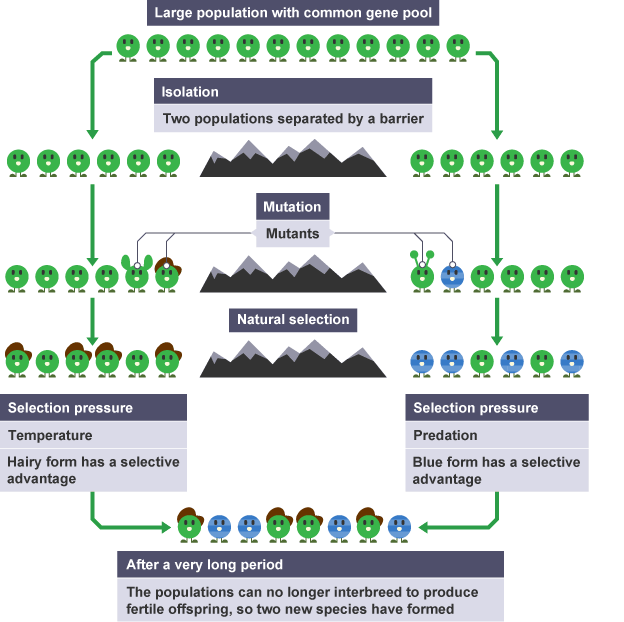
Speciation is the process by which new species arise through the selection of different alleles, leading to increased genetic variation. Over time, this can result in a new population that can no longer interbreed with the original population to produce fertile offspring, thus forming a new species.
Alfred Russel Wallace and Speciation
- Alfred Russel Wallace co-developed the theory of evolution by natural selection and played a significant role in understanding speciation.
- During his travels, Wallace observed that individuals lacking traits beneficial for survival in changing environments were more likely to die out.
- Wallace collaborated with Darwin, and they published joint studies on natural selection.
- However, the publication of Darwin's "On the Origin of Species" in 1859 led to Darwin receiving most of the credit for the theory.
- Wallace continued his research globally, making significant contributions, such as his work on warning coloration in animals, which helped further the understanding of natural selection.
The Process of Speciation
- Genetic Variation: Variation exists within a population due to genetic differences.
- Natural Selection: Alleles that provide a survival advantage are selected for, allowing those traits to become more common in the population.
- Isolation: A population may become isolated (e.g., by physical barriers like mountains or rivers), preventing it from breeding with the original population.
- Divergent Evolution: In the new environment, different alleles may be advantageous, leading to the selection of traits that differ from those in the original population.
- Genetic Divergence: Over time, the accumulation of genetic differences between the isolated populations increases.
- Reproductive Isolation: Eventually, the two populations become so genetically distinct that they can no longer interbreed to produce fertile offspring, marking the emergence of a new species.