Quality control during manufacture (AQA GCSE Design and Technology): Revision Notes
📚Revision Notes
Quality control during manufacture
Understanding tolerance in manufacturing
Manufacturing would be ideal if every product could be made with perfect accuracy, but this simply isn't realistic in the real world. All manufacturers accept that there will be small variations in their products, which is why they establish something called tolerance.
Tolerance refers to the acceptable range of variation that a product can have while still functioning properly. Think of it as setting boundaries - as long as a part falls within these boundaries, it will work correctly. Manufacturers establish both an upper limit (the maximum acceptable size) and a lower limit (the minimum acceptable size) for each specification.
The tolerance is expressed using plus or minus symbols (±) followed by a measurement. For example, if a component should be 50mm long with a tolerance of ±2mm, then any component between 48mm and 52mm would be acceptable. This tolerance system applies to all aspects of manufacturing including size, weight, colour, strength, and quantity.
Important
Parts that fall outside their tolerance range simply won't fit together properly or function as intended. Imagine if a nut and bolt in an aircraft engine were manufactured outside their tolerance limits - this could create a dangerous loose connection that might fail during flight.
Quality control systems
Quality control (QC) represents the systematic approach manufacturers use to ensure their products meet the required standards and stay within tolerance limits. Rather than hoping for the best, companies establish formal QC processes throughout their manufacturing operations.
Setting up comprehensive QC equipment can be expensive for manufacturers, so many companies use a cost-effective approach called random sampling. Instead of checking every single product, they select random samples from production batches and test these thoroughly. If the samples meet standards, they assume the entire batch is acceptable.
Note
Random sampling offers significant cost savings while still maintaining quality standards. This approach allows manufacturers to allocate resources more efficiently while catching potential problems before they affect entire production runs.
The fundamental goal of any QC system is verification - confirming that parts and assembled products have been manufactured to the correct standard and fall within their specified tolerance ranges. This systematic checking helps catch problems early before defective products reach customers.
Material-specific quality control methods
Different materials and manufacturing processes require specialised quality control approaches. Each material type presents unique challenges that demand specific testing methods and tools.
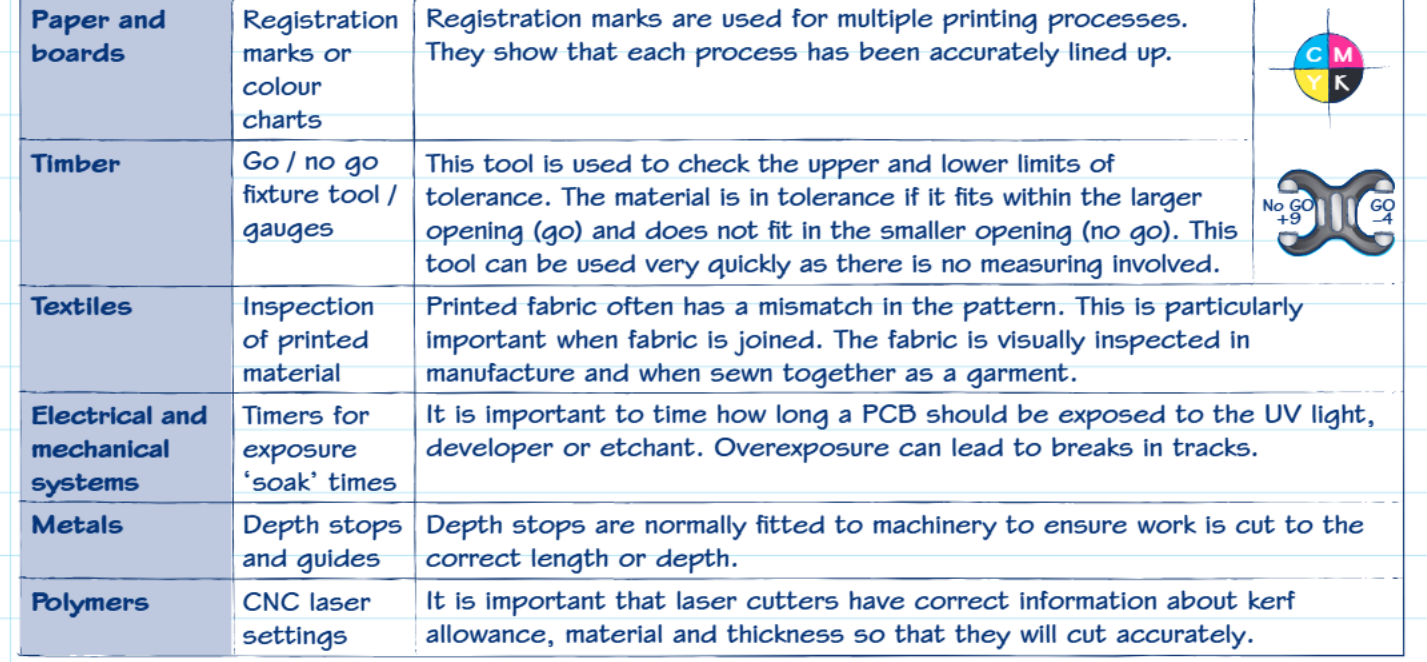 Paper and board products
When manufacturing paper and board items, registration marks and colour charts play a crucial role in quality control. Registration marks help ensure that multiple printing processes align correctly with each other. These marks show operators whether each colour layer has been applied in precisely the right position, preventing blurry or misaligned printing that would make the final product unacceptable.
Timber manufacturing
Timber products rely heavily on go/no go fixture tools for quality control. These clever tools work on a simple principle - if a piece of timber fits through the "go" opening, it's within tolerance, but if it fits through the "no go" opening, it's too small and should be rejected. This method allows for very quick quality checking since it requires no measuring or calculations.
Textile production
Textile manufacturing focuses heavily on visual inspection of printed materials. Fabric printing often produces pattern mismatches, particularly when different pieces of fabric need to be joined together or sewn into garments. Quality controllers carefully examine printed fabrics during manufacturing and again when pieces are sewn together to catch any alignment issues.
Electrical and mechanical systems
For electrical components like printed circuit boards (PCBs), timing becomes critical for quality control. Controllers use precise timers to monitor how long PCBs are exposed to UV light during manufacturing processes. Too little exposure can lead to incomplete processing, while too much exposure might damage delicate components.
Metal fabrication
Metal manufacturing commonly uses depth stops and guides to maintain quality control. These devices attach to machinery and prevent cutting tools from going too deep or not deep enough. This ensures that all metal components are cut to exactly the right dimensions without requiring constant manual measurement.
Polymer processing
Polymer manufacturing, particularly when using CNC laser cutting equipment, relies on precise laser settings for quality control. Operators must input correct information about material thickness, type, and kerf allowance (the width of material removed by cutting) to ensure the laser cuts accurately and produces parts within tolerance.
Example
Worked Example: Applying Tolerance in Manufacturing
Consider a steel chair leg that must measure 720mm in length with a tolerance of ±5mm.
Step 1: Calculate the acceptable range
- Upper limit: 720mm + 5mm = 725mm
- Lower limit: 720mm - 5mm = 715mm
- Acceptable range: 715mm to 725mm
Step 2: Test sample measurements Given legs measuring: 726mm, 770mm, 716mm, and 670mm
Step 3: Determine which pass inspection
- 726mm: Outside range (too long) - REJECT
- 770mm: Outside range (too long) - REJECT
- 716mm: Within range (715-725mm) - ACCEPT
- 670mm: Outside range (too short) - REJECT
Only the 716mm leg would pass inspection since it falls within the acceptable range.
This demonstrates why tolerance is so important - even small deviations outside the acceptable range could result in wobbly chairs or assembly problems that would make the final product unsafe or unusable.
Summary
Key Points to Remember:
- Tolerance creates acceptable boundaries for manufacturing variations, ensuring products still function properly even with small differences
- Quality control systems use systematic checking throughout manufacturing to catch problems before products reach customers
- Random sampling offers a cost-effective way to check quality without testing every single product
- Different materials require specialised QC methods - from registration marks for printing to depth stops for metal cutting
- Parts outside tolerance limits won't fit or function properly, which can create safety hazards or product failures