Addition (AQA GCSE Design and Technology): Revision Notes
📚Revision Notes
Addition - Timber joining methods
When working with timber-based materials, understanding how to properly join pieces together is essential for creating strong, durable structures. The method you choose depends on what you're building and how much strength you need. There are three main categories of timber joints, each designed for specific construction purposes.
Note
The choice of joining method significantly impacts both the structural integrity and appearance of your finished project. Understanding the strengths and limitations of each joint type will help you make informed decisions in your woodworking projects.
Carcase joints
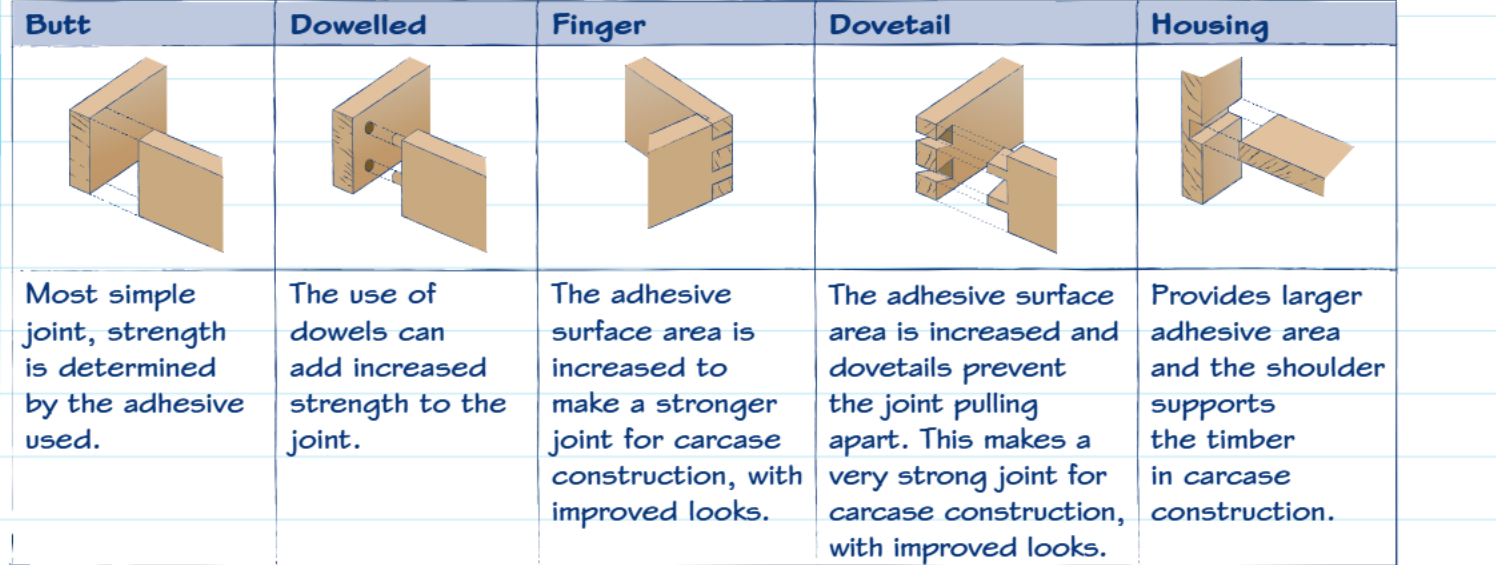
Carcase joints, also known as box joints, are specifically designed for constructing enclosed structures like cabinets, drawers, and shelving units. These joints connect the flat panels that form the sides, top, and bottom of box-like constructions.
 Butt joints
The butt joint represents the most straightforward approach to joining timber pieces. Two pieces of wood are simply placed end-to-end or edge-to-edge and held together with adhesive. While this method is quick and easy to execute, its strength relies entirely on the adhesive bond since there's minimal surface area for the glue to grip.
Dowelled joints
Dowelled joints improve upon the basic butt joint by incorporating wooden pegs (dowels) that fit into corresponding holes drilled in both pieces. These dowels significantly increase the joint's strength by providing additional adhesive surface area and mechanical connection. The dowels help align the pieces during assembly and resist forces that might pull the joint apart.
Finger joints
Finger joints create an interlocking connection through a series of rectangular projections and slots that fit together like interlaced fingers. This design dramatically increases the adhesive surface area compared to a simple butt joint, making it much stronger for carcase construction. The interlocking nature also improves the joint's appearance and provides better resistance to pulling forces.
Dovetail joints
The dovetail joint is renowned for its exceptional strength in carcase construction. Its distinctive wedge-shaped projections (resembling a dove's tail) lock into corresponding slots, creating a joint that actually becomes stronger under tension. The increased adhesive surface area combined with the mechanical locking action makes this joint ideal for high-quality cabinet work, though it requires considerable skill to execute properly.
Important
Common Mistake to Avoid: Never rely solely on adhesive for joints that will experience pulling forces. Joints like dovetails and dowelled joints provide mechanical reinforcement that prevents failure when the adhesive bond is stressed.
Housing joints
Housing joints involve cutting a groove or channel in one piece of timber to receive the end of another piece. This creates a larger adhesive surface area and provides a shoulder that supports the timber, making it particularly useful in carcase construction where shelves need to be supported by the sides of a cabinet.
Frame joints
Frame joints are engineered to create sturdy structural frameworks for furniture like tables and chairs. These joints must handle different types of forces and provide the rigid support structure that other components will attach to.
 Mortise and tenon joints
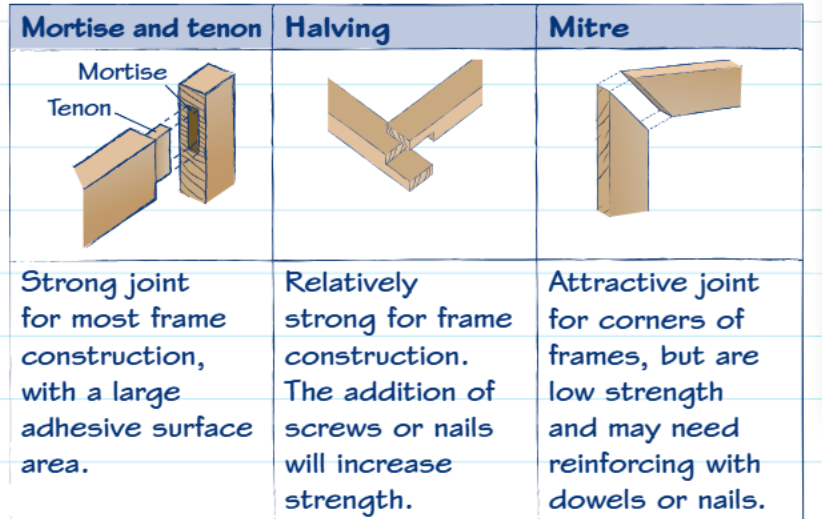
The mortise and tenon joint is considered the gold standard for frame construction. It consists of a projecting tenon (rectangular peg) that fits precisely into a corresponding mortise (rectangular hole). This joint provides exceptional strength due to its large adhesive surface area and the way the tenon is supported on all sides within the mortise. It's commonly used in high-quality furniture construction where long-lasting strength is essential.
Example
Practical Application: Table Construction
When building a dining table frame:
- Cut mortises in the table legs (vertical supports)
- Cut corresponding tenons on the rails (horizontal supports)
- The tenon fits completely inside the mortise, creating maximum surface contact
- This joint can support significant weight and resist the racking forces that occur during use
Halving joints
Halving joints are created by cutting halfway through each piece of timber so they can interlock at their crossing point. While not as strong as mortise and tenon joints, they provide reasonable strength for frame construction and are much easier to cut accurately. The strength can be enhanced by adding screws or nails to supplement the adhesive bond.
Mitre joints
Mitre joints are primarily chosen for their attractive appearance, particularly at frame corners where they create clean, uninterrupted lines. However, they're inherently weak because the joint relies mainly on end-grain adhesion, which doesn't bond as effectively as side-grain connections. These joints typically require reinforcement with dowels, biscuits, or nails to achieve adequate strength.
Note
Mitre joints are perfect when appearance is the priority, such as in picture frames or decorative trim work. However, always consider adding hidden reinforcement for structural applications.
Edge joints
Edge joining techniques are used when you need to create wider boards by joining narrower timber planks along their length. This is common when the required width exceeds the available timber dimensions.
 Biscuit or dowel joints
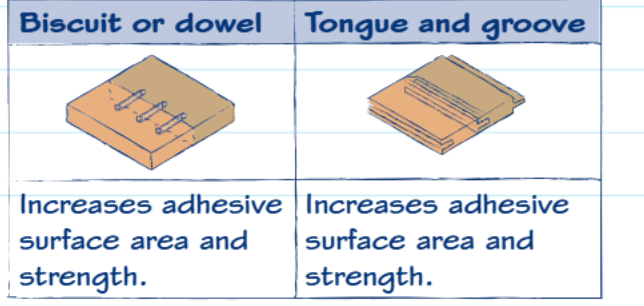
These methods improve upon simple edge glueing by inserting wooden biscuits or dowels into corresponding slots cut in the edges of adjacent boards. The biscuits or dowels increase the adhesive surface area and help align the boards during clamping. This results in a stronger, more reliable joint that's less likely to separate over time.
Tongue and groove joints
Tongue and groove joints feature a protruding tongue cut along one edge that fits into a corresponding groove cut in the adjacent board's edge. This interlocking design significantly increases the adhesive surface area compared to simple edge-to-edge glueing, creating a much stronger joint. It's commonly used in flooring and panelling applications where the joint must withstand considerable stress.
Important
Critical Design Principle: The strength of any timber joint is directly related to the amount of adhesive surface area available. Always look for ways to increase this contact area through mechanical means rather than relying on simple end-grain connections.
Understanding joint strength principles
The strength of any timber joint depends largely on the adhesive surface area available for the glue to bond. Joints that increase this surface area through mechanical means (like dowels, tongues, or interlocking shapes) will generally be stronger than those relying solely on end-grain or simple edge-to-edge contact.
Additionally, some joints gain strength from their mechanical design - dovetails resist pulling forces through their wedge shape, while mortise and tenon joints distribute loads across a large internal surface area. Understanding these principles helps you select the most appropriate joint for your specific application.
Note
Research has found that end-grain glueing is significantly weaker than side-grain glueing. This is why simple butt joints are often reinforced with dowels or other mechanical connections that expose more side-grain surface for adhesive bonding.
Summary
Key Points to Remember:
- Joint selection matters - Choose carcase joints for box construction, frame joints for structural support, and edge joints for widening boards
- Surface area equals strength - Joints with more adhesive contact area are generally stronger than simple butt joints
- Mechanical advantage helps - Joints that interlock or have internal support (like dovetails and mortise-and-tenon) resist forces better than those relying only on adhesive
- Purpose drives design - Some joints prioritise appearance (mitre) while others focus on maximum strength (dovetail, mortise and tenon)
- Reinforcement options exist - Weaker joints can often be strengthened with additional fasteners like screws, nails, or dowels