Algebra III (AQA GCSE Further Maths): Revision Notes
📚Revision Notes
Graphs of functions with up to three parts to their domains
What are piecewise functions?
A piecewise function is a special type of function that has different rules or expressions for different parts of its domain. Think of it like having different instructions depending on which range of x-values you're working with. These functions are incredibly useful for modelling real-world situations where behaviour changes at certain points.
Note
Definition: A piecewise function uses different mathematical expressions for different intervals of its domain, allowing it to model complex behaviours that change at specific points.
When we write a piecewise function, we specify:
- The expression or rule for each part
- The domain (range of x-values) where each rule applies
- Whether endpoints are included (, ) or excluded (, )
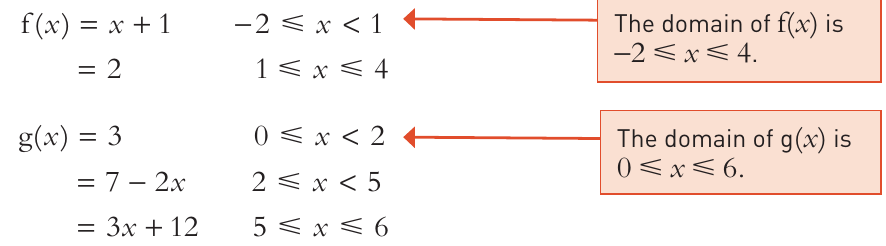
Here's what makes piecewise functions special: the complete domain is the union of all the individual parts, and crucially, no x-value should appear in more than one part of the domain. This ensures the function gives exactly one output for each input.
Important
Critical Rule: Each x-value must belong to exactly one part of the domain - no overlaps allowed! This ensures the function is well-defined and gives exactly one output for each input.
Understanding domain notation
When working with piecewise functions, you'll encounter inequality symbols that tell you exactly where each rule applies:
- or : The endpoint is included (shown as a filled circle on graphs)
- or : The endpoint is excluded (shown as an empty circle on graphs)
Note
Visual Representation: Remember that filled circles mean the point is included in the domain, while empty circles mean the point is excluded. This visual cue is essential for correctly interpreting and drawing piecewise function graphs.
The key rule to remember is that each x-value must belong to exactly one part of the domain - no overlaps allowed!
Step-by-step graphing approach
Let's work through how to graph piecewise functions systematically using a detailed example.

Example
Worked Example: Graphing a Three-Part Piecewise Function
Consider this three-part function:
- for
- for
- for
Step 1: Identify each part
- First part: is a horizontal line (constant function)
- Second part: is a quadratic curve (parabola)
- Third part: is a straight line with gradient
Step 2: Graph each part within its domain
- For the horizontal line, draw from to (filled circle at , empty circle at )
- For the parabola, draw from to (filled circle at , empty circle at )
- For the straight line, draw from to (filled circles at both ends)
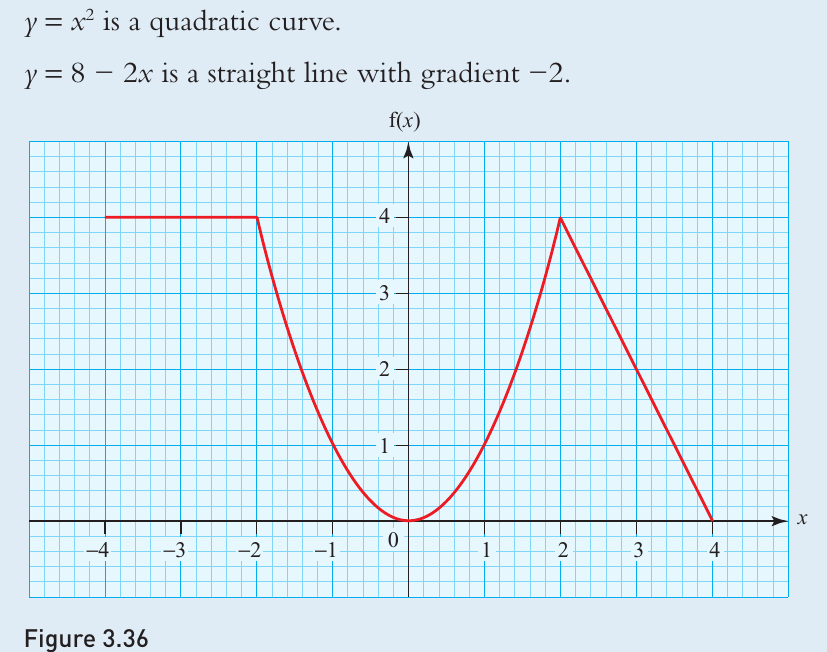
The result is a function that changes behaviour at the boundary points, creating a unique graph that combines different mathematical shapes.
Reading graphs to find function definitions
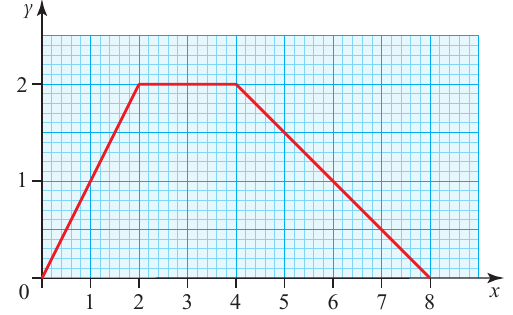
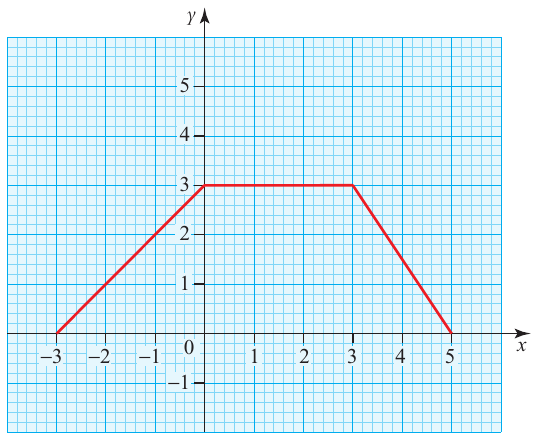
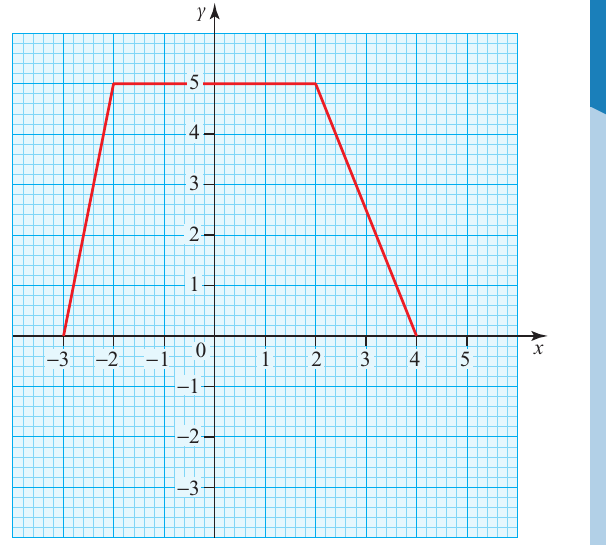
Sometimes you'll be given a graph and asked to write the piecewise function definition. Here's how to approach this systematically:
Note
Step-by-Step Approach to Reading Piecewise Graphs
Step 1: Identify the different sections Look for points where the graph changes direction or behaviour. These are usually the boundary points between different parts.
Step 2: Determine the type of function in each section
- Horizontal lines indicate constant functions
- Straight slanted lines indicate linear functions
- Curved sections might be quadratic or other function types
Step 3: Find the equations
- For horizontal lines:
- For straight lines: find the gradient using , then use
- For curves: identify the function type and key features
Step 4: Specify domains carefully Pay close attention to whether endpoints are included or excluded by looking at filled vs empty circles on the graph.
Real-world applications: velocity and distance
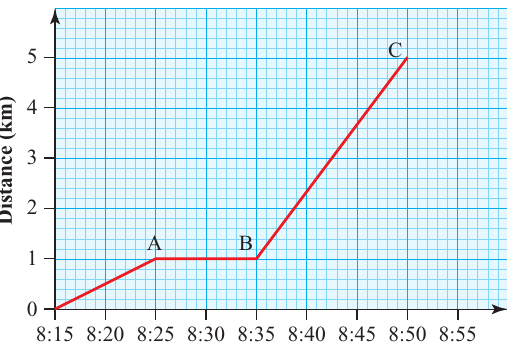
Piecewise functions are particularly useful for modelling motion problems. Let's examine a practical example involving a car's journey.
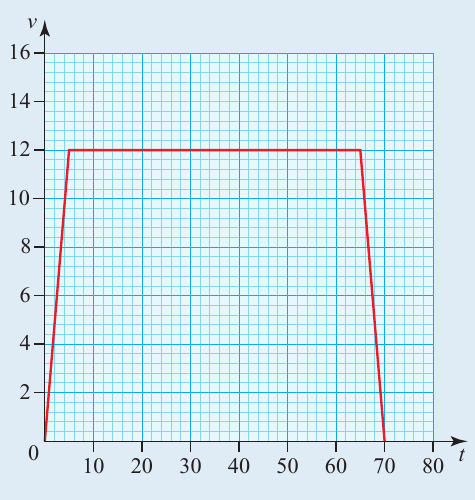
In velocity-time problems, the graph shows how speed changes over time. Different phases of motion (acceleration, constant speed, deceleration) create natural segments in the piecewise function.
Important
Key Relationships to Remember:
- Acceleration =
- Distance travelled = area under the velocity-time curve
For rectangular or trapezoidal shapes under the curve, you can calculate areas using geometric formulas:
- Rectangle:
- Trapezium:
Note
Distance-time graphs show a different perspective, displaying cumulative distance against time. These often create step-like or continuously increasing patterns depending on the motion involved.
Common function types in piecewise definitions
When working with piecewise functions, you'll frequently encounter these types:
Constant functions:
- Create horizontal line segments
- Gradient is zero
- Useful for representing periods of no change
Linear functions:
- Create straight line segments
- Constant gradient
- Can be increasing () or decreasing ()
Quadratic functions:
- Create curved parabolic segments
- Can open upward () or downward ()
- Often used for sections involving acceleration or deceleration
Exam tips and common pitfalls
Important
Critical Points to Watch:
Boundary points: Always check whether endpoints are included or excluded. This affects whether you draw filled or empty circles and can change function values at those points.
Domain completeness: Ensure your complete domain covers all intended x-values without gaps or overlaps.
Function continuity: Piecewise functions don't have to be continuous - they can have jumps or breaks at boundary points.
Area calculations: When finding areas under piecewise graphs, break the region into simpler shapes (rectangles, triangles, trapeziums) and add their areas together.
Summary
Key Points to Remember:
-
Piecewise functions have different rules for different parts of their domain - think of them as functions with multiple personalities depending on the x-value
-
No x-value should appear in more than one part of the domain - this ensures each input gives exactly one output
-
Pay careful attention to inequality symbols - they determine whether boundary points are included (filled circles) or excluded (empty circles)
-
Graph each part separately within its specified domain - tackle one piece at a time for clarity
-
Real-world applications often create natural piecewise functions - especially in motion problems where behaviour changes at specific times or positions