Simultaneous equations in two unknowns (AQA GCSE Further Maths): Revision Notes
📚Revision Notes
Simultaneous equations in two unknowns
What are simultaneous equations?
Until now, you've worked with equations containing just one unknown variable. Simultaneous equations are different - they involve two unknown variables (usually x and y) that must be found together. These equations work as a pair, where both equations must be satisfied by the same values of x and y.
For example, you might have:
Note
The solution to these equations will be a pair of values that makes both equations true at the same time. This is what makes them "simultaneous" - they must be solved together, not separately.
Understanding solutions graphically
When you have an equation with two unknowns like , there are infinitely many possible pairs of values that satisfy it. Each point on the line represents a valid solution.
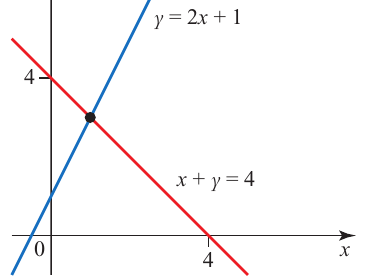
However, when you have two equations together, they typically intersect at just one point. This intersection point gives you the unique solution that satisfies both equations simultaneously.
The coordinates of the intersection point represent the solution: and . You can verify this works by substituting back into both original equations.
Note
While the graphical method helps you visualise the problem, it has some limitations. Drawing graphs can be time-consuming, and if the solution doesn't have nice integer coordinates, it can be difficult to read the exact answer from the graph.
Solving by substitution method
The substitution method works particularly well when one equation already has a variable expressed in terms of the other, or when you can easily rearrange one equation to isolate a variable.
Step-by-step process
Example
Worked Example: Basic Substitution
Solve the system:
Solution:
- Take the expression for y from the second equation
- Substitute this into the first equation:
- Simplify: , so , therefore
- Substitute back into either original equation:
- Check your answer in both equations
The solution is , .
Working with curves
The substitution method also works when one equation represents a curve rather than a straight line.
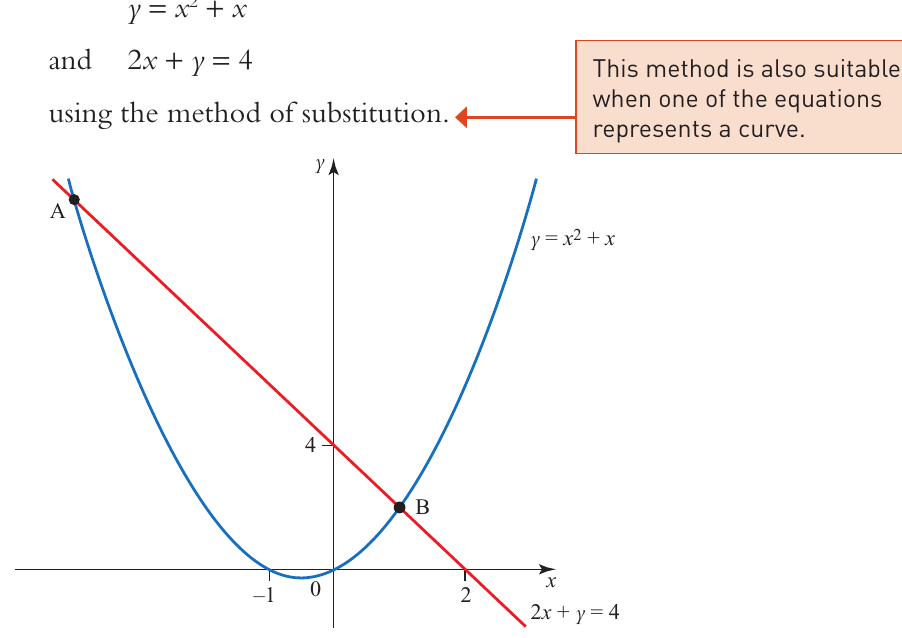
Example
Worked Example: Substitution with Quadratic
Solve the system:
Solution:
- Substitute the first equation into the second:
- Rearrange:
- Factorise:
- This gives or
- Find corresponding y-values by substituting back into the linear equation:
- When : , so one solution is
- When : , so the other solution is
Notice that when dealing with curves, you often get two solutions. Always substitute back into the linear equation rather than the quadratic one, as it's usually simpler.
Important
Critical Point: Solutions must always be written as complete pairs of values. Don't just write or , or . Always express as coordinate pairs: and .
Solving linear equations by elimination
When both equations are linear and written in standard form, the elimination method is often the most efficient approach. This method involves adding or subtracting the equations to eliminate one of the variables.
Basic elimination example
Example
Worked Example: Basic Elimination
Solve the system:
Solution:
- Notice that multiplying the first equation by 2 gives another equation with :
- (equation 2)
- (2 × equation 1)
- Subtract the second from the first:
- Substitute into the first equation: , so
The solution is , .
When you need to manipulate both equations
Example
Worked Example: Advanced Elimination
Solve the system:
Solution:
- To eliminate y, multiply the first equation by 2 and the second by 3:
- (2 × equation 1)
- (3 × equation 2)
- Add the equations: , so
- Substitute into the first equation: , so
The solution is , .
Important
Key Decision in Elimination: Look at the coefficients of the variable you want to eliminate. If they have the same sign, subtract the equations; if they have opposite signs, add the equations.
Word problems with simultaneous equations
Real-world problems often lead to simultaneous equations. The key is to identify what the unknowns represent and translate the given information into mathematical equations.
Problem-solving steps
Note
Systematic Approach:
- Introduce your unknowns - clearly define what each variable represents
- Set up the equations - translate each piece of information into an equation
- Solve the system using substitution or elimination
- Check your answer - make sure it makes sense in the context
Example
Worked Example: Fruit Pricing Problem
Tracey is buying fruit for a picnic. Five apples and four pears cost exactly £2.20. Two apples and six pears also cost exactly £2.20. Find the cost of each type of fruit.
Solution: Let = cost of an apple in pence, = cost of a pear in pence
Setting up equations:
Using elimination (multiply first equation by 3, second by 2):
Subtracting: , so
Substituting back: , so
Therefore, an apple costs 20 pence and a pear costs 30 pence.
Geometric applications
Example
Worked Example: Flag Geometry Problem
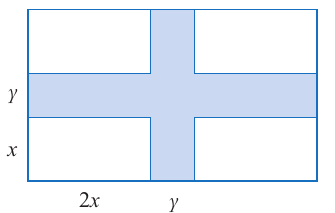
A flag consists of a blue cross on a white background. Each white rectangle measures cm by cm, and the cross is cm wide. The total area of the flag is 4500 cm² and the area of the cross is 1300 cm².
Solution:
- Total area =
- Cross area =
- Subtracting: , so , therefore
- Substituting back:
- Solving: , which gives (rejecting the negative solution)
The dimensions are cm and cm.
Key tips for success
Here are essential strategies for mastering simultaneous equations:
- Always check your solutions by substituting back into both original equations
- Write solutions as complete pairs - never leave them as separate statements
- Choose the most appropriate method - substitution for when one variable is isolated, elimination for standard form linear equations
- In word problems, always define your variables clearly before setting up equations
- When working with decimals in money problems, convert to pence to avoid decimal arithmetic
- For quadratic systems, expect two solutions and substitute back into the linear equation for simplicity
Summary
Key Points to Remember:
- Simultaneous equations involve finding values for two unknowns that satisfy both equations at the same time
- The graphical method shows solutions as intersection points, but algebraic methods are more accurate
- Use substitution when one equation is already solved for a variable, or when dealing with curves
- Use elimination for linear equations in standard form by adding or subtracting to eliminate one variable
- Always express your final answer as complete coordinate pairs
- Word problems require careful identification of unknowns and systematic translation of information into equations