Solving linear equations (AQA GCSE Further Maths): Revision Notes
📚Revision Notes
Solving linear equations
What are linear equations?
Linear equations are mathematical statements that show two expressions are equal, containing variables (usually ) raised only to the power of 1. When we solve a linear equation, we're finding the value of the variable that makes the equation true.
The fundamental principle of equation solving is maintaining balance - whatever operation you perform on one side of the equation, you must perform the same operation on the other side. Think of an equation like a balanced scale where both sides must remain equal.
Basic method for solving linear equations
The goal when solving any linear equation is to isolate the variable (get the letter on its own). This systematic approach works for all linear equations, regardless of their complexity.
Note
Standard Method for Solving Linear Equations:
- Expand any brackets if present
- Collect like terms on each side
- Move all terms with the variable to one side and all numbers to the other
- Divide by the coefficient of the variable
Solving equations with brackets
When your equation contains brackets, you'll need to expand them first before collecting like terms. This step is crucial because it allows you to see all terms clearly and proceed with the standard method.
Example
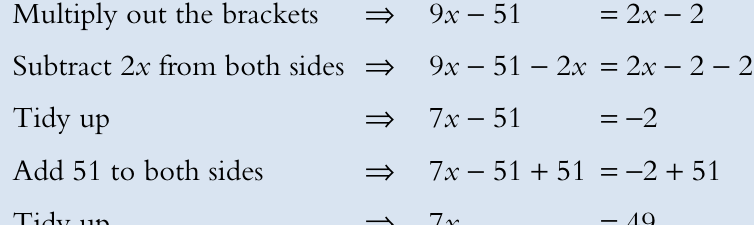
Worked Example: Equation with Brackets
This diagram shows how to solve an equation systematically. Starting with the equation containing brackets, we multiply out the brackets first, then collect like terms by moving all -terms to one side and all numbers to the other side, finally dividing to find the solution.
Dealing with fractions in equations
Equations containing fractions can look intimidating, but there's a simple technique to make them much easier to handle. The secret is to eliminate the fractions completely at the very beginning of your solution process.
Important
Key Strategy: Clear Fractions First
The key is to eliminate the fractions at the beginning by multiplying the entire equation by the lowest common multiple (LCM) of all denominators. This converts your fractional equation into a much simpler equation with whole numbers only.
Example
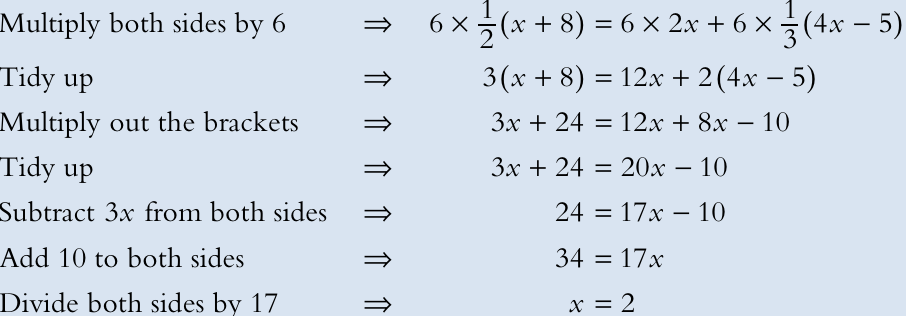
Worked Example: Clearing Fractions
This diagram demonstrates the process of clearing fractions first. By multiplying both sides by 6 (the LCM of 2 and 3), we convert the fractional equation into a much simpler equation with whole numbers only.
The systematic approach for handling fractions ensures you avoid the common errors that occur when working with fractional coefficients throughout your solution.
Note
Steps for Handling Fractions:
- Identify the denominators in your equation
- Find the LCM of all denominators
- Multiply every term by this LCM
- Simplify to get an equation without fractions
- Solve using the standard method
Setting up equations from word problems
Sometimes you'll need to create the equation yourself from a word problem before solving it. This requires careful reading and defining your variables clearly. The ability to translate word problems into mathematical equations is a crucial skill that builds with practice.
For example, with angle problems in triangles:
- Remember that angles in a triangle sum to 180°
- Define your variable (e.g., let = smallest angle)
- Express other angles in terms of your variable
- Set up the equation using the constraint (angles sum to )
Note
Process for Setting Up Equations:
- Read the problem carefully and identify what you're looking for
- Define your variable clearly (e.g., "let = ...")
- Express all quantities in terms of your variable
- Use the given constraints to form your equation
- Solve the equation and check your answer makes sense
Common techniques and exam tips
Understanding these key techniques will help you solve linear equations more efficiently and avoid common pitfalls that students often encounter.
For expanding brackets: Use the distributive property carefully, paying attention to signs (especially with negative numbers).
For collecting like terms: Group all terms with the variable on one side and all constant terms on the other.
When clearing fractions: Always multiply every single term by the LCM, not just the fractions.
Important
Critical Points to Avoid Common Mistakes:
- For word problems: Take time to set up your equation properly - a correct equation is half the battle won
- Check your answers: Substitute your solution back into the original equation to verify it works
Summary
Key Points to Remember:
- Balance is key - whatever you do to one side, do to the other side
- Clear fractions early by multiplying through by the LCM of denominators
- Expand brackets first before collecting like terms
- Define variables clearly when setting up equations from word problems
- Always check your answer by substituting back into the original equation