Algebraic indices (AQA GCSE Maths): Revision Notes
📚Revision Notes
Algebraic indices
Algebraic indices are a way of writing repeated multiplication in a shorter form. When working with algebra, you'll often need to simplify expressions that contain powers, and understanding index laws will help you do this efficiently.
Understanding the parts
Before diving into the rules, it's important to know the terminology:
When you see an expression like , there are two key parts:
- The base is the main letter or number (in this case, )
- The index is the small number written above and to the right (in this case, )
The index tells you how many times to multiply the base by itself. For example, means .
Note
The words "index" and "power" mean the same thing in mathematics. You might hear both terms used interchangeably.
The four index laws
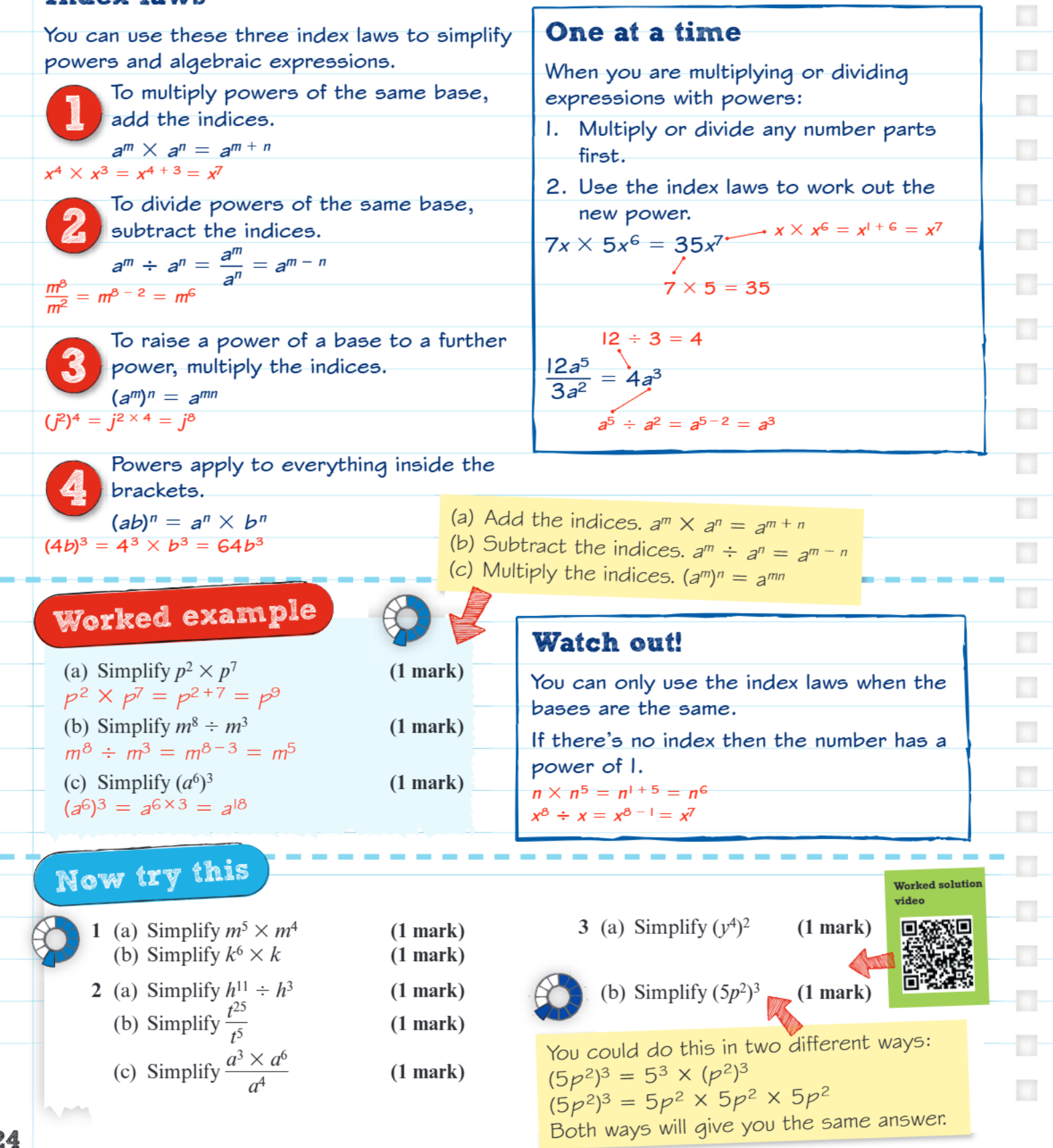
These laws help you simplify algebraic expressions containing powers. You can only use these laws when the bases are the same.
Law 1: Multiplying powers with the same base
When multiplying powers that have the same base, add the indices.
The rule:
For example:
This works because you're essentially combining groups of the same base being multiplied together.
Law 2: Dividing powers with the same base
When dividing powers that have the same base, subtract the indices.
The rule:
For example:
This makes sense because division cancels out some of the multiplied bases.
Law 3: Raising a power to another power
When raising a power to another power, multiply the indices.
The rule:
For example:
This happens because you're repeating the original power multiple times.
Law 4: Powers inside brackets
When everything inside brackets is raised to a power, apply the power to each part inside the brackets.
The rule:
For example:
Important
Remember: Same base only! You can only use these index laws when the bases are exactly the same. Different letters or numbers cannot be combined using these rules.
Step-by-step approach
For complex expressions with multiple operations, use the "one at a time" method:
Note
Systematic Problem-Solving Approach:
- Deal with any number parts first - multiply or divide the numbers
- Apply the index laws to work out the new power for each letter
This methodical approach prevents errors and ensures you don't miss any steps.
For example, with :
- First:
- Then:
- Final answer:
Worked examples
Let's look at how to apply these laws in practice:
Example
Worked Examples: Applying Index Laws
Example 1: Simplify
- Same base , so add the indices:
- Answer:
Example 2: Simplify
- Same base , so subtract the indices:
- Answer:
Example 3: Simplify
- Power to a power, so multiply the indices:
- Answer:
Important restrictions
Important
Critical Rules to Remember:
You can only use these index laws when the bases are the same.
If there's no visible index, remember that the number has a power of . For example:
You cannot use index laws with different bases - they must be identical letters or numbers.
Practice problems
Note
Try these problems to test your understanding:
- Simplify
- Simplify
- Simplify
- Simplify
- Simplify
Summary
Key Points to Remember:
- Index laws only work when bases are the same - you cannot combine different letters or numbers
- Multiplication: add the indices ()
- Division: subtract the indices ()
- Power to a power: multiply the indices ()
- Use "one at a time" for complex problems - deal with numbers first, then apply index laws to letters
- Remember that no visible index means the power is 1