Collecting like terms (AQA GCSE Maths): Revision Notes
📚Revision Notes
Collecting like terms
What are expressions, equations and formulae?
In algebra, letters are used to represent unknown numbers. Understanding the difference between expressions, equations and formulae is essential for collecting like terms effectively.
Note
Understanding these three concepts is fundamental to algebra success. Each serves a different purpose and follows different rules for manipulation.
Expression
An expression is a mathematical statement that contains numbers, letters and operations but does not have an equals sign. The different parts of an expression that are separated by plus (+) or minus (-) signs are called terms.
Example:
Equation
An equation is a mathematical statement that contains an equals sign. Equations can be solved to find the value of the unknown letter.
Example:
Formula
A formula is a mathematical rule that shows the relationship between different quantities. You can use a formula to calculate one value when you know the other values, but you cannot solve a formula.
Example:
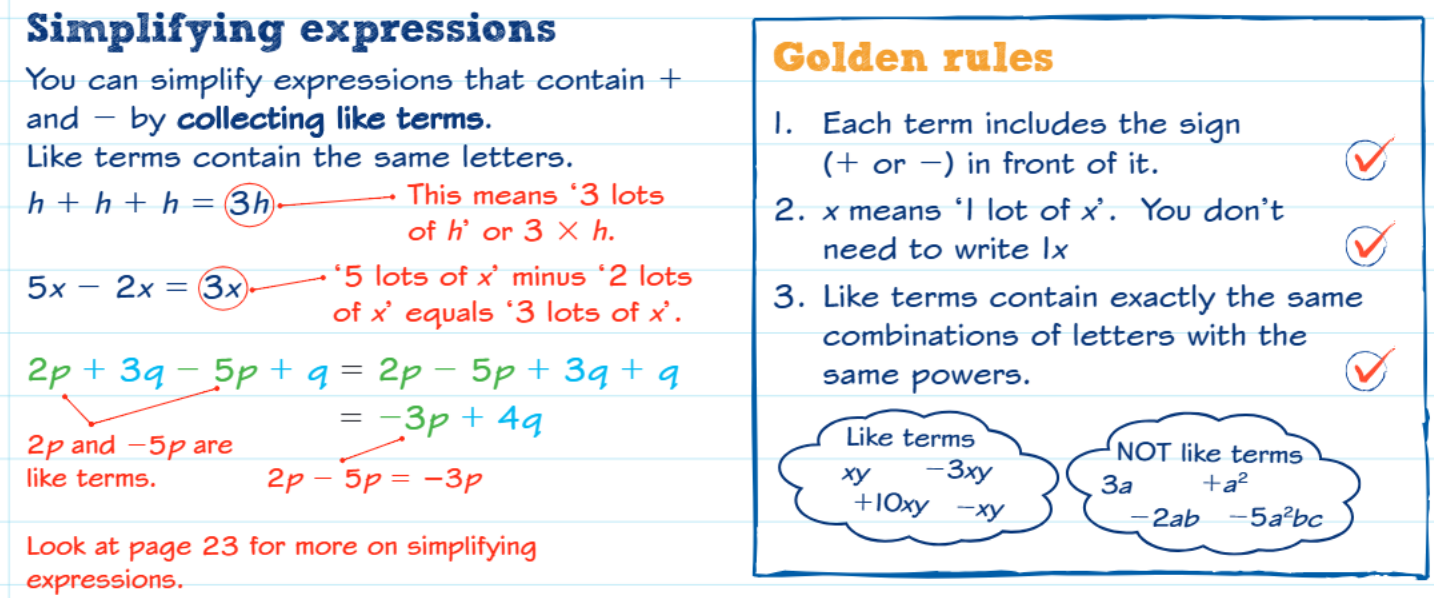
Golden rules for collecting like terms
There are three essential rules you must follow when working with algebraic terms:
Important
These rules are fundamental - memorise them and apply them consistently in all algebraic work.
Rule 1: Include the sign
Each term includes the sign (+ or -) that appears in front of it. When moving terms around, the sign travels with the term.
Rule 2: Invisible coefficient
The letter x means '1 lot of x'. You don't need to write the number 1 in front of a letter - it's understood to be there.
Rule 3: Like terms definition
Like terms contain exactly the same combination of letters with the same powers. Only like terms can be combined together.
Like terms examples: , , , NOT like terms examples: , ,
Simplifying expressions by collecting like terms
When you simplify expressions, you collect and combine like terms. This means adding or subtracting terms that contain the same letters.
Basic examples
- (three lots of h combined)
- (five lots of x minus two lots of x equals three lots of x)
Note
The key to success is methodically identifying like terms before attempting to combine them. Rushing this step leads to common mistakes.
Step-by-step method
- Identify all the like terms in the expression
- Group the like terms together
- Add or subtract the coefficients (numbers in front of the letters)
- Keep the letter part unchanged
Example
Worked Example 1: Collecting Like Terms
Simplify:
Step 1: Identify like terms
- p terms: and
- q terms: and
Step 2: Collect like terms
- p terms:
- q terms:
Answer: -3p + 4q
Example
Worked Example 2: Simplifying Mixed Terms
Simplify:
Step 1: Group like terms together
- m terms:
- b terms:
Answer: m + 7b
Summary
Key Points to Remember:
- Like terms contain exactly the same letters - only these can be combined together
- Always include the sign (+ or -) when moving terms around
- The number 1 doesn't need to be written in front of letters (x means 1x)
- Expressions don't have equals signs, equations do have equals signs
- Collect terms with the same letters and add or subtract their coefficients