Formulae (AQA GCSE Maths): Revision Notes
📚Revision Notes
Formulae
What is a formula?
A formula is a mathematical rule that shows the relationship between different quantities or variables. The plural of formula is formulae. Formulae are incredibly useful because they allow you to calculate one quantity when you know the values of the others.
Note
Formulae are essential tools in mathematics that create connections between different measurements and variables. They serve as shortcuts for complex calculations and help us understand patterns in mathematical relationships.
For example, the area of a triangle can be calculated using the formula: Area = ½ × base × height
In algebra, this same formula can be written more simply as:

Using formulae through substitution
To use any formula effectively, you need to substitute the known values into the formula. This means replacing the letters (variables) with the actual numbers you've been given.
The key steps are:
- Identify which values you know
- Replace the letters in the formula with these numbers
- Calculate the result following the correct order of operations
Note
Substitution is the bridge between abstract formulas and concrete answers. Always substitute all known values before beginning any calculations to avoid confusion and errors.
Order of operations - BIDMAS
When substituting values into formulae, you must follow the correct order of operations. This is where BIDMAS becomes essential:
Important
BIDMAS Order of Operations:
- B - Brackets first
- I - Indices (powers) next
- D - Division
- M - Multiplication
- A - Addition
- S - Subtraction last
Always remember: multiply before you add or subtract! This is the most common source of errors in formula calculations.
Worked example: Cooking time formula
Example
Worked Example: Calculating Cooking Time
Let's look at a practical formula for calculating cooking time:
Formula: Cooking time = Weight in kg × 30 + 45
Problem: Find the cooking time for a 7kg turkey
Solution: Step 1: Substitute the weight Cooking time = 7 × 30 + 45
Step 2: Follow BIDMAS - multiply first = 210 + 45
Step 3: Then add = 255 minutes
Step 4: Convert to hours and minutes 255 ÷ 60 = 4 hours and 15 minutes

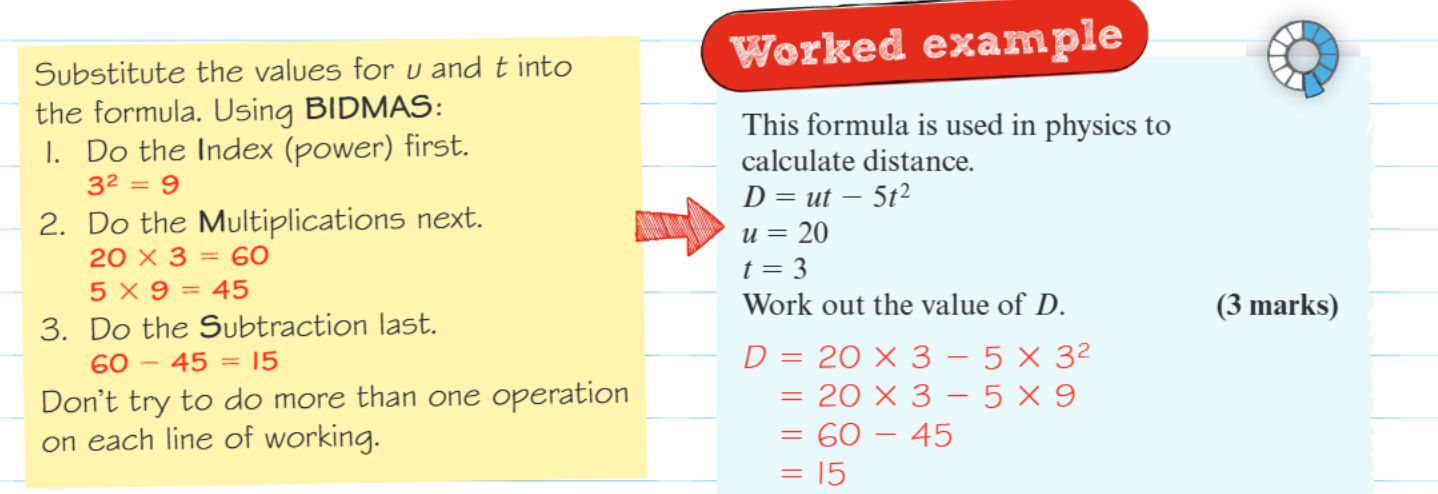
Worked example: Physics distance formula
Example
Worked Example: Physics Distance Calculation
Physics often uses formulae to calculate distance, speed, and time. Here's a distance formula:
Formula:
Given: u = 20 and t = 3
Solution following BIDMAS: Step 1: Indices first
Step 2: Multiplication next and
Step 3: Subtraction last
Therefore, D = 15
Practice with geometric formulae
Understanding how to apply formulae extends to geometry, where precise calculations are essential for finding areas and solving equations.
Example
Worked Example: Trapezium Area Formula
Formula:
Given: h = 4.5, a = 6.5, and b = 9.5
Key steps:
- Substitute all values before calculating
- Follow the order of operations carefully
- Work through brackets first, then multiply
Example
Worked Example: Quadratic Formula Component
Formula:
Given: a = 2, b = 5, and c = -3
Solution: Step 1: Calculate the index first
Step 2: Then multiplication
Step 3: Finally subtraction

Exam tips
Note
Exam Success Strategies:
- Always substitute all values first before starting any calculations
- Follow BIDMAS strictly - this prevents careless errors
- Show your working clearly in exam questions for maximum marks
- Convert units appropriately (minutes to hours, etc.)
- Double-check your arithmetic, especially with negative numbers
- Write out each step clearly to avoid losing marks for working
Summary
Key Points to Remember:
- A formula is a mathematical rule showing relationships between quantities
- Always substitute known values before calculating
- Use BIDMAS for the correct order of operations: Brackets, Indices, Division/Multiplication, Addition/Subtraction
- Multiply before you add or subtract - this is the most common error to avoid
- Show clear working in exam questions for maximum marks
- Practice substitution with different types of formulae to build confidence