Identities (AQA GCSE Maths): Revision Notes
📚Revision Notes
Identities
What is an identity?
An identity is a mathematical statement that is always true, regardless of what values you substitute for the variables. This is different from an equation, which is only true for specific values.
Note
Key points about identities:
- They use the symbol ≡ (not = like equations)
- The left-hand side will always equal the right-hand side
- No matter what numbers you put in for the variables, both sides remain equal
- You might need to prove that an identity is true in your exam
Golden rule for identities
Important
Critical Rule: An identity is not like an equation. You cannot solve it using the balance method.
What to do instead:
- ✅ Manipulate each side separately
- ❌ Do not apply the same operation to both sides
This means you work on the left-hand side and the right-hand side independently to show they are equivalent.
How to show an identity is true
When you need to prove an identity in an exam, follow these steps:
- Start with one side (usually the more complicated left-hand side)
- Use algebraic techniques such as:
- Multiplying out brackets
- Simplifying expressions
- Factorising
- Work towards the expression on the right-hand side
- Show every line of your working clearly
Example
Worked Example: Proving an Identity
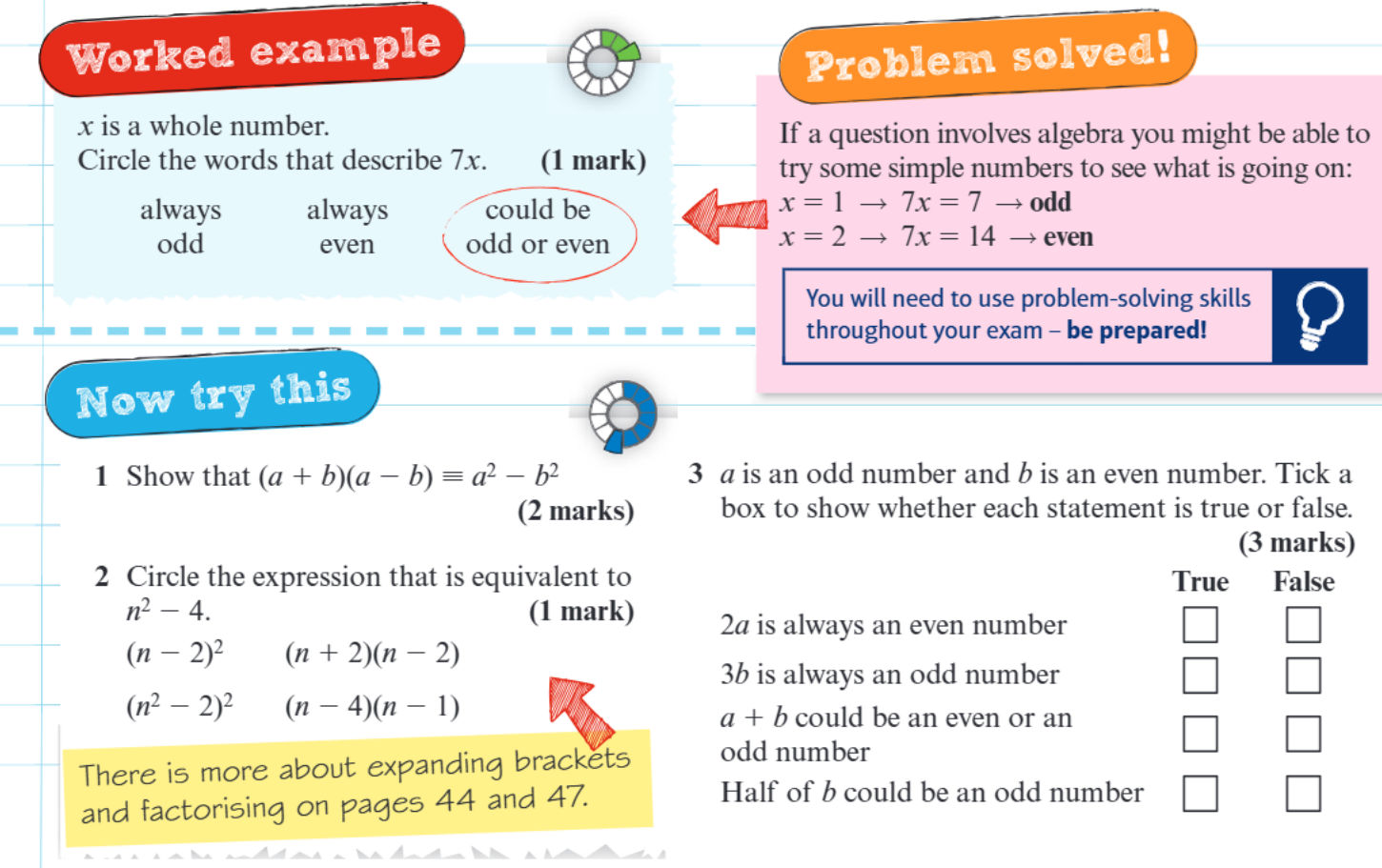
Show that
Starting with the left-hand side:
- ✓
Working with odd and even numbers
You can determine whether algebraic expressions will be odd or even based on the variable.
If n is a whole number:
- 2n is always even (any number × 2 = even)
- 3n could be odd or even (depends if n is odd or even)
- 4n is always even (any number × 4 = even)
Useful patterns:
- Even × any number = even
- Odd × odd = odd
- Odd × even = even
Note
Exam tip: Try simple numbers to test your thinking. For example, if , then (odd). If , then (even). So could be either odd or even.
Common identity patterns
Important
Difference of squares:
This is a very important identity pattern you should memorise.
Factorising expressions: Some expressions can be written in different equivalent forms:
- [using difference of squares]
- [this would be incorrect]
Remember!
Summary
Key Points to Remember:
- An identity is always true, unlike an equation which is only true for specific values
- Use the ≡ symbol for identities, not the = symbol
- Never use the balance method - work on each side separately
- Show all your working when proving identities in exams
- Test with simple numbers to check odd/even patterns in algebra
- The difference of squares pattern is essential to know