Linear equations 1 (AQA GCSE Maths): Revision Notes
📚Revision Notes
Linear equations 1
What is an equation?
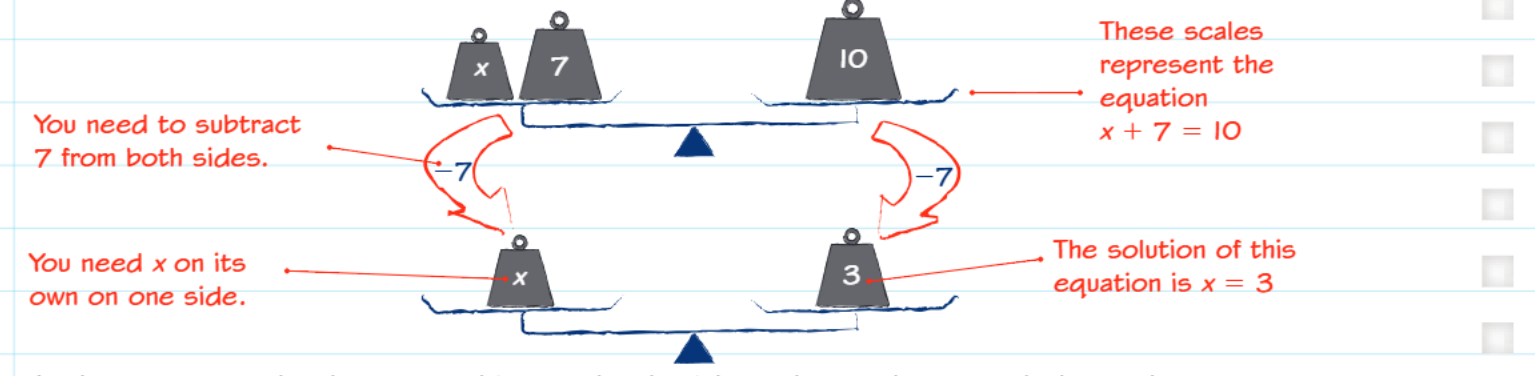
An equation is a mathematical statement that shows two expressions are equal. Think of an equation like a pair of balanced scales - the equals sign tells you that both sides have the same value, just like how balanced scales have equal weights on each side.
Note
The balance scale metaphor is one of the most powerful ways to understand equations. Just like physical scales must have equal weight on both sides to balance, mathematical equations must have equal values on both sides of the equals sign.
The letter in an equation represents an unknown value that you need to find. When you solve the equation, you discover what number the letter represents.
Key principles for solving equations
The most important rule when solving equations is to keep both sides balanced. Just like with scales, whatever you do to one side, you must do exactly the same to the other side. This maintains the equality and keeps your equation correct.
Important
Your goal is always to get the letter on its own on one side of the equation. You achieve this by using inverse operations - operations that undo each other.
Remember: Addition and subtraction are inverse operations, as are multiplication and division.
Step-by-step method
When solving equations, follow these important steps:
Important
Essential Rules for Solving Equations:
- Write neatly and show all your working
- Every line must have an equals sign
- Start a new line for each step
- Do only one operation at a time
- Always do the same operation to both sides

The example above shows how to solve . First, subtract 3 from both sides to remove the . Then divide both sides by 5 to get on its own. Each step is clearly shown on a separate line.
Types of linear equations
You'll encounter several types of linear equations:
Example
Simple addition/subtraction equations:
Example:
Solution: Subtract 6 from both sides to get
Example
Simple multiplication/division equations:
Example:
Solution: Divide both sides by 8 to get
Example
Two-step equations:
Example:
Solution:
- Add 7 to both sides: , so
- Divide by 2:
Example
Equations with fractions:
Example:
Solution: Multiply both sides by 4 to get
Practice and exam guidance
Note
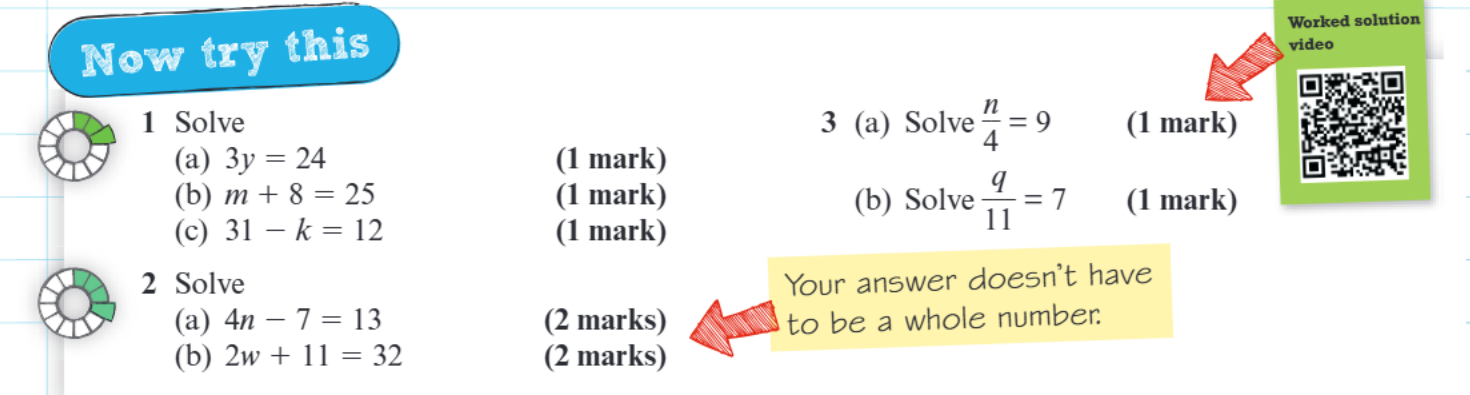
When practising equations, remember that your answer doesn't have to be a whole number. Many solutions will be decimals or fractions, and that's perfectly correct.
In exams, equations are typically worth 1-2 marks depending on complexity. Simple one-step equations usually carry 1 mark, while two-step equations often carry 2 marks.
Make sure you show your working clearly, as you can still gain marks for correct method even if you make a small calculation error.
Remember!
Summary
Key Points to Remember:
- Think of equations as balanced scales - whatever you do to one side, do to the other
- Your goal is to get the letter on its own on one side
- Use inverse operations to undo what's being done to the letter
- Show all working clearly with equals signs on every line
- Do one operation at a time and start each step on a new line
- Solutions can be whole numbers, decimals, or fractions