Quadratic equations (AQA GCSE Maths): Revision Notes
📚Revision Notes
Quadratic equations
What are quadratic equations?
A quadratic equation is an equation where the highest power of x is 2. In your Foundation exam, you'll need to solve these equations without a calculator using factorisation.
Note
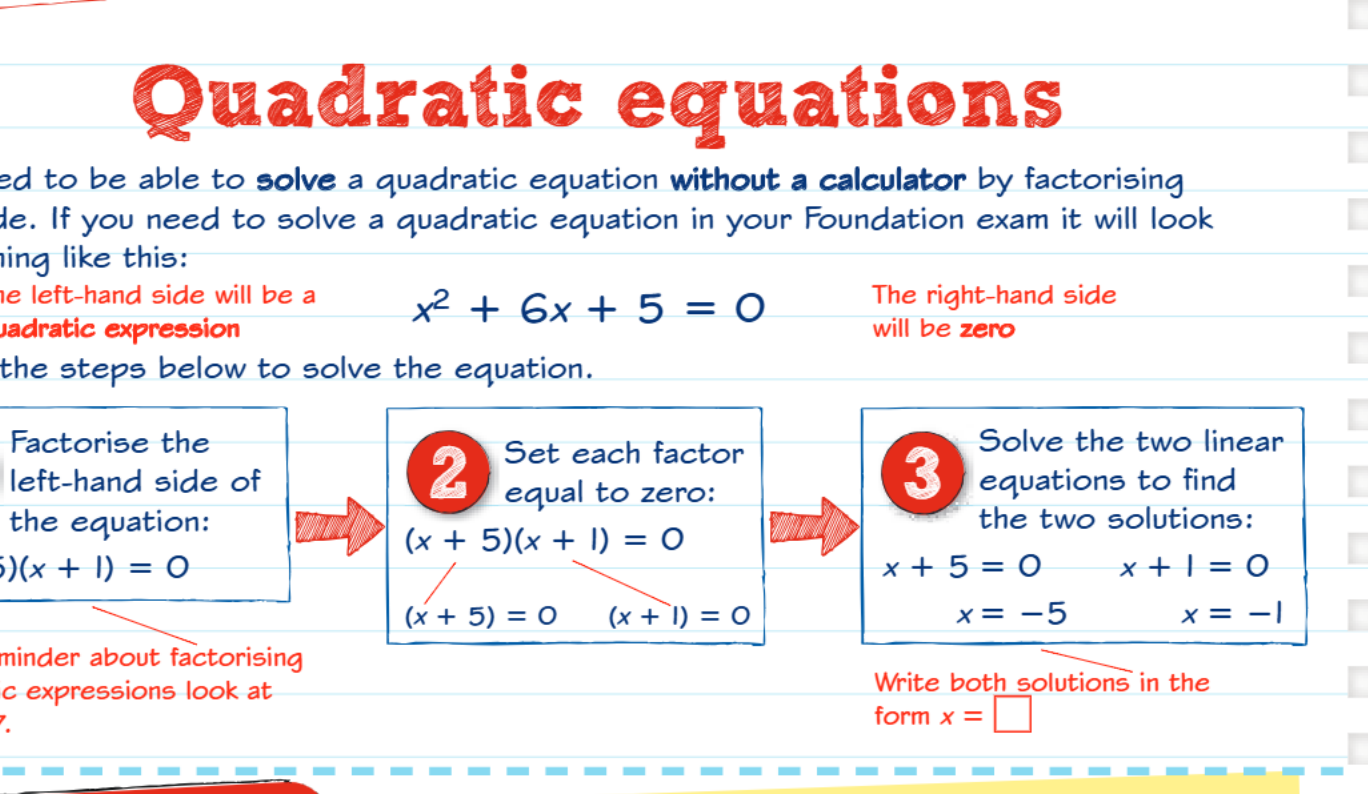
Quadratic equations follow this pattern:
- The left-hand side contains a quadratic expression (like )
- The right-hand side equals zero
Solving quadratic equations by factorisation
The factorisation method involves three clear steps that you must follow in order.
Important
The Three-Step Method for Solving Quadratic Equations:
- Factorise the left-hand side
- Set each factor equal to zero
- Solve the linear equations
Step-by-step method
Step 1: Factorise the left-hand side
- Rewrite the quadratic expression as two brackets multiplied together
- For example: becomes
Step 2: Set each factor equal to zero
- Since the right-hand side equals zero, at least one bracket must equal zero
- Write out: and
Step 3: Solve the linear equations
- Solve each simple equation to find your two solutions
- From the example: and
- Always write your final answers in the form
Worked examples
Example
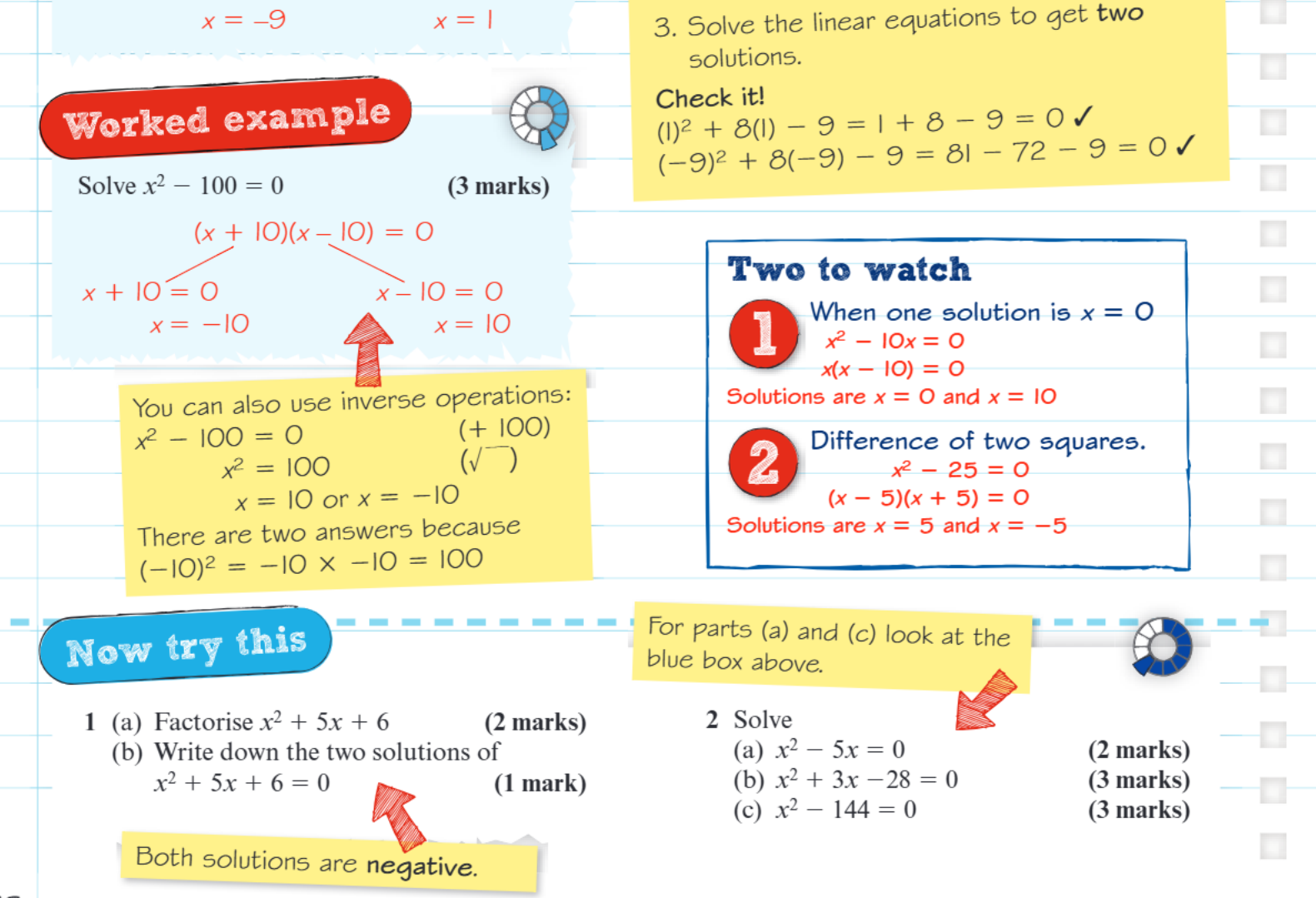
Worked Example 1: Standard Quadratic
For :
Step 1: Factorise to get
Step 2: Set each factor to zero: and
Step 3: Solutions are and
Example
Worked Example 2: Difference of Two Squares
For :
Method 1 (Factorisation):
- Recognise this as a difference of two squares
- Factorise to get
- Solutions are and
Method 2 (Inverse Operations):
- Add 100 to both sides:
- Take the square root:
Special cases to watch
When one solution is x = 0
If you see an equation like , this represents a special case where you can factor out .
Note
Solving equations with x = 0 as a solution:
- Factor out to get
- One solution will always be
- The other solution comes from the second bracket:
Difference of two squares
Look for equations in the form where both terms are perfect squares.
Important
Difference of Two Squares Pattern:
- These factorise as
- Example: becomes
- Solutions are and
Checking your solutions
Always verify your answers by substituting back into the original equation. Both solutions should make the left-hand side equal zero.
Note
How to check your solutions:
- Take each solution and substitute it back into the original equation
- Calculate the left-hand side
- Confirm it equals zero
- If it doesn't equal zero, check your working for errors
Exam tips
Important
Essential Exam Strategy:
- Questions are typically worth 2-3 marks
- Show all your working clearly - this is where most marks come from
- Write your final answers in the form
- Look out for special cases that might have simpler methods
- Both solutions are often negative in exam questions
Remember!
Summary
Key Points to Remember:
- Quadratic equations have as the highest power and equal zero on one side
- Follow the three-step method: factorise, set each factor to zero, solve the linear equations
- Always write solutions in the form
- Special cases include when one solution is and difference of two squares patterns
- Check your answers by substituting back into the original equation