Sequences 1 (AQA GCSE Maths): Revision Notes
📚Revision Notes
Sequences 1
What is a sequence?
A sequence is a pattern of numbers or shapes that follows a specific rule. Think of it as a list of numbers where each number relates to the others in a predictable way.
Each individual number in a sequence is called a term. The terms are usually written in order, and you can continue the pattern by finding the rule that connects them.
Note
Understanding sequences is fundamental to many areas of mathematics. They appear in algebra, calculus, and even in real-world applications like population growth, financial calculations, and computer algorithms.
Common types of sequences
Linear sequences follow a pattern where the same number is added or subtracted each time:
- (even numbers - add 2 each time)
- (add 4 each time)
Square number sequences follow the pattern of perfect squares:
- ()
Finding missing terms
When you're given part of a sequence, you can find missing terms by identifying the pattern or rule.
For linear sequences: Find the common difference (how much you add or subtract each time) and apply it to find the missing terms.
Example
Worked Example: Finding Missing Terms
In the sequence
Step 1: Find the common difference , so we're adding each time
Step 2: Apply the pattern
- Missing first term:
- Missing last term:
Answer:
Working backwards through sequences
Sometimes you need to find earlier terms in a sequence when you're given a later term. This is where function machines become very useful.
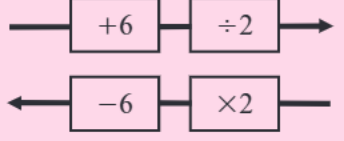
Function machines show you the operations needed to get from one term to the next. To work backwards, you need to use the inverse operations in reverse order.
Important
Key Concept: Inverse Operations
To work backwards through a sequence, you must apply inverse operations in the reverse order:
- Addition becomes subtraction
- Multiplication becomes division
- Apply operations in reverse order
Example
Worked Example: Working Backwards
If you know the third term is 8, and the rule is "add 6 then divide by 2":
Step 1: Identify the inverse operations
- Inverse of "add 6 then divide by 2" is "multiply by 2 then subtract 6"
Step 2: Work backwards step by step
- From 3rd term (8): (2nd term)
- From 2nd term (10): (1st term)
Answer: 1st term = 14, 2nd term = 10, 3rd term = 8
Generating sequences using formulas
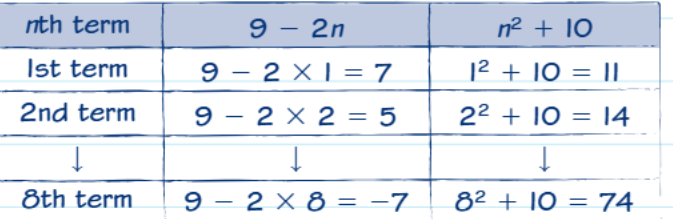
You can work out any term in a sequence by substituting the term number into an algebraic formula called the nth term.
Example
Worked Example: Using nth Term Formulas
For the formula :
- 1st term:
- 2nd term:
- 8th term:
For the formula :
- 1st term:
- 2nd term:
- 8th term:
This method allows you to find any term in the sequence without having to work out all the previous terms.
Special sequence types
Fibonacci-type sequences are special patterns where each term equals the sum of the two previous terms.
Example
Worked Example: Fibonacci-type Sequence
Starting with
Pattern: Each term = sum of the two previous terms
Continuing the pattern:
Extended sequence:
Summary
Exam Tips:
- Always look for the pattern first - is it linear, quadratic, or something else?
- Check your answers by working forwards through the sequence
- For working backwards problems, remember to use inverse operations in reverse order
- When using nth term formulas, substitute carefully and show your working
- Practice identifying different sequence types as this is a common exam question
Summary
Key Points to Remember:
- A sequence is a pattern of numbers following a rule, and each number is called a term
- Linear sequences have a constant difference between consecutive terms
- Use function machines to work backwards through sequences by applying inverse operations
- The nth term formula lets you find any term by substituting the position number
- Fibonacci-type sequences are formed by adding the two previous terms together