Substitution (AQA GCSE Maths): Revision Notes
📚Revision Notes
Substitution
What is substitution?
Substitution means replacing the letters (variables) in an algebraic expression with their given numerical values. This allows you to calculate the exact value of the expression.
When you know the values of letters in an algebraic expression, you can substitute these numbers into the expression to work out its final value.

The substitution process
The process of substitution follows a clear method. Let's look at how this works step by step.
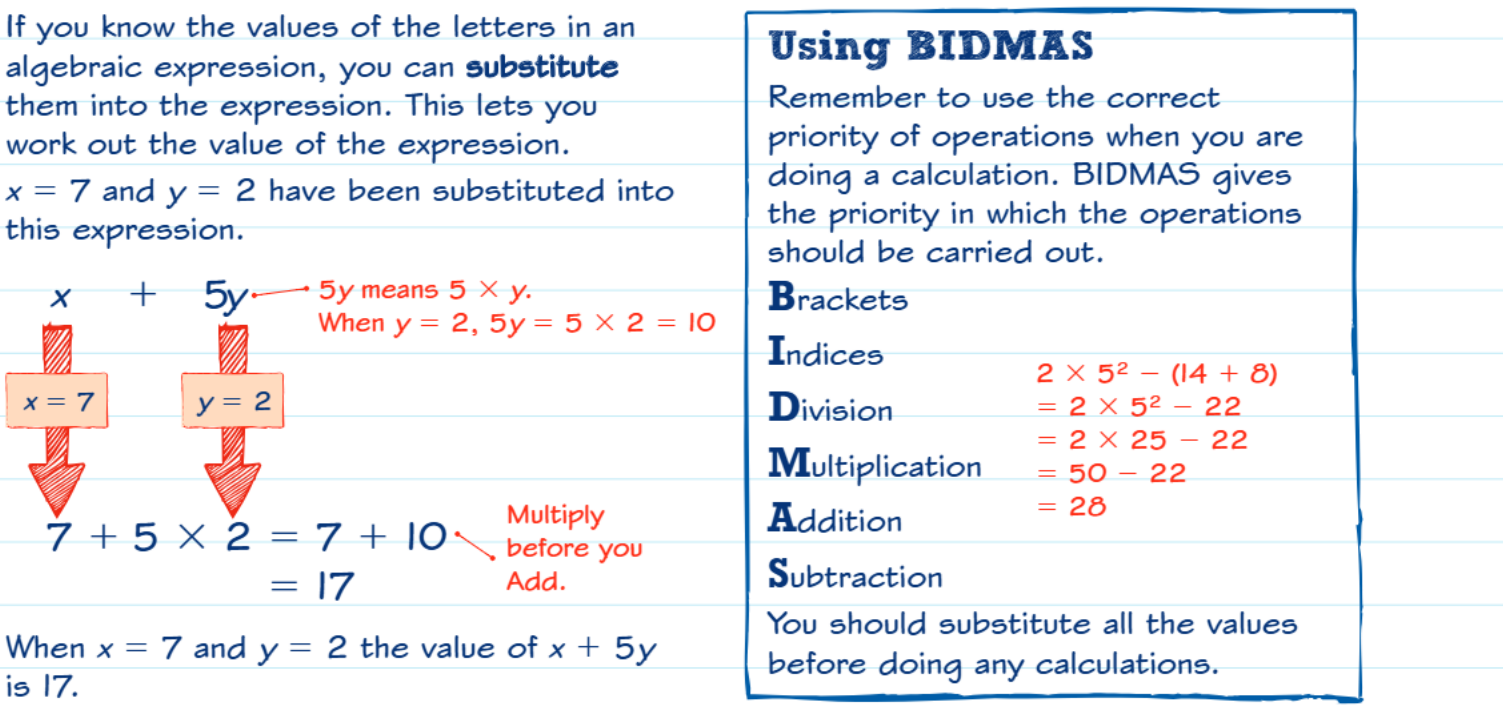
Here's how to substitute values effectively:
- Identify the variables - Look at which letters appear in the expression
- Note their given values - Check what numbers each letter represents
- Replace each letter - Substitute the numbers in place of the letters
- Follow BIDMAS - Calculate using the correct order of operations
- Work out the final answer - Complete the calculation carefully
Note
Simple Substitution Example
When and , the expression becomes:
- First substitute:
- Then calculate:
Remember that 5y means 5 × y, so when , this becomes .
Order of operations - BIDMAS
BIDMAS is crucial when substituting values. It tells you the priority order for mathematical operations:
Important
BIDMAS Order of Operations
- Brackets (do these first)
- Indices (powers and roots)
- Division and Multiplication (left to right)
- Addition and Subtraction (left to right)
You must substitute all values first before starting any calculations, then follow BIDMAS to get the correct answer.
In the expression , multiplication comes before addition in BIDMAS, so you calculate first, then add 7 to get 17.
Worked examples
Let's examine different types of substitution problems you might encounter in your GCSE exam.
Example
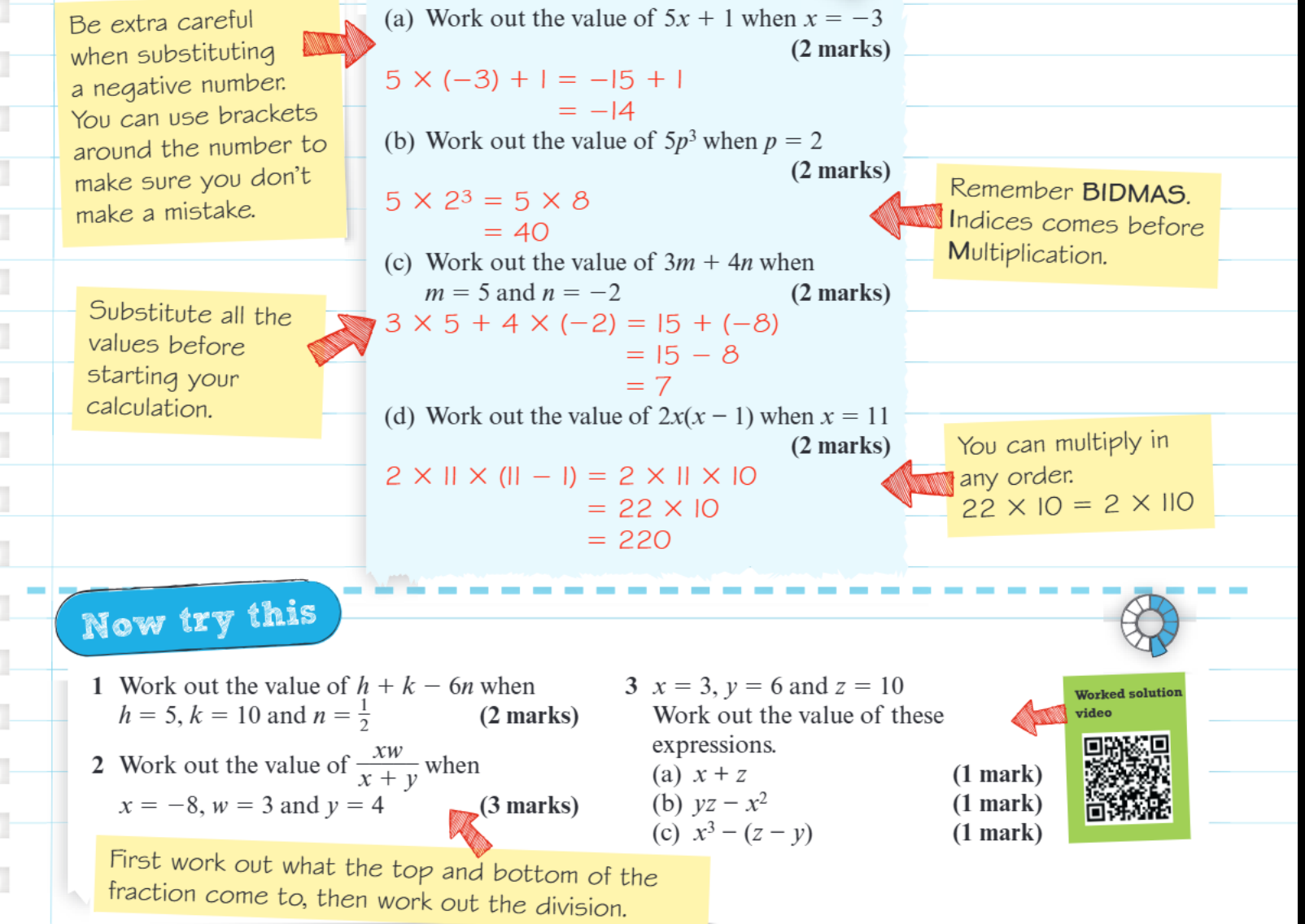
Worked Example 1: Linear expressions with negative numbers
Work out when
Solution:
- Substitute :
- Calculate:
Key tip: Be extra careful with negative numbers. Use brackets around negative values to avoid mistakes.
Example
Worked Example 2: Expressions with indices
Work out when
Solution:
- Substitute :
- Calculate the index first (BIDMAS):
- Then multiply:
Key tip: Indices come before multiplication in BIDMAS.
Example
Worked Example 3: Multiple variables
Work out when and
Solution:
- Substitute both values:
- Calculate:
Key tip: Substitute all values before starting calculations.
Example
Worked Example 4: Expressions with brackets
Work out when
Solution:
- Substitute :
- Calculate brackets first:
- Then multiply:
Key tip: You can multiply in any order - gives the same result as .
Common mistakes and tips
Important
Avoiding Common Pitfalls
Working with negative numbers:
- Always use brackets around negative numbers when substituting
- For example, if , write rather than
- This prevents calculation errors
Following BIDMAS:
- Always substitute first, then calculate using BIDMAS
- Don't try to do substitution and calculation simultaneously
- Work through operations in the correct priority order
Double-checking your work:
- Verify that you've substituted all variables correctly
- Check your arithmetic step by step
- Make sure you've followed BIDMAS throughout
Summary
Key Points to Remember:
- Substitution means replacing letters with their given number values
- Always substitute all values first before starting any calculations
- Follow BIDMAS to get the correct order of operations: Brackets, Indices, Division, Multiplication, Addition, Subtraction
- Use brackets around negative numbers to avoid mistakes when substituting
- Check your working by going through each step carefully