Algebra Basics (AQA GCSE Maths): Revision Notes
📚Revision Notes
Algebra basics
Before you can tackle more advanced algebraic concepts, you need to master some fundamental skills that form the foundation of all algebraic work. These basics will help you understand how to work with numbers, letters, and expressions confidently.
Working with negative numbers
Negative numbers appear constantly in algebra, so understanding how to handle them is essential for success. There are specific rules that govern how positive and negative numbers interact when you multiply or divide them.
Important
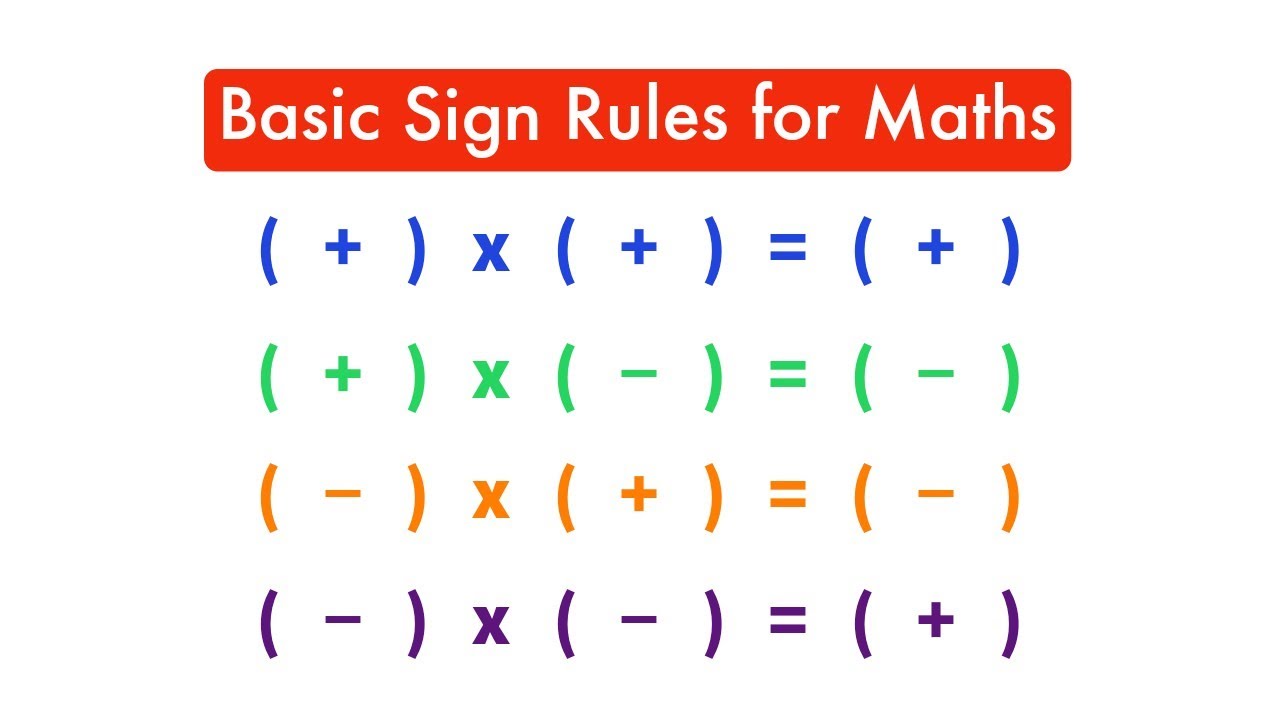
Sign Rules for Multiplication and Division:
- Same signs make positive (+ with + gives +, - with - gives +)
- Different signs make negative (+ with - gives -, - with + gives -)
These sign rules apply in two key situations:
When multiplying or dividing numbers: The pattern is straightforward - when the signs are the same, the result is positive; when the signs are different, the result is negative. For example, (different signs give negative), but (same signs give positive), and .
Note
This rule works the same way for division: (different signs give negative), but (same signs give positive).
When two signs appear next to each other: This happens in expressions where you might see something like . Here, the two minus signs together make a plus, so becomes . Similarly, becomes , and becomes .
Understanding letters multiplied together
In algebra, letters are often written side by side without multiplication signs, which can initially seem confusing. Learning to interpret this notation correctly is crucial for working with algebraic expressions.
When letters appear next to each other, they represent multiplication:
- means (the multiplication signs are omitted for simplicity)
- means (only the is squared, not the )
- means (the brackets show that both letters are squared)
- means (only the bracketed expression is cubed)
Important
Common Mistake to Avoid: Be especially careful with expressions like . This can be interpreted as either or . Generally, it's understood as .
What are algebraic terms?
To work effectively with algebraic expressions, you need to understand their building blocks - terms. Recognising and identifying terms is fundamental to simplifying expressions and solving equations.
Note
Definition of a term: A term consists of numbers, letters, and brackets that are all multiplied or divided together. Terms are the individual components of an algebraic expression, and they're separated by plus and minus signs.
Each term has either a plus or minus sign in front of it. If you can't see a sign at the beginning of the first term, there's an invisible plus sign there.
Consider the expression :
- is an '' term
- is an '' term
- is a '' term
- is a '' term
- is a 'number' term
Simplifying expressions by collecting like terms
One of the most important skills in algebra is simplifying expressions by combining similar terms. This process makes expressions more manageable and is essential for solving equations effectively.
Note
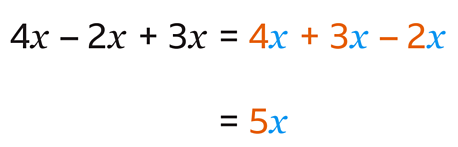
What makes terms "like" each other: Like terms contain exactly the same combination of letters. This means all the terms can be combined, all the terms can be combined, and all the number terms can be combined.
The step-by-step process:
- Identify each term by putting bubbles around them - Make sure you include the plus or minus sign that belongs to each term
- Rearrange the terms into groups - Put like terms together so they're easier to combine
- Combine the like terms - Add or subtract the numbers in front of the letters (called coefficients)
Example
Worked Example: Collecting Like Terms
To simplify :
Step 1: Identify the terms: , , ,
Step 2: Group like terms: and
Step 3: Combine:
This process of collecting like terms is a fundamental skill that you'll use throughout your algebraic studies.
Summary
Key Points to Remember:
- When multiplying or dividing, same signs give positive results, different signs give negative results
- Letters written together (like ) represent multiplication without the symbol
- A term is everything multiplied or divided together, separated by and signs
- Like terms have identical letter combinations and can be combined by adding or subtracting their coefficients
- Always include the sign in front of each term when collecting like terms