Completing the Square (AQA GCSE Maths): Revision Notes
📚Revision Notes
Completing the square
What is completing the square?
Completing the square is a powerful algebraic technique used to solve quadratic equations and analyse their graphs. While it might seem challenging at first, once you understand the systematic approach, it becomes a valuable tool for working with quadratic expressions.
The method involves rewriting a quadratic expression in the form , which reveals important information about the quadratic's behaviour and makes certain calculations much easier.
Note
The completed square form immediately shows you the turning point of the parabola at , making it incredibly useful for both solving equations and sketching graphs.
The basic method (when a = 1)
When working with quadratics where the coefficient of is 1, you can follow this systematic four-step process.
The process works by transforming expressions like into the completed square form. Here's how each step works:
Step 1: Rearrange into standard format Make sure your quadratic is written as . For basic cases, we work with expressions where .
Step 2: Write the initial bracket Create a bracket where you divide the coefficient of x by 2. This is the foundation of your completed square.
Step 3: Multiply out the brackets and compare Expand your initial bracket and compare it to the original expression. This shows you what adjustments need to be made.
Step 4: Add the adjusting number Calculate what number you need to add or subtract to make the expanded bracket match the original expression exactly.
Example
Worked Example: Completing the Square
Let's complete the square for :
Step 1: Already in standard format:
Step 2: Initial bracket:
Step 3: Expand:
Step 4: Compare with original: We need:
Therefore:
Using the completed square to solve equations
Once you have the completed square form, solving quadratic equations becomes more straightforward. The process involves three additional steps:
- Rearrange the equation so the completed square equals zero
- Square root both sides (remembering to include both positive and negative solutions)
- Solve for x by isolating the variable
Important
Always remember to include both the positive and negative square root when solving. This is where many students make mistakes!
For example, if you have , you can rearrange to get , then take the square root to find , giving you .
When the coefficient of x² is not 1
When dealing with quadratics where , you need to factor out the coefficient of first before applying the completing the square method.
Important
Key Difference for : After factoring out the coefficient, the number inside the bracket becomes instead of just . This requires careful attention to fraction arithmetic, but the fundamental principle remains the same.
The process becomes slightly more complex because you need to work with fractions. This requires careful attention to fraction arithmetic, but the fundamental principle remains the same.
Using the completed square to sketch graphs
The completed square form provides valuable information for sketching quadratic graphs. The form reveals two crucial pieces of information:
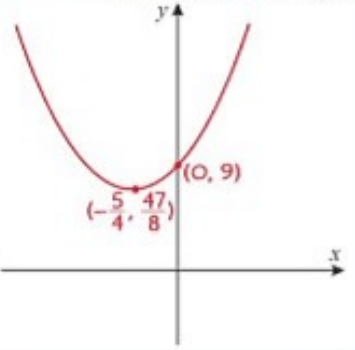
Finding the turning point: The minimum (or maximum) point occurs when the bracket equals zero, which happens when . At this point, the y-value equals .
Determining if the graph crosses the x-axis: If the adjusting number () is positive for a positive quadratic, the graph never crosses the x-axis because the minimum value is above zero.
Note
To sketch the graph, you identify the turning point coordinates and find where the curve crosses the y-axis by substituting into the original equation.
Important shortcuts and tips
For those who find the full method challenging, remember that the adjusting number always follows the pattern . This can help you check your work or speed up calculations.
Note
When working with more complex coefficients, take your time with the fraction arithmetic. It's better to work slowly and accurately than to rush and make errors.
Summary
Key Points to Remember:
- The initial bracket always contains (or when )
- The adjusting number compensates for the difference between the expanded bracket and the original expression
- Completed square form reveals the turning point of the quadratic graph immediately
- For positive quadratics, a positive adjusting number means the graph never crosses the x-axis
- This method works for any quadratic equation and often provides the most insight into the quadratic's behaviour