Inequalities (AQA GCSE Maths): Revision Notes
📚Revision Notes
Inequalities
What are inequalities?
Inequalities are mathematical statements that compare two values or expressions. Unlike equations which show that two things are equal, inequalities show when one value is greater than, less than, or equal to another value.
There are four main inequality symbols you need to know:
- > means 'is greater than'
- ≥ means 'is greater than or equal to'
- < means 'is less than'
- ≤ means 'is less than or equal to'
Note
The pointed end of the symbol always points towards the smaller value, whilst the open end faces the larger value. Think of the symbol as an arrow pointing to the smaller number!
Solving basic inequalities
When you solve an inequality like , you need to find all values that make the statement true. In this example, must be greater than 3 AND less than or equal to 6.
For integer solutions, this would give us: 4, 5, and 6.
Example
Worked Example: Finding Integer Solutions
For the inequality :
Step 1: Identify the range
- must be greater than 3 (so 3 is not included)
- must be less than or equal to 6 (so 6 is included)
Step 2: List integer values in this range
- Values greater than 3: 4, 5, 6, 7, 8...
- Values less than or equal to 6: ..., 4, 5, 6
Step 3: Find values that satisfy both conditions Integer solutions: 4, 5, and 6
Inequalities and rounding error
You can use inequalities to show the range of possible values when a number has been rounded. This is particularly useful in real-world contexts where measurements are involved.
Understanding rounding ranges
When a measurement is given as a rounded value, there's always a range of possible actual values:
Example
Worked Example: Rounding to Nearest 10m
If the height of the London Eye is given as 140m (to the nearest 10m):
- The actual height could be anywhere from 135m up to (but not including) 145m
- This is written as:
Why 135m is included but 145m is not:
- 135m rounds up to 140m ✓
- 145m would round up to 150m ✗
For decimal rounding, if (to 1 decimal place), then the actual value must satisfy:
Important
Key points about rounding ranges:
- Use '≤' (less than or equal to) for the smallest possible value
- Use '<' (less than) for the greatest possible value
This is because the upper boundary would round to the next value, so it's not included in our range.
Representing inequalities on number lines
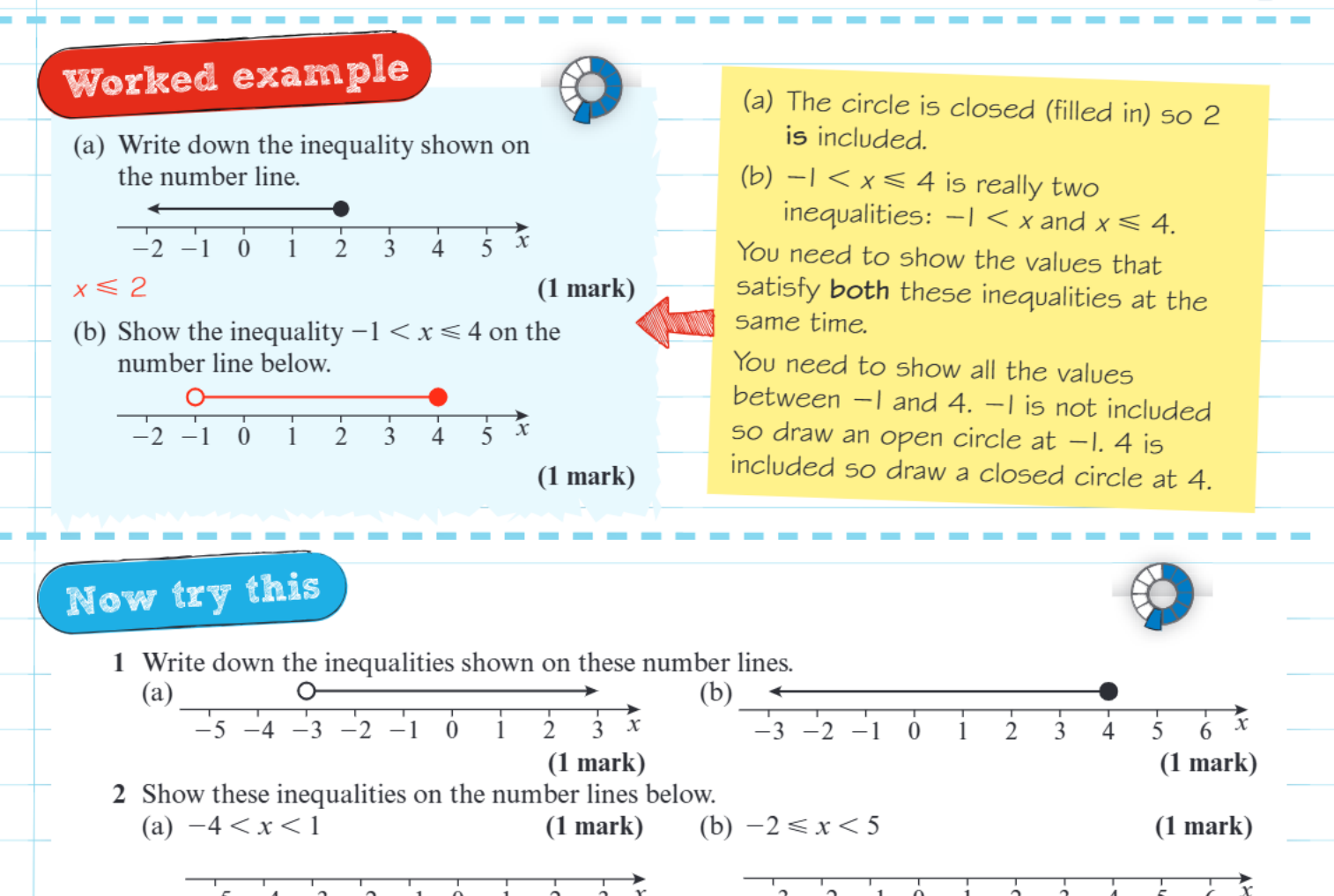
Number lines provide a clear visual way to show inequalities. You use circles and arrows to represent the range of values.
Circle notation
Understanding the circle symbols is crucial for reading and drawing number line representations:
- Open circle (○): The value is not included in the solution
- Closed circle (●): The value is included in the solution
Note
Think of open circles as "hollow" - the value falls through and isn't caught. Closed circles are "solid" - they catch and include the value.
Drawing inequalities on number lines
Here's how to represent different types of inequalities:
Example
Worked Example: Drawing
Step 1: Locate -1 on the number line Step 2: Draw an open circle at -1 (because -1 is not included) Step 3: Draw an arrow pointing right to show all values greater than -1
Example
Worked Example: Drawing
Step 1: Locate 3 on the number line
Step 2: Draw a closed circle at 3 (because 3 is included)
Step 3: Draw an arrow pointing left to show all values less than or equal to 3
Compound inequalities
Some inequalities combine two conditions, such as . This means is greater than -1 AND less than or equal to 4.
Example
Worked Example: Drawing
Step 1: Locate both -1 and 4 on the number line Step 2: Draw an open circle at -1 (not included) Step 3: Draw a closed circle at 4 (included) Step 4: Shade or draw a line between these points to show all values in between
The solution includes all real numbers between -1 and 4, including 4 but not -1
Exam tips
Summary
Key Exam Strategies:
- Always check whether circles should be open or closed by looking carefully at the inequality symbols
- For compound inequalities, make sure you satisfy both conditions
- When writing inequalities from number lines, look at the circle types and arrow directions
- Practice converting between inequality notation and number line representations
- Double-check your inequality symbols - they determine whether endpoints are included!
Remember!
Summary
Essential Points to Remember:
- Open circles mean the value is not included (use < or >)
- Closed circles mean the value is included (use ≤ or ≥)
- Arrows show the direction of the inequality
- Rounding creates ranges - use inequalities to show possible actual values
- Compound inequalities combine two conditions that must both be satisfied