Independent events (AQA GCSE Maths): Revision Notes
📚Revision Notes
Independent events
What are independent events?
Independent events are two events where the outcome of one event does not change the probability of the other event occurring. This means that what happens in the first event has no influence on what happens in the second event.
Note
Definition of Independence
Two events are independent when knowing the outcome of one event gives you no information about the outcome of the other event. The probability of each event remains exactly the same, regardless of what happens with the other event.
For example, when you spin a spinner twice, the result of the first spin doesn't affect what will happen on the second spin. Each spin is completely separate from the other.
Calculating probability of independent events
When you want to find the probability that both independent events will occur, you use the multiplication rule. This fundamental principle is essential for solving problems involving independent events.
Important
The Multiplication Rule for Independent Events
P(Event A and Event B) = P(Event A) × P(Event B)
This means you multiply the individual probabilities together to get the combined probability. This rule only works when the events are truly independent of each other.
Worked example: spinner problem
Let's examine a practical application using a spinner with different coloured sections.
Example
Worked Example: Spinner Probability Calculations
Given: A spinner where P(blue) = 7/8 and P(green) = 1/8
Problem 1: Find the probability of spinning blue then green
Solution:
- Since the spins are independent: P(blue then green) = P(blue) × P(green)
- P(blue then green) = 7/8 × 1/8 = 7/64
Problem 2: Find the probability of spinning blue twice
Solution:
- P(blue twice) = P(blue) × P(blue)
- P(blue twice) = 7/8 × 7/8 = 49/64
Key insight: We multiply the probabilities because the spins are independent of each other.
Using tree diagrams
Tree diagrams are visual tools that help you work out probabilities for independent events. They show all possible outcomes and make calculations easier to follow.
How to construct tree diagrams
When drawing a tree diagram for independent events, you need to follow a systematic approach:
Note
Steps for Constructing Tree Diagrams
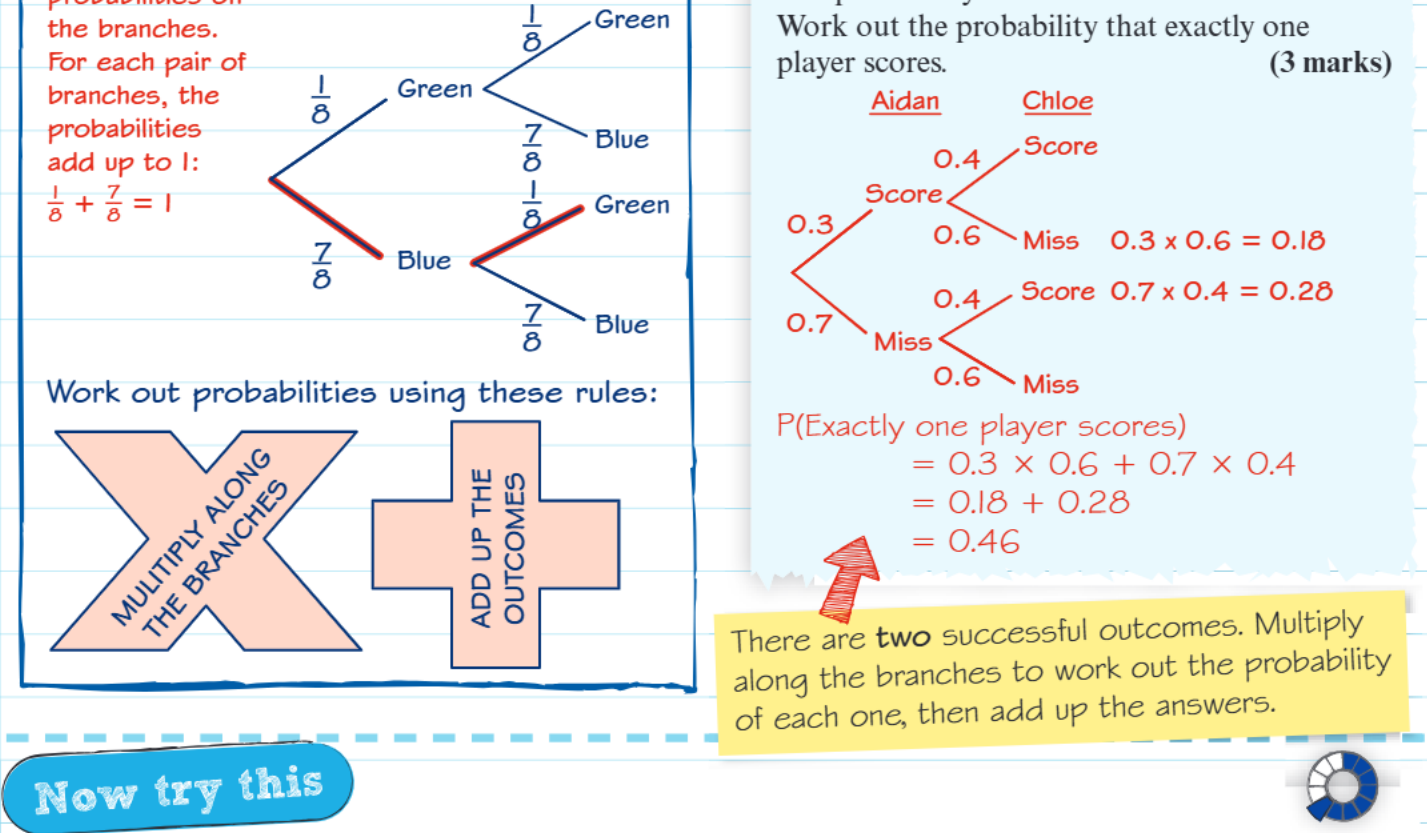
- Write the probabilities on the branches - each branch shows the probability of that outcome
- Check probabilities add to 1 - for each pair of branches, the probabilities should add up to 1
- Use the multiplication and addition rules - apply these consistently throughout your diagram
Key rules for tree diagrams
Understanding these fundamental rules is crucial for working with tree diagrams effectively.
Important
Essential Tree Diagram Rules
There are two important rules to remember:
- Multiply along the branches - to find the probability of a specific sequence of events
- Add up the outcomes - to find the probability when there are multiple ways to achieve the same result
These rules form the foundation of all probability calculations using tree diagrams.
Worked example: basketball shots
Let's explore a more complex scenario involving two players with different success rates.
Example
Worked Example: Basketball Shooting Probabilities
Given: Aidan has a 0.3 probability of scoring, and Chloe has a 0.4 probability of scoring.
Problem: Find the probability that exactly one player scores.
Step 1: Identify the successful outcomes
- Aidan scores AND Chloe misses: P(Aidan scores) × P(Chloe misses) = 0.3 × 0.6 = 0.18
- Aidan misses AND Chloe scores: P(Aidan misses) × P(Chloe scores) = 0.7 × 0.4 = 0.28
Step 2: Add up the successful outcomes
- P(exactly one scores) = 0.18 + 0.28 = 0.46
Explanation: This demonstrates how you multiply along branches for individual outcomes, then add them together for the final answer.
Exam tips
Note
Essential Exam Strategies
- Always check that probabilities on branches from the same point add up to 1
- Remember to multiply probabilities when events happen and occur together
- Remember to add probabilities when you want either outcome to happen
- Show your working clearly by writing out the multiplication and addition steps
- Use tree diagrams to organise your thinking and avoid missing outcomes
Remember!
Summary
Key Points to Remember
- Independent events don't affect each other - the outcome of one doesn't change the probability of the other
- Multiply probabilities when you want both independent events to occur
- Tree diagrams help visualise all possible outcomes with probabilities on branches
- Multiply along branches to find individual outcome probabilities
- Add up outcomes when there are multiple ways to achieve the same result