Relative frequency (AQA GCSE Maths): Revision Notes
📚Revision Notes
Relative frequency
What is relative frequency?
Relative frequency is another name for probability when it's calculated using data from experiments or surveys. It tells us how often something happens compared to the total number of times we tried.
When we calculate probability from a frequency table, we use this formula:
This type of probability calculation is called relative frequency because it shows how frequent an outcome is relative to all the other outcomes.
The golden rule about accuracy
Important
The Golden Rule of Relative Frequency Accuracy
Probability estimates based on relative frequency are more accurate for larger samples or more trials in an experiment.
This means the more data you collect, the closer your estimate will be to the true probability. Small samples can give misleading results, but large samples give better estimates.
Calculating relative frequency from tables
Let's look at how to work with frequency tables to find relative frequencies.
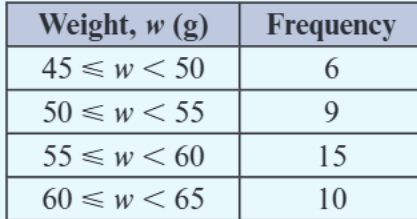
When you have a frequency table like this showing weights of eggs, you can calculate the probability of selecting an egg in any weight range by following these three key steps:
- Find the frequency for your chosen outcome
- Find the total frequency by adding all frequencies together
- Divide the frequency by the total frequency
Example
Worked Example: Finding Probability from a Frequency Table
To find the probability of selecting an egg weighing 55g or more:
Step 1: Find the frequency for eggs weighing 55g or more
- Eggs weighing 55g or more = 15 + 10 = 25 eggs
Step 2: Find the total frequency
- Total eggs = 6 + 9 + 15 + 10 = 40 eggs
Step 3: Calculate the probability
- Probability = = 0.625
Note
Since this is a fairly small sample (40 eggs), the estimate might not be very accurate. A larger sample would give a better estimate.
Experimental probability
Experimental probability involves carrying out experiments to estimate the probability of something happening. The more trials you do, the more accurate your estimate becomes.

This table shows results from repeatedly dropping a drawing pin to see if it lands point up. Notice how the relative frequency changes as more trials are completed:
- After 10 trials:
- After 20 trials:
- After 60 trials:
The estimate becomes more reliable as the number of trials increases. This demonstrates the law of large numbers - experimental probability gets closer to theoretical probability with more trials.
Practice with experimental probability


When working with experimental data like dice rolling, you can follow these steps:
Note
Working with Experimental Data
- Calculate experimental probability by dividing the frequency by total trials
- Compare with theoretical probability (what should happen in theory)
- Comment on fairness by comparing experimental and theoretical results
For a fair four-sided dice, each number should have a theoretical probability of . If your experimental results are very different from this, the dice might not be fair.
Exam tips
Important
Essential Exam Tips for Relative Frequency
- Always show your working when calculating relative frequency
- Remember to simplify fractions where possible
- For questions about accuracy, mention that larger samples give better estimates
- When comparing experimental and theoretical probability, comment on whether results suggest the object is fair or biassed
Summary
Summary
Key Points to Remember:
- Relative frequency is probability calculated from experimental data or frequency tables
- Formula:
- Larger samples give more accurate probability estimates than smaller ones
- Experimental probability gets closer to theoretical probability as you increase the number of trials
- Always check if your calculated probabilities make sense in the context of the problem