Two-way tables (AQA GCSE Maths): Revision Notes
📚Revision Notes
Two-way tables
Two-way tables are data tables that show information organised by two different categories or variables. They help us analyse relationships between different groups and answer questions using addition and subtraction.
What are two-way tables?
A two-way table displays data in rows and columns, where each row represents one category and each column represents another category. The intersections show how many items belong to both categories.

Note
In this example, students are categorised by both their year group (columns) and their dietary preference (rows). This allows us to see patterns, such as how many Year 8 vegetarians there are.
Structure of two-way tables
Understanding the components of two-way tables is essential for working with them effectively.
Note
Key Components of Two-way Tables:
- Rows run horizontally and show one category (e.g. vegetarian/not vegetarian)
- Columns run vertically and show another category (e.g. year groups)
- Row totals appear at the end of each row
- Column totals appear at the bottom of each column
- Grand total appears in the bottom right corner
Golden rules for two-way tables
Important
Essential Rules for Two-way Tables
These rules must always apply when working with two-way tables:
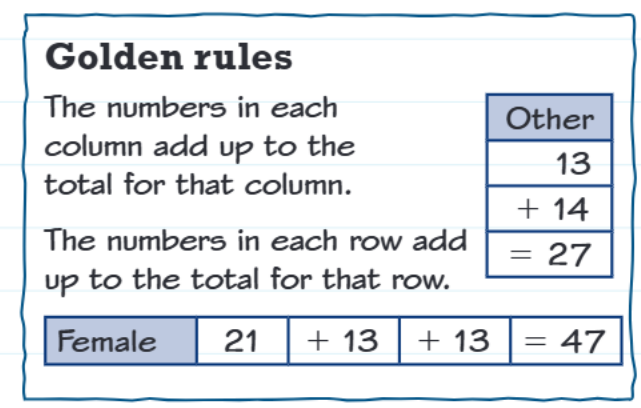
- Column rule: All numbers in each column must add up to match the column total
- Row rule: All numbers in each row must add up to match the row total
- Grand total check: The sum of all row totals equals the sum of all column totals
These rules help us find missing values and check our work is correct.
How to complete two-way tables
When you have a partially completed two-way table, following a systematic approach will ensure accuracy and efficiency:
- Start with the grand total - write this in the bottom right-hand cell if it's missing
- Find the easiest gaps first - look for rows or columns with only one missing number
- Use addition and subtraction - subtract known values from totals to find missing numbers
- Work systematically - fill in missing values as you discover them
- Check your work - ensure all rows and columns add up correctly
For example, if a row shows: 21, ?, 13 with a total of 47, then the missing number is 47 - 21 - 13 = 13.
Worked example process
Example
Worked Example: Completing a Two-way Table
When completing two-way tables in exams, follow these systematic steps:
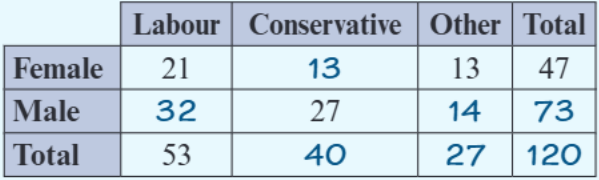
Step 1: Labour column - If total is 53 and one value is 21, then 53 - 21 = 32
Step 2: Female row - If total is 47 and values are 21 and 13, then 47 - 21 - 13 = 13
Step 3: Conservative column - Add known values 13 + 27 = 40
Step 4: Continue systematically until all cells are complete
Final check: Always verify your answer by checking that row totals and column totals both sum to the same grand total.
Exam tips
Note
Strategies for Success in Exams:
- Read carefully - identify what each row and column represents
- Show your working - write down your calculations clearly
- Check systematically - verify each row and column adds up correctly
- Look for the easiest calculations first - tackle cells with only one missing value
- Double-check - ensure your grand total is consistent

Summary
Summary
Key Points to Remember:
- Two-way tables organise data using two different categories shown in rows and columns
- Golden rule: every row and column must add up to its stated total
- Start with sections that have only one missing number for easier calculations
- Use subtraction to find missing values: total minus known values equals missing value
- Always check your final answer by verifying all totals are correct