Changes in Energy (AQA GCSE Physics Combined Science): Revision Notes
📚Revision Notes
1.1.8 Changes in Energy
Energy Transfer
Note
When an object is heated, thermal energy is transferred to it, resulting in an increase in the object's temperature. For example, when you heat a pan of soup over a flame, the thermal energy from the flame is absorbed by the soup, causing its temperature to rise.
Note
The amount of energy required to heat different objects by a certain amount can be calculated using the principles of specific heat capacity.
Specific Heat Capacity
Note
Specific heat capacity refers to the amount of energy required to raise the temperature of 1 kilogramme of material by 1°C. This property is denoted by the lowercase letter c and is measured in J/kg°C.
Note
Study Tip
- Materials with a high specific heat capacity require more thermal energy to increase their temperature.
- Materials with a low specific heat capacity need less thermal energy to achieve the same temperature increase.
Note
The formula for Heat Change To calculate the amount of thermal energy needed to increase the temperature of an object, we use the formula:
where:
- is the change in thermal energy (Joules, J),
- is the mass of the object (kilogrammes, kg),
- is the specific heat capacity of the material (J/kg°C),
- is the change in temperature (degrees Celsius, °C or Kelvin, K).
Note
Worked Example If you want to calculate the energy required to heat 2 kg of water (with a specific heat capacity of 4,200 J/kg°C) from 20°C to 30°C:
This means 84,000 joules of energy are needed to raise the temperature of the water by 10°C.
Required Practical Investigation into Specific Heat Capacity
Note
Conducting the Experiment
- Measure the mass of the block using a balance.
- Place the block in a container surrounded by insulating material (e.g., bubble wrap) to minimise heat loss.
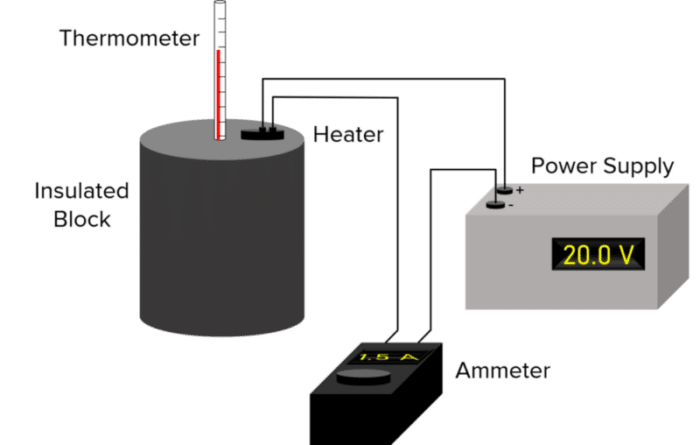
- Insert a thermometer into the container, and connect a power supply, heater, and ammeter to the block as shown in the diagram.
- Record the starting temperature of the block.
- Turn on the power supply and start a stopwatch simultaneously.
- Record the current (I) from the ammeter and the potential difference (V) from the power source.
- After 10 minutes, measure the final temperature of the block.
Note
Calculating the Specific Heat Capacity 8. Calculate the change in temperature using:
- Find the power of the heater using the equation:
- Calculate the energy transferred to the block:
where t is the time in seconds (600 s for 10 minutes).
-
6 3Assuming no heat is lost to the surroundings (due to insulation), this energy is the amount transferred to the block, so
-
Rearrange the specific heat capacity formula to solve for
- Substitute the values for and into the equation to find the specific heat capacity.
Note
Real-World Applications
- Water has a high specific heat capacity, making it effective for use in cooling systems and radiators because it can absorb a lot of heat without a large temperature increase.
- Metal utensils heat up quickly due to their low specific heat capacity, which makes them efficient for cooking but also means they need to be handled carefully to avoid burns.