Nuclear Fission & Fusion (AQA GCSE Physics): Revision Notes
📚Revision Notes
4.4.4 Nuclear Fusion
Note
Nuclear fission and nuclear fusion are both ways of extracting energy from nuclei. They are both potentially very useful sources of energy however they can also be very dangerous.
Nuclear Fusion
Note
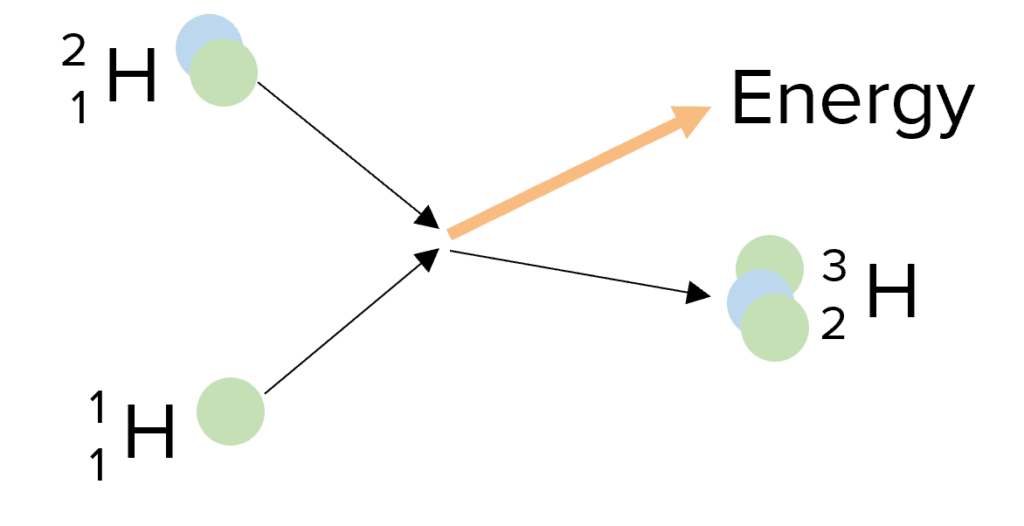
In nuclear fusion, two small nuclei collide and join together (fuse) to make a larger nucleus. The most common example is when two types of hydrogen fuse together to form helium. The bigger nucleus created has slightly less mass than the sum of the original two nuclei. This mass is converted to energy and released as gamma rays.
So far, scientists have not found a way to use nuclear fusion to generate electricity. This is because fusion requires very high temperatures and pressures and so a nuclear fusion reactor is very difficult and expensive to build.
Note
Key Points:
- The sum of the masses of the two nuclei is more than the mass of the heavier nucleus.
- Some of the mass is converted into energy (released as radiation).
- The sun is a natural fusion reactor.
- Fusion would be a much more efficient way of producing energy compared to fission. However, no design has been produced that could accomplish positive net energy on Earth.