Electric Fields & Static Electricity (AQA GCSE Physics): Revision Notes
📚Revision Notes
2.4.4 Electric Fields & Static Electricity
Static Electricity
Note
Static electricity is caused by a build-up of electric charges that are not free to move. This can often result in an electric shock or a spark when the built-up charges eventually move.
Build-up of Static
When two insulating materials are rubbed together, electrons move from one material to the other. This makes one material positively charged because it loses electrons, and the other material negatively charged because it gains electrons. The direction the electrons move depends on the materials.
Note
For example, if you rub a cloth on a polythene rod, electrons move from the cloth to the rod. This leaves the rod negatively charged and the cloth positively charged.

Note
Remember, opposite charges attract each other. This is called electrostatic attraction, which is a non-contact force. So, the positively charged cloth and the negatively charged polythene rod will pull towards each other. If you had two positively charged cloths, they would push away from each other, known as electrostatic repulsion.
Sparking
Note
As electric charge builds up on an object, the potential difference between the object and the Earth (which has a potential difference of 0V) increases. If the potential difference becomes large enough, electrons may jump across the gap to the Earth, creating a spark.
Note
Sparks can also leap to an earthed conductor, a material connected to the Earth. This is why it's advisable to avoid tall metal objects like electricity pylons during a thunderstorm. Lightning is an example of a large spark caused by the potential difference between charged storm clouds and the Earth. Electrons from the clouds can jump to metal objects like pylons, resulting in a massive current.
Electric Fields
Note
Electric fields are generated by electrically charged objects. The strength of the electric field increases as you get closer to the charged object.
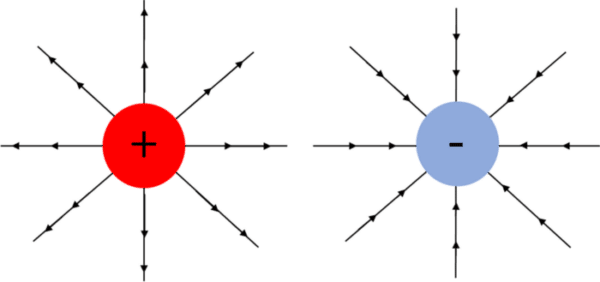
Electric fields are shown by field lines that always go from positive to negative charges. The closer the field lines are to each other, the stronger the electric field in that area.
- When an object is placed in an electric field, it feels a force. This force can either pull the object closer or push it away, depending on the charges involved. The stronger the electric field, the greater the force on the object. Sparks can be explained by electric fields, too. When there's a high potential difference between a charged object and the Earth, a strong electric field is created. This field can ionise the air, meaning it strips electrons from air molecules, turning the air into a conductor. This conductive air allows a large current to flow, which we see as a spark.
Note
Remember, opposite charges attract each other, which is called electrostatic attraction, a non-contact force. So, if you rub a cloth on a polythene rod, electrons move from the cloth to the rod, making the rod negatively charged and the cloth positively charged. These opposite charges will pull towards each other, while like charges (e.g., two positively charged cloths) will repel each other.