Levers & Gears (AQA GCSE Physics): Revision Notes
📚Revision Notes
5.4.3 Levers & Gears
Levers and Gears (Physics only)
Note
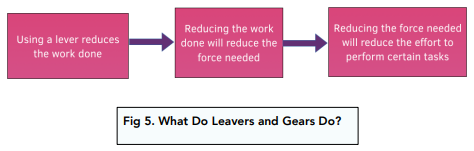
Levers and gears are tools that help make tasks easier by reducing the effort needed to turn objects. They achieve this by decreasing the force you need to apply, meaning less effort is required.
Levers
Note
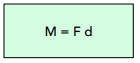
Levers work by increasing the moment (the turning effect of a force) by making the force act farther from the pivot (the point the lever turns around).
Note
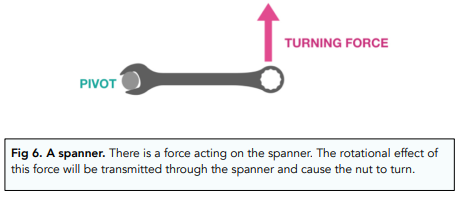
For example, a spanner is a type of lever:
- A longer spanner increases the moment because the force is applied farther from the pivot.
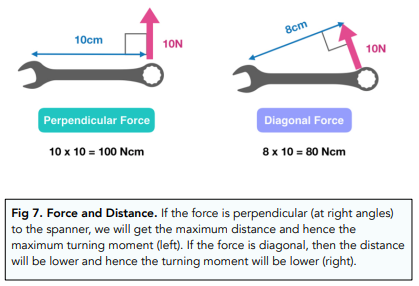
- The moment is greatest when the force is applied at a right angle (perpendicular) to the lever.
Using a longer spanner:
- Increases the moment (turning effect).
- Reduces the amount of force you need to apply to turn something, like a nut or bolt.
- Increasing the length of the spanner increases the moment. By increasing the length of the spanner, we are increasing the size of the moment. This is because our perpendicular distance is effectively the length of the spanner (assuming the force is straight). We already know that increasing the perpendicular distance will increase the size of the moment, so we can do the same thing by making the spanner longer.
- Increasing the length of the spanner decreases the force needed. As well as increasing the moment, a longer spanner will decrease the force needed to act on an object.
Gear Interactions
- Gears can change speed, force, or direction by rotation.
- First Gear Supplying the Force:
- Connected to a Gear with Fewer Teeth (Smaller Gear):
- The second gear will turn faster.
- With less force.
- In the opposite direction to the first gear.
- Connected to a Gear with More Teeth (Larger Gear):
- Turns slower.
- More force.
- In the opposite direction.
Direction of Turn
- The second gear will always turn in the opposite direction.
Example
Example:
- The Blue Gear is supplying the power.
- To increase the power, a larger gear is used for the secondary (red).
- As the force on the red gear is a further distance from its pivot, the momentum of the larger gear is greater.