Refraction Ray Diagrams (AQA GCSE Physics): Revision Notes
📚Revision Notes
6.2.4 Refraction Ray Diagrams
Refraction of Waves
Note
Waves can change direction when they change speed, moving from one medium to another.
Behaviour of Waves
- Slowing Down: When waves slow down, they bend towards the normal.
- Speeding Up: When waves speed up, they bend away from the normal.
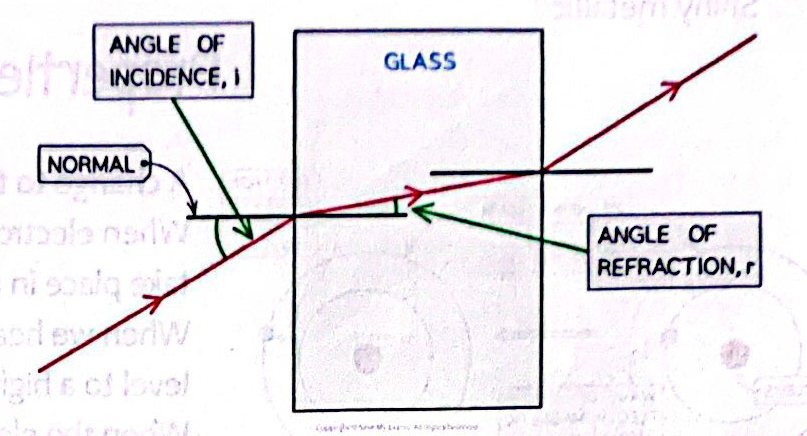
Important
Important Note
- If the wave enters or leaves the medium at right angles (along the normal), then they do not change direction.
Wavefront
Note
An imaginary line that connects all the same points in a set of waves.
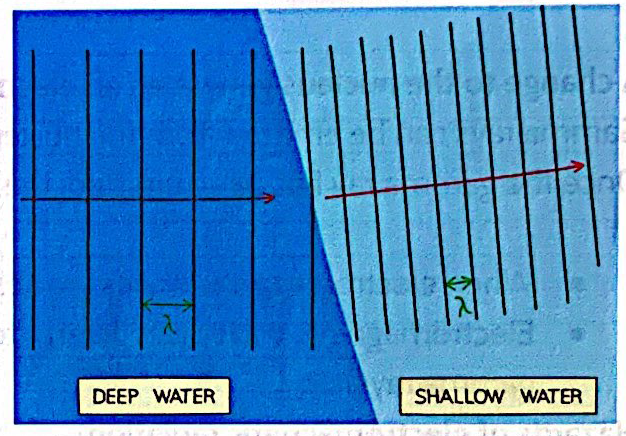
Process of Refraction
Note
When the first wavefronts start to move into the glass (or any other medium):
- Those parts of the wavefronts slow down.
- This causes those parts of the wavefronts to get closer together, and their wavelength gets smaller.
- This change in speed and wavelength causes the waves to change direction towards the normal.
Diagram Explanation
- The angle of Incidence (i): The angle between the incident wave and the normal.
- The angle of Refraction (r): The angle between the refracted wave and the normal.
Example
Example (Water):
- Waves moving from deep water to shallow water slow down and bend towards the normal.
Summary
Refraction occurs when waves change speed as they pass from one medium to another, causing them to change direction. The behaviour of the waves depends on whether they speed up or slow down.
Refraction
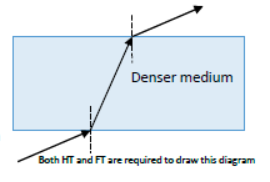
- General Rule:
- If entering a denser material, it bends towards the normal.
- If entering a less dense material, it bends away from the normal.
Interaction with EM Waves
Note
Substances will absorb, transmit, refract, or reflect certain EM waves depending on wavelength.
Example
Examples:
- The glass will transmit/refract visible light.
- Absorb UV radiation.
- Reflect IR radiation.
Note
The material interacts differently for different parts of the EM spectrum because the wavelengths (and frequencies) are different.
Velocity Differences
- Some effects are due to differences in velocity:
- When light enters a denser medium, it slows down.
- Shorter wavelengths slow down more than longer wavelengths.
Example
Example: Blue light slows down more than red light.
Dispersion
- Dispersion occurs when white light enters a prism:
- Different wavelengths refract a different amount and therefore spread out creating a rainbow effect.
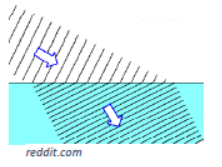
- When refracting, the speed decreases and the wavelength decreases too in denser material:
- The horizontal lines show the "wavefronts" of the waves, with each line representing the peaks of the transverse wave.