Sample space diagrams (AQA GCSE Statistics): Revision Notes
📚Revision Notes
Sample space diagrams
What is a sample space?
A sample space is a complete list that shows every possible outcome that could happen in a probability experiment or trial. Think of it as your "master list" of everything that could possibly occur when you conduct an experiment.
For example, when you roll a standard six-sided die once, the sample space would include all the numbers that could appear: .
Note
The sample space is typically denoted by the symbol and written using set notation with curly braces. Each individual outcome within the sample space is called an element of the set.
Key requirements for using sample spaces
Important
There's one crucial rule you must remember when working with sample spaces: all outcomes must be equally likely. This means each outcome has exactly the same chance of happening as any other outcome.
This requirement is essential because it ensures our probability calculations will be accurate. If outcomes aren't equally likely, we can't use the simple counting methods that sample spaces provide.
Note
When outcomes are equally likely, the probability of any single outcome is simply . This makes calculations much more straightforward.
Sample space diagrams for two events
When you're dealing with two events happening together (like spinning two spinners or rolling two dice), you can create a sample space diagram using a table. This systematic approach helps you list every possible combination without missing any.
The key is to write outcomes as ordered pairs, where the first number represents the result of the first event and the second number represents the result of the second event. For instance, if you roll two dice, means the first die shows 3 and the second die shows 5.
Here's why this method is so powerful:
- It ensures you don't miss any possible combinations
- It makes counting successful outcomes much easier
- It helps you visualise all the ways events can combine
Note
Systematic Listing Approach
When creating sample space diagrams for two events, always work methodically through your table. This prevents errors and ensures completeness in your listing.
Worked example: Using spinners
Example
Worked Example: Two Triangular Spinners
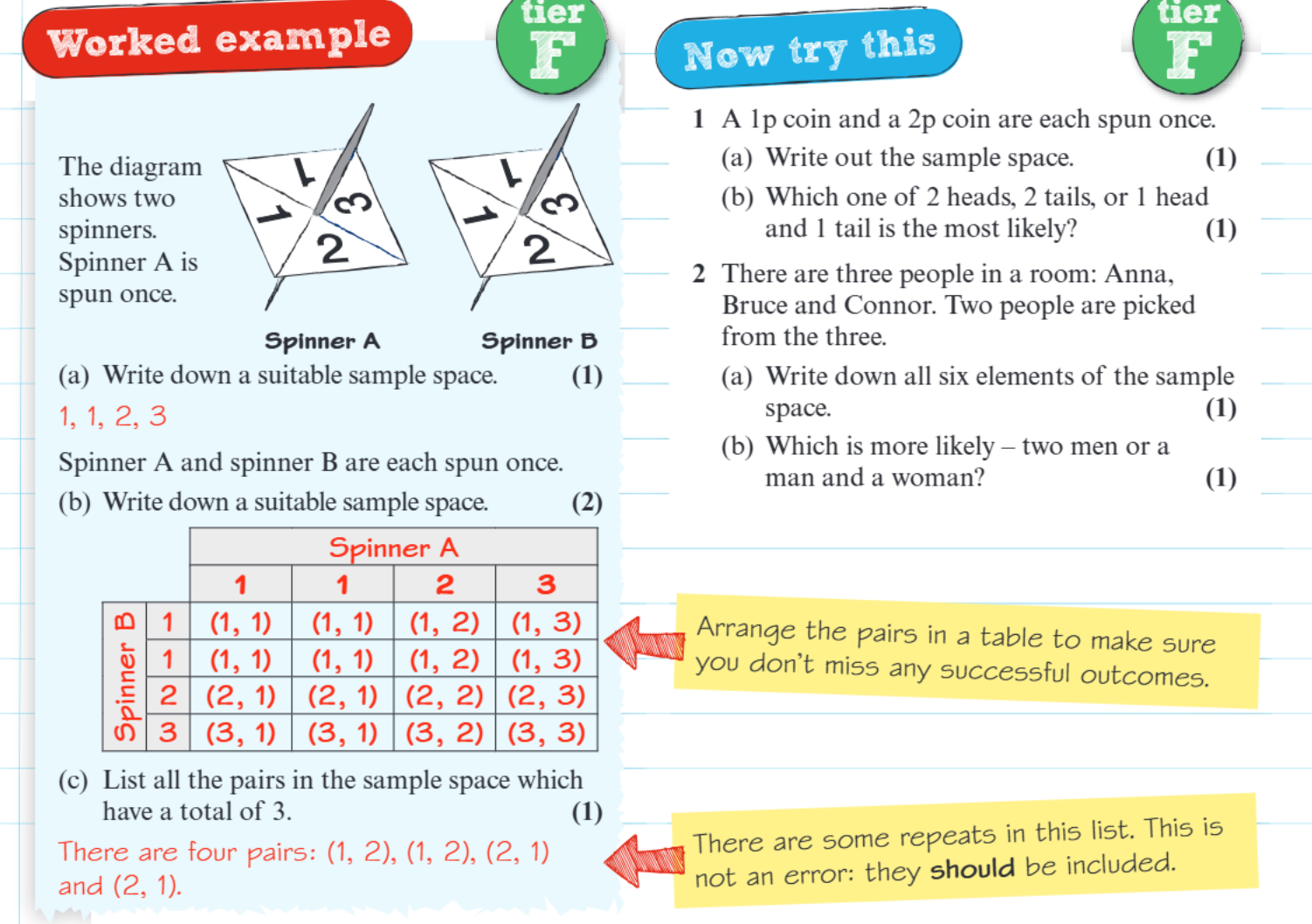
The problem: We have two triangular spinners, each divided into three equal sections numbered 1, 2, and 3. Each spinner is spun once.
Step 1: Identify the sample space for each individual spinner
- Spinner A can land on:
- Spinner B can land on:
Step 2: Create a systematic table We arrange all possible combinations in a table format:
| Spinner B → | 1 | 2 | 3 |
|---|---|---|---|
| Spinner A ↓ | |||
| 1 | (1,1) | (1,2) | (1,3) |
| 2 | (2,1) | (2,2) | (2,3) |
| 3 | (3,1) | (3,2) | (3,3) |
Step 3: List the complete sample space Reading from our table, the complete sample space contains 9 equally likely outcomes:
Step 4: Use the sample space to answer questions If we wanted to find outcomes where the total equals 4, we would identify: , , and . Notice that and are different outcomes because the order matters - they represent different ways the spinners can land.
Important exam tips
Note
Always include repeated outcomes: If the same combination can happen in different ways, count each way separately. For example, getting a total of 4 with two dice can happen as or - these are two different outcomes.
Note
Use systematic ordering: Work through your table methodically, either row by row or column by column. This prevents you from accidentally missing combinations.
Note
Check your total: For two events with and possible outcomes respectively, your sample space should contain exactly total outcomes.
Important
Remember order matters: is different from when dealing with two separate objects or events, even if they might look similar at first glance.
Remember!
Summary
Key Points to Remember:
- A sample space lists every possible outcome of an experiment
- All outcomes in a sample space must be equally likely to occur
- Sample space diagrams use tables to show combinations of two events systematically
- Write outcomes as ordered pairs: (first event result, second event result)
- Count carefully - don't miss any combinations, and don't ignore repeated outcomes that happen in different ways