The formula for conditional probability (AQA GCSE Statistics): Revision Notes
📚Revision Notes
The formula for conditional probability
What is conditional probability?
Conditional probability helps us find the likelihood of one event happening when we already know that another event has occurred. When we write P(B|A), we're asking: "What's the probability of event B happening, given that event A has already happened?"
Note
The vertical line "|" means "given that" or "knowing that". So P(B|A) is read as "the probability of B given A".
The main formula
The formula for conditional probability is:
Where:
- P(B|A) = probability of B happening given that A has happened
- P(A and B) = probability of both A and B happening together
- P(A) = probability of A happening
Note
This formula essentially says: "Out of all the times A happens, how many of those times does B also happen?" This is why we divide the joint probability by the probability of A.
Understanding with Venn diagrams
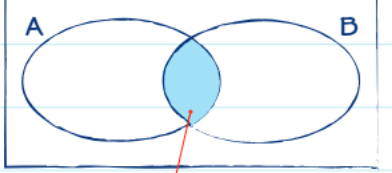
Using a Venn diagram makes conditional probability much clearer. The formula can also be written as:
This makes sense because:
- We know A has happened, so we only consider outcomes within circle A
- We want B to happen as well, so we count outcomes in the overlap (A and B)
- We divide by the total outcomes in A to get the probability
Rearranging the formula
Sometimes it's useful to rearrange the conditional probability formula:
This tells us that the probability of both events happening equals the conditional probability multiplied by the probability of the first event.
Independent events
Important
When two events are independent, one doesn't affect the other. For independent events A and B:
This means that knowing one event has happened doesn't change the probability of the other event occurring.
Worked example 1: Basic conditional probability
Example
Worked Example: Basic Conditional Probability
Problem: Events A and B have P(A) = 0.5 and P(A and B) = 0.4. Given that A and B are independent events, find P(B|A).
Solution: Using the formula:
Since A and B are independent, we can check this makes sense: ✓
Worked example 2: The tiles problem
Example
Worked Example: The Tiles Problem
Problem: Kim has 20 tiles. 10 tiles have the letter X (6 are red, 4 are white). The remaining 10 tiles have the letter Y (7 are red, 3 are white). Kim picks one tile randomly.
Let A = "a white tile is selected" Let B = "a tile with letter X is selected"
Part (a): Find P(A)
Total white tiles = 4 white X tiles + 3 white Y tiles = 7 white tiles Total tiles = 20
Part (b): Find P(B|A)
Outcomes in A and B = white tiles with letter X = 4 Outcomes in A = total white tiles = 7
Part (c): Find P(A and B)
Method 1 - Direct counting:
Method 2 - Using the formula: ✓
Key exam tips
Note
Essential Exam Strategies:
-
Always identify what you're looking for: Read P(B|A) carefully - which event is given and which are you finding?
-
Draw Venn diagrams when possible: They help visualise the problem and make calculations clearer.
-
Check your answer makes sense: Conditional probabilities should be between 0 and 1.
-
Use the rearranged formula: can be very useful for finding joint probabilities.
-
Remember independent events: If A and B are independent, then P(B|A) = P(B).
Common mistakes to avoid
Important
Critical Mistakes to Watch Out For:
- Confusing P(B|A) with P(A|B) - these are usually different values
- Forgetting that conditional probability uses only the outcomes where the given event has occurred
- Not checking whether events are independent when this information is given
Remember!
Summary
Key Points to Remember:
- - the fundamental conditional probability formula
- The "|" symbol means "given that" - you know the event after the line has already happened
- For independent events, P(B|A) = P(B) - knowing A doesn't change B's probability
- Venn diagrams help visualise the relationship between events and their overlaps
- Always double-check your working by substituting back into the original formula