Ionic bonding (Edexcel GCSE Chemistry Combined Science): Revision Notes
📚Revision Notes
2.1.2 Ionic Bonding
Ions
Note
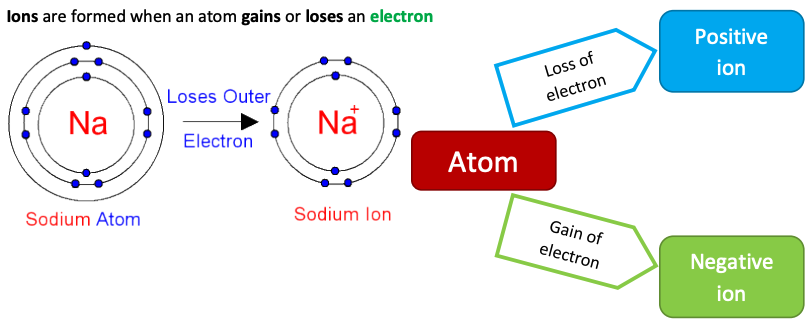
An ion is an atom or a group of atoms that carries a positive or negative charge. Ions are formed when atoms either lose or gain electrons in order to achieve a full outer shell of electrons, which makes them more stable.
Formation of Positive Ions (Cations):
- Metal atoms tend to lose electrons from their outer shell.
- This loss of electrons results in a positively charged ion because there are more protons (positive charge) than electrons (negative charge).
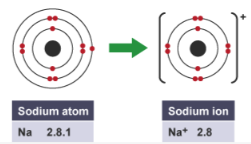
- Example: A sodium atom (Na) loses one electron to form a sodium ion (Na⁺).
Formation of Negative Ions (Anions):
- Non-metal atoms tend to gain electrons to fill their outer shell.
- This gain of electrons results in a negatively charged ion because there are more electrons (negative charge) than protons (positive charge).
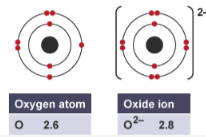
- Example: An oxygen atom (O) gains two electrons to form an oxide ion (O²⁻).
Ionic Bonds
Formation:
Ionic bonds form when one atom transfers electrons to another atom. This usually happens between a metal and a non-metal.
- Metals tend to lose electrons and become positively charged ions (cations).
- Non-metals tend to gain electrons and become negatively charged ions (anions).
Example
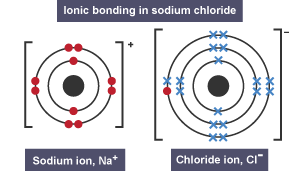
Example: Sodium chloride (NaCl) is formed when sodium (Na) transfers one electron to chlorine (Cl).
Bonding:
The positive and negative ions are attracted to each other by electrostatic forces, forming a strong ionic bond. These ions arrange themselves in a regular structure known as a giant ionic lattice.
Properties:
- Ionic compounds have high melting and boiling points due to the strong forces of attraction between the ions.
- They are usually soluble in water.
- Ionic compounds can conduct electricity when melted or dissolved in water because the ions are free to move.