The fetch-decode-execute cycle (Edexcel GCSE Computer Science): Revision Notes
📚Revision Notes
The fetch-decode-execute cycle
What is the fetch-decode-execute cycle?
The fetch-decode-execute cycle is the fundamental process that your computer's processor (CPU) follows to run programmes. Think of it like the CPU's way of reading and following instructions, just like you might follow a recipe step by step.
This cycle happens continuously when your computer is running a programme. The CPU takes instructions from memory one at a time, figures out what each instruction means, then carries out the required action.
Note
Modern processors can complete billions of these cycles every single second! This incredible speed is what allows your computer to run complex programmes and perform multiple tasks simultaneously.
The cycle consists of three main stages that repeat over and over again:
- Fetch - Get the next instruction from memory
- Decode - Work out what the instruction means
- Execute - Carry out the instruction
The fetch stage
During the fetch stage, the CPU needs to get the next instruction from the computer's memory. This process involves several important components working together.
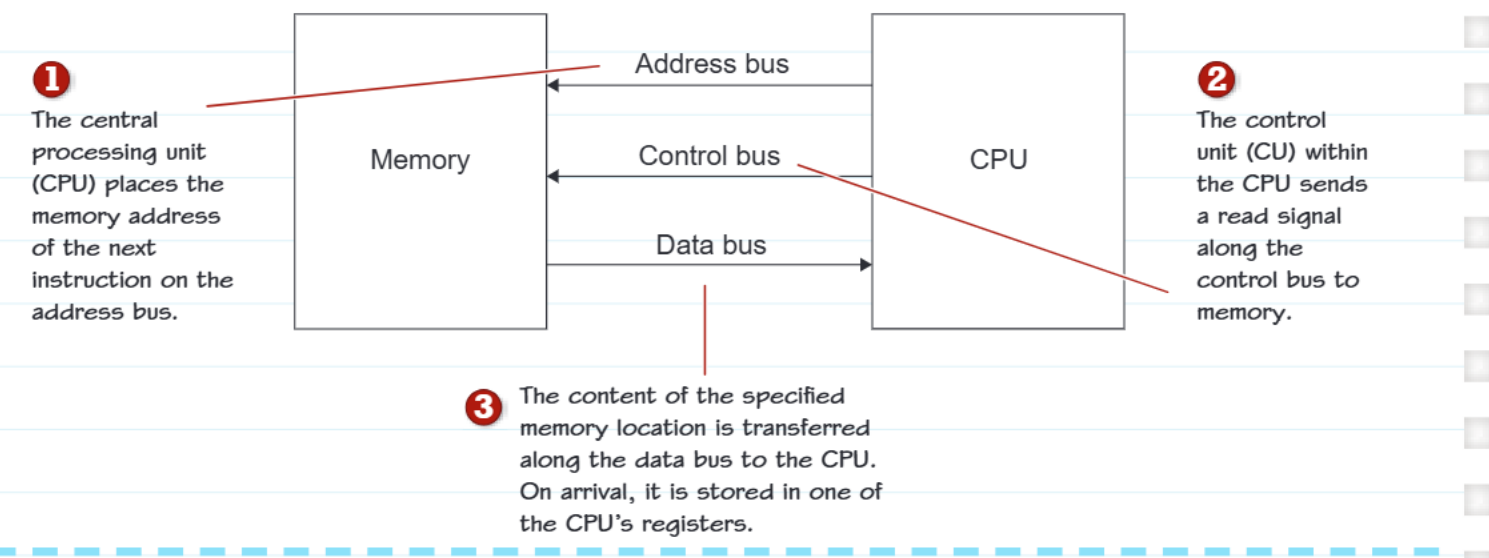
The fetch process involves three key communication pathways between the CPU and memory: the address bus, control bus, and data bus. These buses work together to ensure instructions can be retrieved efficiently from memory.
Example
Worked Example: The Fetch Process
Step 1: The CPU's control unit places the memory address of the next instruction onto the address bus. Think of this like writing down the address of a house you want to visit.
Step 2: The control unit then sends a read signal through the control bus to tell the memory "I want to read what's stored at this address."
Step 3: The memory responds by sending the instruction data back to the CPU through the data bus. Once this data arrives at the CPU, it gets stored in one of the CPU's registers (special storage locations inside the processor).
The three buses (address, control, and data) are like different communication channels that allow the CPU and memory to work together effectively.
The decode stage
After fetching an instruction, the CPU needs to understand what it's supposed to do. This is where the decode stage comes in.
During this stage, the control unit examines the instruction that was just fetched. Every CPU has its own instruction set - this is like a dictionary that lists all the different operations the processor knows how to perform.
The control unit looks up the fetched instruction in this instruction set to determine:
- What type of operation needs to be performed
- What data the operation should work with
- Which parts of the CPU need to be involved
Note
This is similar to reading a recipe instruction and understanding whether you need to chop, mix, or cook something. The CPU must interpret the instruction before it can act on it.
The execute stage
The final stage is where the actual work gets done. The control unit now coordinates all the different parts of the CPU to carry out the instruction.
Depending on what the instruction requires, the control unit might:
- Send data to the ALU (Arithmetic Logic Unit) for mathematical calculations
- Move data between different registers
- Send information to other parts of the computer system
Once the instruction has been completely executed, something important happens - the cycle starts all over again! The CPU immediately begins fetching the next instruction, and this process continues until the programme finishes running.
Worked example
Let's see how this works in practice with a complete cycle:
Example
Worked Example: Complete Fetch-Decode-Execute Cycle
Fetch stage: The CPU transfers the next instruction from RAM (the computer's main memory) into the processor. The instruction travels along the data bus and gets stored in a CPU register.
Decode stage: The control unit examines the instruction and looks it up in the CPU's instruction set to understand what operation needs to be performed.
Execute stage: The control unit directs the appropriate parts of the CPU to carry out the instruction. If the instruction involves calculations, the control unit tells the ALU to perform the necessary mathematical operations.
Exam tips
Important
Essential Exam Guidance:
When answering questions about the fetch-decode-execute cycle, remember:
- Be specific about each stage - don't just say "the CPU processes instructions"
- Use the correct technical terms like control unit, ALU, registers, and the different types of buses
- Explain the sequence - emphasise that this is a repeating cycle
- If asked to "state" something, keep your answers concise and factual - you don't need to explain everything in detail
Common exam questions might ask you to:
- Describe what happens in each stage
- Explain how instructions move from memory to the CPU
- Identify which components are involved at each stage
Remember!
Summary
Key Points to Remember:
- The fetch-decode-execute cycle is the basic process all CPUs use to run programmes
- The three stages always happen in order: fetch → decode → execute → repeat
- The fetch stage uses three types of buses (address, control, and data) to get instructions from memory
- During decode, the control unit looks up instructions in the CPU's instruction set
- The execute stage coordinates different CPU components to carry out the instruction
- This cycle repeats billions of times per second in modern computers