The stored program concept (Edexcel GCSE Computer Science): Revision Notes
📚Revision Notes
The stored programme concept
What is the stored programme concept?
The stored programme concept is one of the most important ideas in computing history. This revolutionary concept was developed by Alan Turing and John von Neumann in the 1940s. Before this breakthrough, computers were like giant calculators - they could only do one specific job and had to be physically rewired to perform different tasks.
The key insight was simple but powerful: what if we could store both the programme instructions and the data in the same memory? This would mean we could easily change what the computer does just by loading different programmes, without having to rebuild the entire machine.
Important
This concept transformed computers from single-purpose machines into general-purpose machines that could tackle a wide variety of different tasks simply by running different programmes.
Computer architecture and programmable computers
Computer architecture describes how a computer system is structured - basically, what hardware components it contains and how these components work together to run programmes. The stored programme concept led to a new type of computer architecture that made machines truly programmable.
Before programmable computers, if you wanted a machine to do something different, you'd have to build a completely new machine or physically rewire the existing one. The stored programme concept changed all this by allowing instructions to be stored in memory and easily changed.
Note
The transition from single-purpose to programmable computers represents one of the most significant advances in the history of technology, enabling the digital revolution we see today.
The von Neumann architecture
John von Neumann designed a computer architecture that perfectly implemented the stored programme concept. This design is so successful that it's still the foundation for most modern computers today, even though it was invented over 80 years ago!
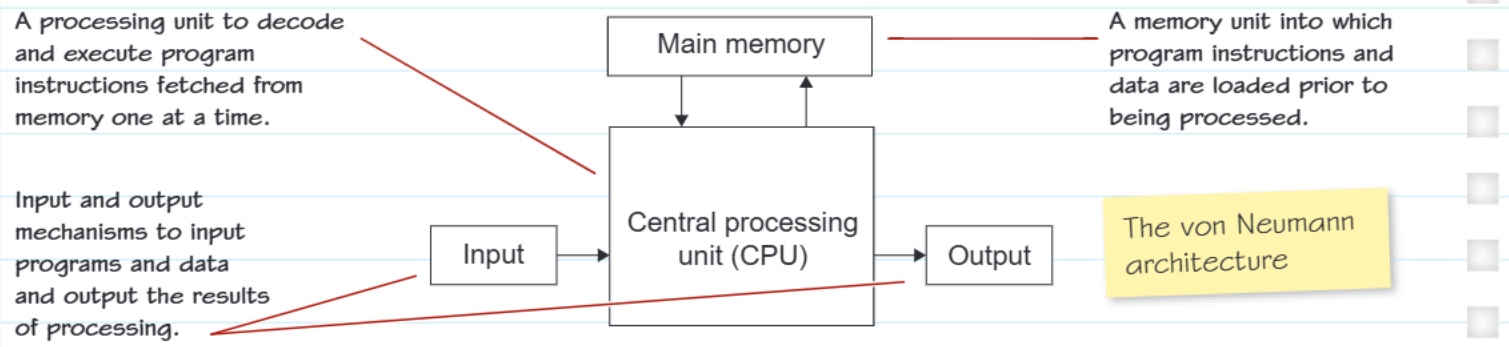
The von Neumann architecture consists of four main components that work together:
Central processing unit (CPU)
This is the "brain" of the computer. The CPU's job is to decode and execute the programme instructions that are stored in memory. It fetches instructions one at a time from memory, works out what each instruction means, and then carries out the required operation.
Main memory
This is where both programme instructions and data are stored while the computer is running. The CPU can quickly access anything stored in main memory. This shared storage space for both instructions and data is what makes the stored programme concept work.
Input mechanisms
These allow programmes and data to be fed into the computer system. Examples include keyboards, mice, touchscreens, microphones, and network connections.
Output mechanisms
These allow the computer to present the results of its processing to users or other systems. Examples include screens, speakers, printers, and network connections.
The beauty of this architecture is that data flows smoothly between all these components, allowing the computer to continuously fetch instructions, process data, and produce results.
Understanding main memory
Main memory plays a crucial role in the stored programme concept, so it's important to understand its key characteristics:
Short-term working memory
Main memory acts like the computer's short-term memory or workspace. It only holds the programme instructions and data that the CPU is currently using or will need very soon. Think of it like your desk when you're doing homework - you only keep out the books and papers you're working with right now.
Collection of storage locations
Main memory is organised as a collection of storage locations, with each location having its own unique address. Each location can store either a programme instruction or a piece of data. The CPU can quickly find and access any location using its address.
RAM (Random Access Memory)
Main memory is often called RAM, which stands for Random Access Memory. The "random access" part means that the CPU can jump directly to any storage location - it doesn't have to read through all the locations in order to find what it wants.
Note
The term "random access" can be confusing - it doesn't mean the access is random or unpredictable. Instead, it means the CPU can access any memory location directly, regardless of its position, making memory access very efficient.
Primary storage with fast access
Main memory is classified as primary storage because the CPU has fast, direct access to it. This speed is essential - if the CPU had to wait too long for instructions or data, the whole computer would run very slowly.
Volatile memory
Main memory is volatile, which means it needs continuous electrical power to keep its contents. When you switch off the computer, everything stored in main memory is completely wiped clean. This is why you need to save your work to permanent storage (like a hard drive) before shutting down.
Important
Remember to save your work regularly! Since RAM is volatile, any unsaved work will be lost if the power goes out or the computer crashes unexpectedly.
Modern memory capacities
Today's devices typically have between 4 and 32 GB of RAM. This large amount of memory allows modern computers to store several programmes in memory simultaneously, enabling you to switch quickly between different applications.
Why the stored programme concept was revolutionary
The stored programme concept enabled a major breakthrough in computing. Instead of building separate machines for different jobs, computers could now become general-purpose machines capable of performing many different tasks.
Here's why this was so important:
Flexibility: Computers could be easily reprogrammed to carry out completely different tasks just by loading new programme instructions into memory. A computer could calculate payroll in the morning and play music in the afternoon.
Efficiency: The same hardware could be used for multiple purposes, making computers much more cost-effective and practical for businesses and individuals.
Speed of development: Software developers could create new programmes much faster than engineers could build new hardware, leading to rapid innovation in computing applications.
Foundation for modern computing: This concept laid the groundwork for everything we use today - from smartphones and laptops to gaming consoles and smart home devices.
Note
The stored programme concept essentially created the software industry as we know it. Before this breakthrough, changing what a computer did required hardware modifications - afterward, it simply required writing new software.
How the CPU and main memory work together
The CPU and main memory work as a team to run programmes using a continuous cycle:
Example
The Fetch-Decode-Execute Cycle
Step 1: Fetch - The CPU requests the next instruction from main memory using the instruction's address
Step 2: Decode - The CPU examines the instruction and works out what operation it needs to perform
Step 3: Execute - The CPU carries out the instruction, which might involve processing data, storing results, or jumping to a different instruction
Step 4: Repeat - The CPU moves on to the next instruction and repeats the cycle
This fetch-decode-execute cycle happens millions of times per second, allowing computers to process programmes and data at incredible speeds.
Summary
Key Points to Remember:
-
The stored programme concept was developed by Alan Turing and John von Neumann in the 1940s to create easily reprogrammable computers
-
Von Neumann architecture includes four key components: CPU, main memory, input mechanisms, and output mechanisms working together
-
Main memory (RAM) is volatile, short-term storage that holds both programme instructions and data for fast CPU access
-
The concept revolutionised computing by enabling general-purpose machines that could perform many different tasks just by changing the stored programmes
-
Modern computers still use this same basic architecture today, proving how successful and enduring this concept has been