Deforestation in deciduous woodlands (Edexcel GCSE Geography A): Revision Notes
📚Revision Notes
Deforestation in deciduous woodlands
Deforestation refers to the permanent removal of trees and woodland areas, often to make way for alternative land uses. In the UK and other developed countries, deciduous woodlands face significant pressure from various economic and political factors that drive their clearance.
Main causes of deciduous woodland deforestation
Several interconnected factors contribute to the loss of deciduous woodlands, with economic considerations often taking priority over environmental protection.
Note
Understanding deforestation requires recognising that multiple factors work together - it's rarely a single cause but rather a combination of economic, social, and political pressures that lead to woodland clearance.
Urbanisation and population growth
As populations increase and urban areas expand, there is growing pressure to find suitable land for development. Deciduous woodlands, particularly those not protected by law, become targets for clearance to accommodate housing estates, shopping centres, and infrastructure projects. The demand for land in green belt areas has intensified as property prices rise, making woodland clearance economically attractive to developers.
Timber extraction and forest management
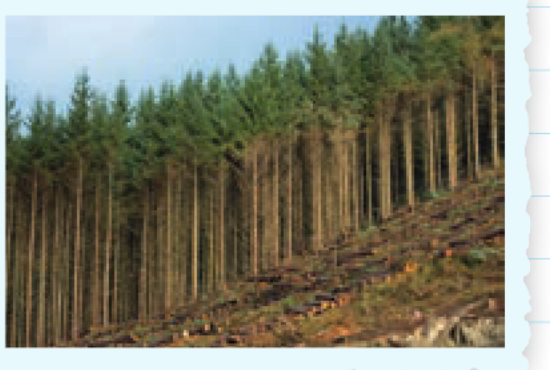
The timber industry plays a significant role in deciduous woodland loss. Many woodland areas are cleared and replaced with coniferous plantations because they offer greater economic benefits. Coniferous trees such as pine and spruce grow much faster than deciduous species, allowing for quicker harvesting cycles and more predictable returns on investment. This makes conifer plantations more economically viable for commercial forestry operations.
Important
Environmental Trade-offs of Conifer Plantations
While coniferous plantations are more economically viable, this shift from deciduous to coniferous forests comes with significant environmental costs. Conifer plantations create dense canopies that block sunlight from reaching the forest floor, reducing the variety of plant species that can survive underneath. These monoculture environments support fewer wildlife species compared to diverse deciduous woodlands, leading to a significant reduction in biodiversity.
Agricultural expansion
The need for additional farmland drives deforestation as agricultural demands increase. Most land suitable for farming commands higher prices than forested areas, and the rising global demand for food crops puts pressure on landowners to clear ancient woodlands for agricultural use. This conversion often results in the permanent loss of complex woodland ecosystems that took centuries to develop.
Important
Permanent Loss of Ancient Ecosystems
The conversion of ancient woodlands to agricultural land often results in irreversible damage. These complex woodland ecosystems took centuries to develop their intricate relationships between plants, animals, and soil systems - relationships that cannot be quickly restored once destroyed.
Housing development pressure
Increasing car ownership has created demand for better road networks and easier access to suburban areas. This transportation infrastructure requires land clearance and often fragments existing woodland areas. Additionally, the pressure to build new homes in areas with good transport links has led to woodland clearance in previously undeveloped regions.
Environmental impacts of woodland clearance
The replacement of deciduous woodlands with alternative land uses creates several environmental problems. When diverse woodland ecosystems are converted to single-species plantations or completely cleared, the resulting habitat loss affects numerous plant and animal species that depend on the complex relationships found in natural deciduous forests.
Note
Indirect Environmental Damage
Environmental impacts extend beyond direct clearance. Pesticide use in agricultural areas that border remaining woodlands can damage trees and wildlife through chemical runoff and spray drift. This indirect impact on woodland health can gradually weaken forest ecosystems even when they are not directly cleared.
Understanding exam questions about deforestation
When tackling exam questions about deforestation causes, it's important to identify what the question is specifically asking for. Questions typically require you to explain the underlying reasons why deciduous woodlands are being removed, focusing on the economic and social pressures that drive these decisions.
Example
Worked Example: Explaining Economic Drivers
Question: "Explain why coniferous forests might replace deciduous woodlands."
Strong Answer Approach:
- Focus on the economic advantages
- Explain that coniferous trees grow faster than deciduous species
- Mention they can be harvested sooner, providing quicker returns
- Highlight the more predictable financial returns for land managers and timber companies
- Connect this to the economic pressures facing woodland owners
A key point to remember is that much deciduous woodland lacks legal protection, making it vulnerable to clearance for development projects. This regulatory gap means that economic considerations often outweigh environmental concerns when decisions are made about land use.
Summary
Key Points to Remember:
- Economic factors drive most deforestation - urbanisation, timber extraction, agriculture, and housing development are the primary causes
- Conifer plantations offer economic advantages but reduce biodiversity compared to natural deciduous woodlands
- Legal protection gaps leave many deciduous woodlands vulnerable to clearance for development
- Multiple interconnected causes often work together, such as population growth creating demand for both housing and transport infrastructure
- Environmental costs include habitat loss, reduced biodiversity, and ecosystem disruption that can take generations to recover