Upper course landscape (Edexcel GCSE Geography A): Revision Notes
📚Revision Notes
Upper course landscape
Introduction to upper course characteristics
The upper course of a river is characterised by distinctive landforms created through erosion processes and influenced by the underlying geology. In this section of the river, the gradient is steep and the channel remains narrow, leading to predominantly vertical erosion as the river cuts downwards into the landscape.
Note
The upper course represents the initial stage of a river's journey from source to mouth, where the primary focus is on downward cutting rather than lateral erosion that becomes more prominent in middle and lower courses.
Key landforms in the upper course
Interlocking spurs
Interlocking spurs are one of the most recognisable features of the upper course landscape. These form because the river at its source is relatively small and has limited energy to erode through obstacles in its path. Instead, the water flows naturally around ridges in the valley sides, creating projections of land called spurs that appear to interlock when viewed from downstream.
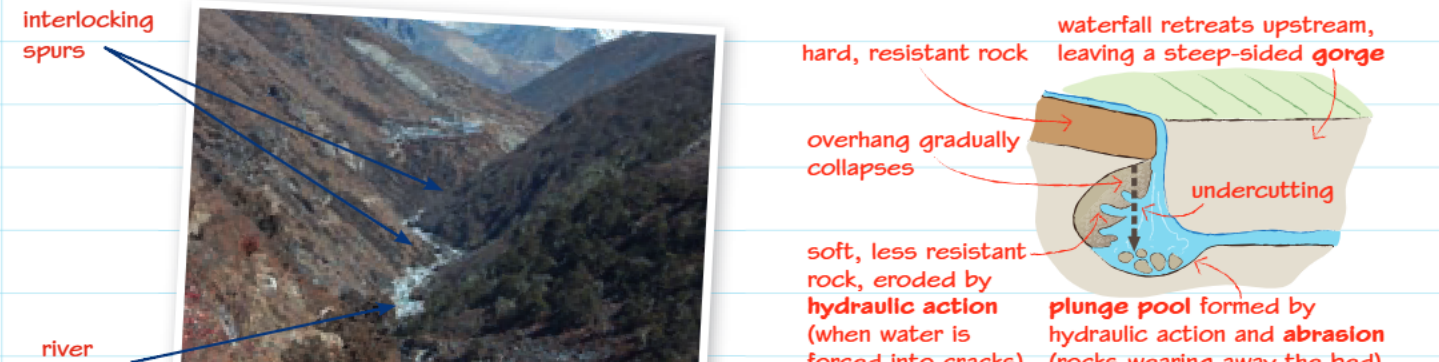
The photograph shows how these spurs create a winding valley pattern, with each spur from one side of the valley appearing to fit between spurs on the opposite side, much like interlocking fingers.
Note
The interlocking pattern is most visible when looking upstream or downstream along the valley, where the alternating spurs create a distinctive zigzag appearance that gives this landform its characteristic name.
Waterfalls
Waterfalls represent one of the most dramatic features found in upper course landscapes and form due to differences in rock resistance. They develop where a layer of hard, resistant rock (known as the cap rock) sits above softer, less resistant rock beneath.
Important
The key to waterfall formation is differential erosion - the process where softer rocks erode much faster than harder rocks, creating the distinctive stepped profile that allows waterfalls to develop.
The formation process involves several key stages:
The softer rock underneath becomes eroded more quickly than the hard rock above, particularly through hydraulic action when water is forced into cracks and joints. This differential erosion leads to undercutting, where the soft rock is gradually worn away, leaving the hard rock unsupported above.
Example
Waterfall Formation Process:
Step 1: Water flows over resistant cap rock onto softer rock below Step 2: Hydraulic action and abrasion erode the softer rock more rapidly Step 3: Undercutting occurs, creating an overhang of hard rock Step 4: The overhang becomes unstable and collapses under its own weight Step 5: Process repeats, causing the waterfall to retreat upstream
As the diagram illustrates, the intense force of falling water creates a plunge pool at the base through hydraulic action and abrasion, where rocks and sediment swirl around, wearing away the riverbed. Over time, the overhang of hard rock becomes unstable and eventually collapses under its own weight.
This process repeats continuously, causing the waterfall to gradually retreat upstream, leaving behind a steep-sided gorge in its wake.
Gorges
Gorges form as a direct result of waterfall retreat over extended periods. As the process of undercutting and collapse continues repeatedly, and the waterfall steadily moves upstream, it carves out a narrow, steep-sided valley behind it.
The Avon Gorge serves as an excellent example of this process, where centuries of waterfall retreat have created the dramatic landscape we see today.
Note
Gorge formation is a slow process that can take thousands of years. The rate of retreat depends on factors such as rock hardness, water volume, and climate conditions affecting erosion rates.
River cliffs
River cliffs develop on the outer bends of meanders in the upper course, though they become more prominent as rivers develop. These near-vertical features form when faster-flowing water on the outside of a bend creates greater erosive force, leading to lateral erosion that cuts into the riverbank.
The formation involves the creation of a concave bank where material is eroded away, while on the inner bend, slower-flowing water deposits sediment to form a convex bank. This process gradually steepens the outer bank until it becomes an almost vertical river cliff.
Key erosion processes
Several important erosion processes work together to shape upper course landscapes:
Hydraulic action occurs when fast-flowing water forces its way into cracks and joints in rocks, gradually widening them until pieces break away.
Abrasion happens when the river carries rocks and sediment that scrape against the riverbed and banks, wearing them away like sandpaper.
Undercutting specifically refers to the erosion of softer rock layers beneath harder ones, creating unstable overhangs that eventually collapse.
Important
These processes work most effectively in the upper course due to the steep gradient and turbulent flow conditions. The combination of all three processes working together creates the distinctive landforms characteristic of this river section.
Summary
Key Points to Remember:
- The upper course features steep gradients and narrow channels that promote vertical erosion
- Interlocking spurs form when rivers wind around obstacles rather than cutting through them
- Waterfalls develop where hard rock overlies soft rock, leading to differential erosion and undercutting
- Gorges are created by waterfall retreat over long periods of time
- Key processes include hydraulic action, abrasion, and undercutting working together to shape the landscape