Global atmospheric circulation (Edexcel GCSE Geography A): Revision Notes
📚Revision Notes
Global atmospheric circulation
What is global atmospheric circulation?
The Earth's atmosphere is constantly moving, transferring heat energy around our planet from areas where there is too much heat to areas where there is not enough. This process happens because our planet receives all of its heat energy from the Sun through solar radiation, but this energy is not distributed evenly across the Earth's surface.
The equatorial regions receive much more solar energy than the polar regions, creating what we call a heat surplus at the equator and a heat deficit at the poles. Global atmospheric circulation is nature's way of balancing this uneven distribution by moving warm air towards the poles and cold air towards the equator.
Note
The uneven heating of Earth's surface is the fundamental driving force behind all atmospheric circulation. Without this temperature difference between equatorial and polar regions, there would be no wind patterns or weather systems as we know them.
How circulation cells work
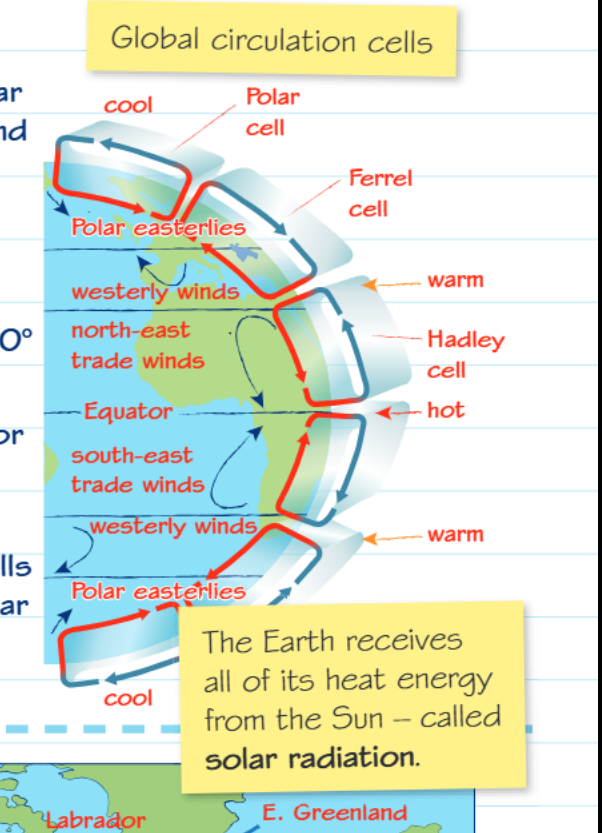
The redistribution of heat energy happens through three large-scale air movement patterns called circulation cells. Each hemisphere contains three of these cells working together like giant conveyor belts in the sky.
Important
Key Concept: Rising warm air creates low pressure areas while sinking cold air creates high pressure areas. This fundamental principle drives all circulation cell movement.
The Hadley cell
The Hadley cell operates closest to the equator and is the most powerful of the three circulation cells. Here's how it works:
At the equator, intense solar heating warms the air, causing it to rise rapidly up to about 15 kilometres into the atmosphere. As this warm air rises, it creates an area of low pressure at the Earth's surface. When the rising air reaches high altitude, it begins to cool and spreads outwards towards the north and south.
Example
How the Hadley Cell Works - Step by Step:
- Heating: Intense solar radiation heats air at the equator
- Rising: Warm air rises to ~15 km altitude, creating low pressure at surface
- Spreading: Air cools and spreads north and south at high altitude
- Sinking: Cooled air descends at 30° N and S, creating high pressure
- Return flow: Surface air flows back towards equator as trade winds
This cooled air eventually sinks back down to Earth at approximately 30° north and south of the equator, creating areas of high pressure. Some of this descending air flows back towards the equator along the Earth's surface, forming the trade winds that sailors have used for centuries.
The Ferrel cell
The Ferrel cell sits in the middle latitudes between the Hadley and Polar cells. This cell works somewhat differently because it's influenced by the other two cells on either side of it.
Some of the air that sank at 30° latitude moves away from the equator towards the poles, forming the lower part of the Ferrel cell. This air eventually meets much colder polar air at around 60° north and south, where the warmer air is forced to rise again, creating another area of low pressure.
The Polar cell
The Polar cell operates in the coldest regions near the North and South Poles. At 60° latitude, where warm air from the Ferrel cell meets cold polar air, the warmer air rises and travels towards the poles at high altitude. This air cools dramatically as it approaches the poles and sinks, creating high pressure areas. The cold, dense air then flows back towards 60° latitude along the surface, completing the polar cell circulation.
Wind patterns
These circulation cells create the major wind patterns we experience around the world:
- Trade winds: Flow from the high pressure areas at 30° towards the low pressure at the equator
- Westerly winds: Created by the Ferrel cell between 30° and 60° latitude
- Polar easterlies: Cold winds flowing from the polar high pressure areas towards 60° latitude
Note
Each circulation cell produces its own characteristic wind pattern. These global wind systems have been crucial for human navigation and trade throughout history, which is why winds between 30°N/S and the equator are called "trade winds."
Ocean currents and heat transfer
The atmosphere isn't the only system transferring heat around our planet. Ocean currents also play a crucial role in moving heat energy from areas of surplus to areas of deficit.
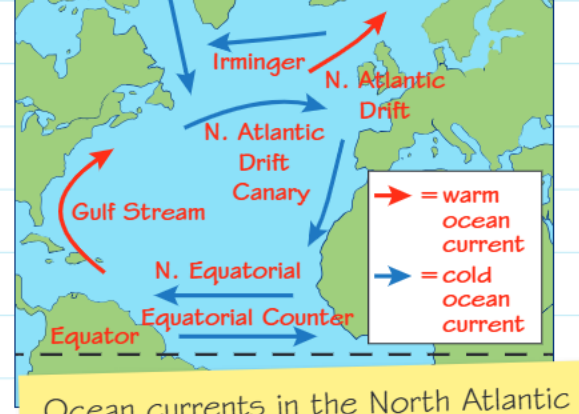
Ocean currents work through differences in water temperature and density. In polar regions like the Arctic and Antarctic, water becomes extremely cold and dense, causing it to sink below the surface. This creates space for warmer water from equatorial regions to flow in and replace it.
Meanwhile, the warm surface currents carry heat energy from the tropics towards the poles. A perfect example is the Gulf Stream, which transports warm water from the Caribbean across the Atlantic Ocean towards Western Europe, significantly warming the climate of countries like the United Kingdom.
Example
The Gulf Stream: A Heat Transfer Highway
The Gulf Stream demonstrates ocean heat transfer perfectly:
- Origin: Warm Caribbean water (25-28°C)
- Path: Flows northeast across Atlantic Ocean
- Effect: Raises UK temperatures by 5-10°C above expected latitude temperatures
- Scale: Transports 30 times more water than all world's rivers combined
Cold currents also form as dense, cold water flows back towards the equator at deeper levels, such as the Humboldt Current along the western coast of South America.
The connection between air and ocean circulation
Atmospheric and oceanic circulation work together as one interconnected system. Wind patterns created by the circulation cells help drive surface ocean currents, while the ocean currents influence local weather patterns and help moderate global temperatures.
Note
Interconnected Systems: The atmosphere and oceans don't work independently. Winds drive surface currents, while ocean temperatures influence air temperatures above them. This creates a complex feedback system that regulates Earth's climate.
This partnership ensures that heat energy continues to be redistributed efficiently around our planet, preventing the equatorial regions from becoming impossibly hot and the polar regions from becoming even colder than they already are.
Summary
Key Points to Remember:
- The Earth receives uneven heating from solar radiation, with surplus heat at the equator and deficit at the poles
- Three circulation cells in each hemisphere (Hadley, Ferrel, and Polar) redistribute heat through organised air movement patterns
- Rising warm air creates low pressure areas while sinking cold air creates high pressure areas
- Ocean currents complement atmospheric circulation by moving warm water towards poles and cold water towards the equator
- This global system prevents extreme temperature differences and helps maintain Earth's climate balance