The rival claimants for the throne (Edexcel GCSE History): Revision Notes
📚Revision Notes
The rival claimants for the throne
The succession crisis of 1066
When Edward the Confessor died on 5 January 1066, England faced a major succession crisis. Edward had died without producing an heir, leaving the throne contested by four different claimants. This situation created instability and ultimately led to foreign invasion. Harold Godwinson was crowned king on 6 January 1066, the same day as Edward's funeral, but this rapid coronation did not end the dispute.
Note
The speed of Harold's coronation - occurring on the same day as Edward's funeral - was unprecedented and demonstrated both the urgency of the situation and Harold's political awareness of the need to act quickly.
Harold Godwinson (c1022-66)
Harold Godwinson had perhaps the strongest immediate position among all the claimants. His claim rested on Edward the Confessor allegedly naming him as successor on his deathbed. This gave Harold a crucial advantage in terms of timing and local support.
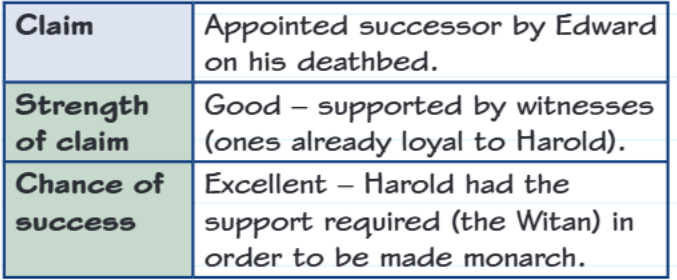
Harold's position was strengthened by several key factors. He had served as Edward's most trusted deputy and had proven himself as an effective military commander. His willingness to fight against external threats, including campaigns against the Welsh, had demonstrated his capability as a leader. Additionally, Harold had strong family connections through his relationship with Edward - he was the brother-in-law of the king.
Most importantly, Harold secured the backing of the Witan, the Anglo-Saxon royal council, which gave his claim significant political legitimacy. The support of witnesses who were already loyal to Harold made his succession appear natural and justified to the English nobility.
Note
Harold's Key Advantages:
- Served as Edward's most trusted deputy
- Proven military commander with experience against Welsh threats
- Strong family connections as Edward's brother-in-law
- Secured backing of the Witan (Anglo-Saxon royal council)
- Had witnesses loyal to him already in position
Edgar the Aethling (c1051-c1126)
Edgar the Aethling possessed the strongest claim by blood, being a direct descendant of Alfred the Great. This royal lineage gave him a theoretically powerful position in the succession dispute.
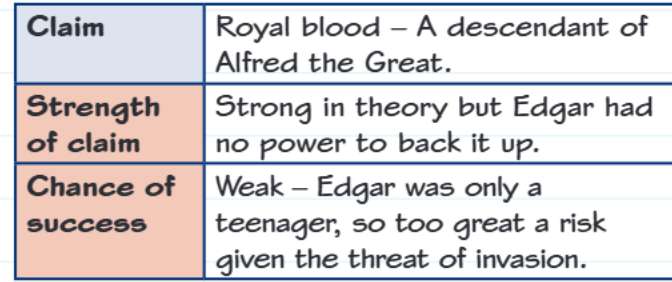
However, Edgar's youth proved to be a fatal weakness. Although Edward the Confessor had considered making Edgar his heir during the 1050s, he ultimately abandoned this plan. The Witan recognised that England faced immediate threats of invasion, and a teenage ruler would be too great a risk during such a critical period.
Edgar's lack of political power and military support made his claim impractical despite its legal strength. The kingdom needed an experienced leader who could defend England against foreign invasion, not a young man who would require guidance and protection.
Important
Despite having the best hereditary claim, Edgar's youth proved to be a fatal weakness. England faced immediate invasion threats and needed an experienced leader who could defend the kingdom immediately - not a teenager requiring guidance and protection.
Harald Hardrada (c1015-66)
Harald Hardrada's claim was based on a supposed secret agreement between Viking rulers, but this formed a weak legal foundation for his bid for the English throne. His claim relied on complex arrangements made between previous Viking leaders rather than any direct relationship with Edward the Confessor.
Despite the weakness of his legal claim, Hardrada possessed formidable military strength. He commanded 300 ships and 15,000 experienced warriors, representing one of the most powerful fighting forces in mediaeval Europe. His extensive battle experience and the expectation that Danelaw regions might welcome his rule gave him genuine prospects of success through conquest.
Hardrada could also point to his descent from Cnut, who had ruled England from 1016-35, though he probably did not seriously consider this connection when planning his invasion. The Viking commander believed that military might could overcome any deficiencies in his legal claim to the throne.
Note
Hardrada's military force was massive by mediaeval standards - 300 ships and 15,000 warriors represented one of the largest invasion fleets assembled in mediaeval Europe. His strategy was simple: use overwhelming military might to overcome his weak legal claim.
William of Normandy (c1028-87)
William based his claim on an alleged agreement with Edward the Confessor following Harold's embassy to Normandy. According to William, Edward had promised him the throne in return for Norman assistance against rebellious earls. William also claimed to be Edward's cousin, adding a family connection to his case.
William's claim received backing from the Pope, which provided important moral authority for his cause. This papal support was connected to plans for reforming England's Church, making William's invasion appear as a religious mission rather than simple conquest.
However, William faced the significant challenge of crossing the English Channel with his army. His military strength was considerable, but his chances of success depended entirely on his ability to transport his forces to England and defeat Harold's established position. The logistical difficulties of amphibious invasion made William's bid highly risky despite his strong preparation and papal endorsement.
Important
William faced the significant challenge of crossing the English Channel with his army. Unlike the other claimants who were already in or near England, William had to transport his entire force across dangerous waters while Harold held defensive positions.
Harold's coronation and early reign
Harold Godwinson was crowned as Harold II on 6 January 1066, with most members of the Witan already gathered at Westminster for Edward's funeral. This timing made it easier for Harold to secure the support he needed for his coronation.
After becoming king, Harold immediately began preparing for the challenges he knew would come. He travelled north to York to ensure he had support from northern England, understanding that regional backing would be crucial for defending his throne. Harold then assembled what became the largest army England had ever seen in the south, demonstrating his awareness of the invasion threats he faced.
Harold also maintained naval patrols in the English Channel, showing his strategic understanding of the military challenges posed by William's potential invasion from Normandy.
Timeline of key events
- 5 January 1066: Edward the Confessor dies, allegedly naming Harold Godwinson as his successor
- 6 January 1066: Harold Godwinson crowned as Harold II on the same day as Edward's funeral
- Early 1066: Harold travels to York to secure northern support and begins military preparations
- 1066: Harold assembles large army and maintains Channel patrols against invasion threats
Summary
Key Points to Remember:
-
Four claimants competed for the English throne in 1066: Harold Godwinson, Edgar the Aethling, Harald Hardrada, and William of Normandy, each with different types of claims and varying strengths.
-
Harold Godwinson had the strongest immediate position due to his deathbed appointment by Edward, support from the Witan, and established role as Edward's deputy and military leader.
-
Edgar the Aethling possessed the best hereditary claim as a descendant of Alfred the Great, but his youth and lack of political power made him impractical during a crisis requiring immediate strong leadership.
-
Military strength vs legal claims created different paths to power: Harald Hardrada relied on Viking military might while William combined legal arguments with papal backing and Norman military organisation.
-
Harold's rapid coronation and immediate preparations showed his understanding that becoming king was only the first step - he would need to defend his throne against multiple invasion threats throughout 1066.