A disrupted society, 1742–64 (Edexcel GCSE History): Revision Notes
📚Revision Notes
Pontiac's rebellion
Background and causes
After the French and Indian War ended in 1763, relations between British colonists and Indigenous peoples dramatically changed. The colonists no longer felt they needed to maintain good relationships with Indigenous tribes, as the French threat had been removed. This shift in attitude had serious consequences for Indigenous communities across the frontier regions.
The British stopped providing the gifts that had been traditional in diplomatic relations with Indigenous peoples. They also limited trade opportunities, which had been crucial for many tribes' economic survival. Additionally, more British settlers began moving into the Ohio Country, putting pressure on Indigenous lands and resources.
Note
The end of the French and Indian War marked a turning point in colonial-Indigenous relations. Without the need to compete with France for Indigenous alliances, British attitudes towards Indigenous peoples became increasingly dismissive and exploitative.
These changes created widespread resentment among Indigenous tribes, who had previously maintained relatively stable relationships with European colonists. The situation became particularly tense as Indigenous peoples realised that British colonial expansion threatened their way of life and territorial control.
The rebellion begins
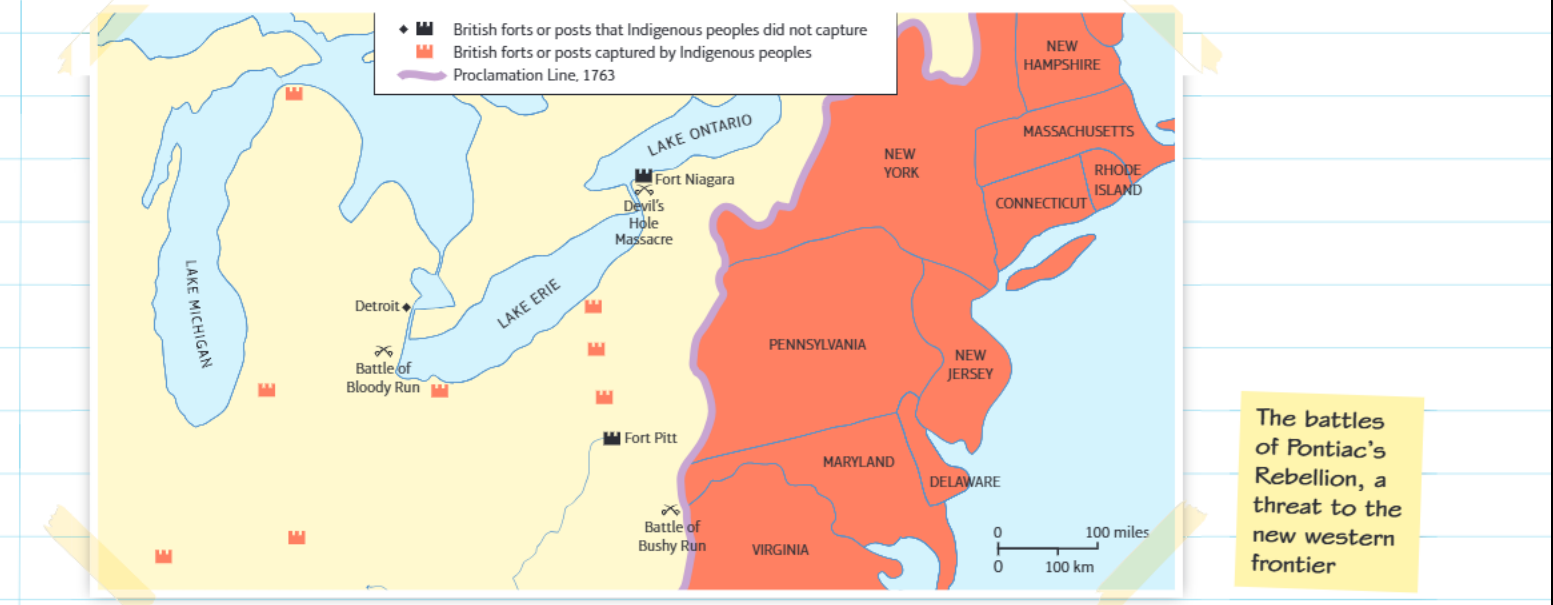
Pontiac's Rebellion erupted in 1763 and lasted until 1766. The conflict was led by Pontiac, an Ottawa war chief who managed to create an alliance between most northern Indigenous tribes. This represented one of the most significant coordinated Indigenous resistance movements in colonial American history.
The rebellion began on 7 May 1763 with attacks on British forts and trading posts throughout the Ohio Country. The Indigenous alliance proved remarkably effective, capturing most British fortifications in the region. Only a few key forts, including Fort Niagara, Fort Pitt, and Detroit, managed to resist the coordinated attacks.
Note
The success of Pontiac's alliance was unprecedented in its scope and coordination. The ability to unite multiple tribes across vast geographical distances demonstrated sophisticated diplomatic and military planning that caught the British completely off guard.
The geographic scope of the rebellion was enormous, stretching across the Great Lakes region and affecting British colonial territories from Pennsylvania to the western frontier. This wide-reaching conflict demonstrated the effectiveness of Indigenous military organisation and their detailed knowledge of the terrain.
Timeline of major events
27 April 1763: Indigenous war chief Pontiac helped establish the alliance between most northern Indigenous tribes, setting the stage for coordinated resistance.
7 May 1763: The rebellion officially began with attacks on British forts and trading posts in the Ohio Country. These attacks continued for over three years, showing the sustained nature of Indigenous resistance.
31 July 1763: The Battle of Bloody Run occurred near Detroit, resulting in the first mass killing of British soldiers by Indigenous peoples during the conflict. Twenty-one British soldiers died in this engagement.
5 August 1763: The Battle of Bushy Run took place, where British forces managed to recapture Fort Pitt after a successful battle and siege operation against Indigenous forces.
14 September 1763: The Devil's Hole Massacre demonstrated the continued intensity of the conflict, with 73 British troops killed in an Indigenous attack.
October 1763: The British government issued the Royal Proclamation, which limited settlement west of the Appalachian Mountains in an attempt to appease Indigenous tribes and reduce frontier tensions.
7 September 1764: Several Indigenous chiefs signed a peace treaty with the British after invasions of the Ohio Country from Pennsylvania, though attacks by Indigenous tribes continued at a reduced level.
July 1766: Pontiac finally signed a comprehensive peace treaty, officially ending the rebellion.
British strategies and responses
The British employed several military strategies during Pontiac's Rebellion, including laying siege to forts and fighting open battles. However, they also executed Indigenous prisoners, which was considered a controversial tactic even by the standards of the time.
Important
Biological Warfare at Fort Pitt
The most controversial British strategy involved the use of biological warfare. During negotiations over Fort Pitt in June 1763, the British gave blankets infected with smallpox to Indigenous tribes as a supposed "gift." This deliberate attempt to spread disease was repeated throughout the conflict, and many tribe members died as a result.
Some historians view this use of smallpox as an early instance of biological weapons designed to spread disease deliberately. The extent of racism towards Indigenous peoples is evident in some historical accounts, with certain historians believing this act demonstrates an intention to completely destroy Indigenous populations.
The British also responded politically to the rebellion by issuing the Proclamation Line of 1763, which was intended to prevent further westward expansion by colonists and reduce tensions with Indigenous peoples.
Significance and impact
Pontiac's Rebellion represented a major threat to the new western frontier established after the French and Indian War. The conflict demonstrated that Indigenous peoples could mount effective, coordinated resistance against British colonial expansion when they worked together across tribal boundaries.
The rebellion forced the British government to reconsider its policies towards Indigenous peoples and frontier settlement. The Royal Proclamation of 1763 was a direct response to the conflict, establishing a boundary line that attempted to separate colonial settlements from Indigenous territories.
Note
The Royal Proclamation of 1763 was one of the first major pieces of legislation attempting to regulate the relationship between European colonists and Indigenous peoples. While it aimed to reduce conflict, it also established precedents for government control over Indigenous affairs that would have lasting consequences.
The use of biological warfare during this conflict marked a dark chapter in colonial-Indigenous relations. The deliberate spreading of smallpox represented an escalation in the methods used against Indigenous populations and contributed to devastating population losses among affected tribes.
The rebellion also highlighted the ongoing tensions between colonial expansion and Indigenous rights that would continue to shape North American history for decades to come.
Summary
Key Points to Remember:
-
Pontiac's Rebellion (1763-1766) was a coordinated Indigenous resistance movement led by Ottawa chief Pontiac against British colonial expansion after the French and Indian War
-
The rebellion succeeded in capturing most British forts in the Ohio Country and Great Lakes region, demonstrating effective Indigenous military organisation and alliance-building
-
The British used controversial biological warfare, deliberately giving smallpox-infected blankets to Indigenous tribes during negotiations, representing an early form of biological weapons
-
The Royal Proclamation of 1763 was issued as a direct response to the rebellion, limiting colonial settlement west of the Appalachian Mountains to reduce tensions
-
The conflict lasted three years and forced the British to reconsider their policies towards Indigenous peoples and frontier expansion, showing the significant impact of coordinated Indigenous resistance