French and Indian War, 1754–63 (Edexcel GCSE History): Revision Notes
📚Revision Notes
French and Indian War, 1754–63
Introduction to the conflict
The French and Indian War (1754–63) began when Britain attempted to prevent French expansion into the Ohio Country. This conflict quickly escalated and by 1756 became part of the much larger Seven Years' War, involving all major European powers. The war fundamentally changed the balance of power in North America and had lasting consequences for British-colonial relations.
Note
The Seven Years' War was a global conflict that involved major European powers fighting on multiple continents. What Americans call the French and Indian War was actually the North American theatre of this much larger worldwide conflict.

Timeline of major events
July 1754: The war opened poorly for Britain when Lieutenant Colonel George Washington suffered defeat at Fort Necessity, experiencing heavy casualties that demonstrated the challenges ahead.
July 1755: Disaster struck again when General Braddock was killed during the failed assault on Fort Duquesne. This defeat led to the loss of support from most remaining Indigenous peoples who had been loyal to Britain.
1755–57: Indigenous tribes launched devastating attacks along the British American frontiers, killing many settlers and creating widespread fear in colonial communities.
August 1756 and August 1757: British fortunes continued to decline with the loss of Fort Oswego and Fort William Henry, showing French strength in the region.
Important
The Turning Point: William Pitt's Leadership
A crucial turning point came when William Pitt was appointed Secretary of State in 1757, taking charge of the war effort. His leadership brought significant changes that transformed British military fortunes.
1757: Pitt's revolutionary approach included:
- Dispatched 8,000 troops and 12 warships to the colonies
- Invested approximately £1 million to support the colonists
- Replaced ineffective commanders like Lord Loudoun with experienced generals who reported directly to Pitt
- Worked to improve relations between British officers and colonial troops
End of 1758: Pitt's strategies began showing results as British forces gained control of the Ohio Country, primarily by cutting off French supply lines after capturing Fort Louisbourg (July 1758), Fort Frontenac (August 1758), and Fort Duquesne (November 1758). Many Indigenous allies abandoned the French cause.
June–September 1759: General James Wolfe launched his famous assault on Quebec, allowing other British generals to capture three additional important forts. After intense fighting in September, Quebec fell to British forces.
September 1760: The war effectively ended when British forces captured Montreal, the last major French settlement. The French formally surrendered on September 7th.
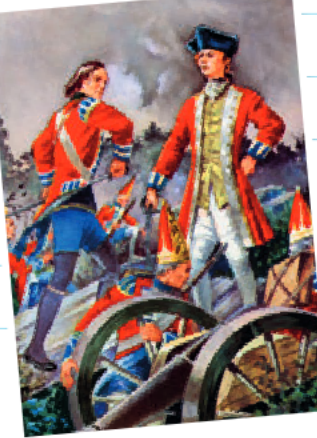
Wolfe's successful strategy at Quebec
General Wolfe's capture of Quebec was the decisive moment that secured British control of Canada. His tactical approach demonstrated masterful military strategy through coordinated operations.
Example
Worked Example: Wolfe's Four-Part Strategy at Quebec
Step 1: Artillery Bombardment Wolfe ordered continuous cannon bombardment of the city for several months. This constant artillery fire wore down both the defenders and civilian population, with many residents wanting to surrender to end the devastating attacks.
Step 2: Scorched Earth Policy He implemented a scorched earth policy around Quebec, burning farmland to prevent access to food and essential supplies within the city walls.
Step 3: Deceptive Landing Wolfe employed deception by landing his forces upstream from Quebec on difficult, steep terrain. The French had not expected this approach and quickly found themselves outmanoeuvred, being drawn into open battle where British advantages became clear.
Step 4: Military Discipline He ensured his army maintained high standards of training and discipline. When the decisive battle finally occurred, French forces were rapidly defeated due to superior British military preparation.
These combined tactics led to complete British control of Canada, as most French military forces became trapped defending Quebec rather than other strategic locations.
Consequences of British victory
The French and Indian War produced several significant long-term effects that shaped the future of British America:
Colonial unity and military experience: Colonists from different regions and immigrant communities fought alongside each other for the first time, creating bonds that helped unify the diverse colonial population. Many colonists also gained valuable military training and combat experience that would prove important in future conflicts.
Increased tensions with Britain: The war heightened existing tensions between colonial and British soldiers, as cultural differences and competing interests became more apparent during extended military cooperation.
Massive financial burden: The enormous cost of the war significantly increased British national debt and taxation. Although the colonists were not immediately affected by these increased taxes, this financial pressure would soon lead to new colonial tax policies.
British control of North America: Britain gained control of the Ohio Country and its valuable fur trade, while the British Empire now dominated most of North America and expanded its global influence considerably.
Important
Foundation for Future Conflict
The military experience gained by colonists, combined with growing tensions with British authorities and the upcoming tax disputes, created conditions that would contribute to future revolutionary sentiment. This war, ironically, helped prepare the colonists for their eventual fight against British rule.
Summary
Key Points to Remember:
- The French and Indian War lasted from 1754 to 1763 and became part of the worldwide Seven Years' War
- William Pitt's leadership from 1757 transformed British military fortunes through better funding, troops, and commanders
- General Wolfe's four-part strategy at Quebec (bombardment, burning farmland, surprise landing, disciplined army) secured decisive British victory
- The war united colonists from different regions and gave them valuable military experience
- British control of North America was established, but the war's costs would soon lead to new colonial taxation policies