Opposition to the Sugar Act, 1764 (Edexcel GCSE History): Revision Notes
📚Revision Notes
Opposition to the Sugar Act, 1764
Background and context
In 1764, the British government faced a major financial crisis following years of expensive warfare. To address mounting debts and fund the defence of their expanded American territories, Parliament passed the American Revenue Act on 5 April 1764, commonly known as the Sugar Act. This legislation marked a significant shift in British colonial policy, effectively ending the period of "salutary neglect" where Britain had largely allowed the colonies to govern their own trade affairs.
Note
The end of salutary neglect represented a fundamental change in British-American relations. For decades, Britain had allowed the colonies considerable autonomy in managing their own affairs, but the financial pressures of war forced Parliament to take a more active role in colonial governance and taxation.
The Act represented Britain's first serious attempt to raise substantial revenue directly from the American colonies through reformed taxation and stricter trade enforcement.
Terms and provisions of the Sugar Act
The Sugar Act introduced several key changes to colonial trade regulations, each designed to increase British revenue while maintaining control over colonial commerce.
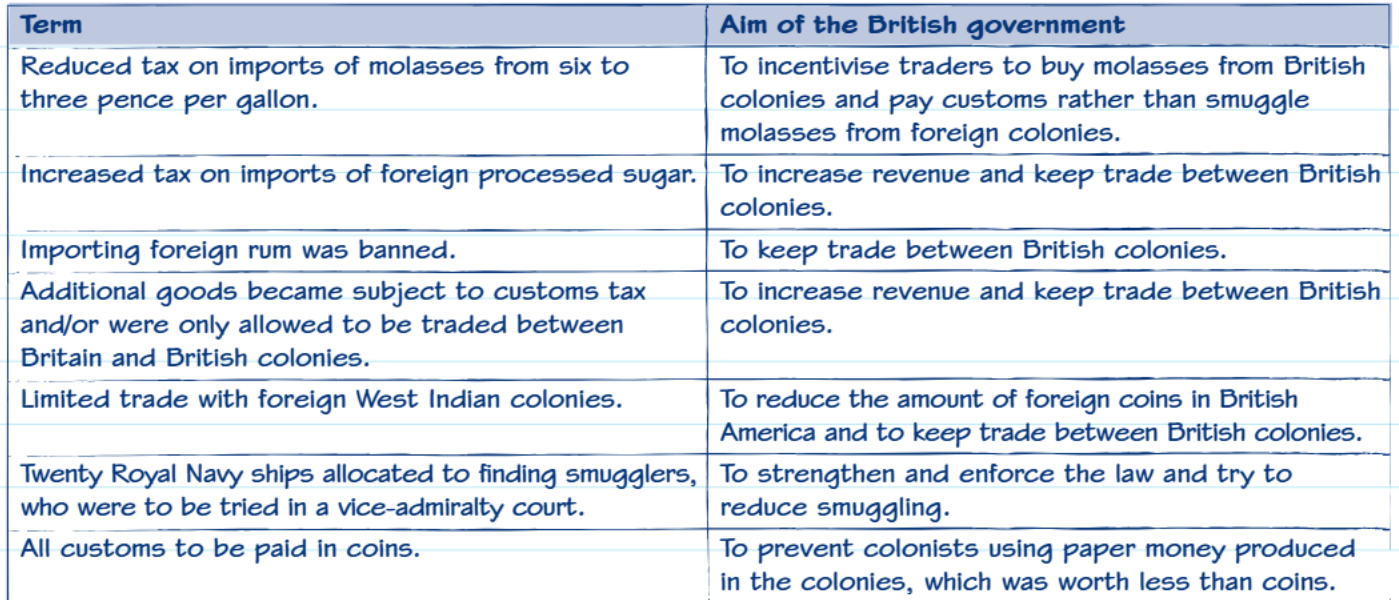
The most significant change was the reduction of the molasses tax from six pence to three pence per gallon. While this appeared to be a tax cut, the British government's real aim was to encourage merchants to purchase molasses from British colonies rather than smuggle cheaper foreign alternatives. The lower rate was set to make legal trade more attractive than illegal smuggling.
Additional provisions included higher taxes on foreign processed sugar, a complete ban on importing foreign rum, and the extension of customs duties to various other goods. The Act also severely limited trade with foreign West Indian colonies, forcing colonists to conduct more business within the British imperial system.
Important
Controversial Enforcement Measures
The Act introduced strict enforcement that colonists found particularly objectionable:
- Twenty Royal Navy ships were assigned to patrol American waters
- Smugglers faced trial in vice-admiralty courts rather than local colonial courts
- All customs payments had to be made in coins rather than colonial paper money
- Judges received 5% of confiscated smuggled goods, creating financial incentives for convictions
Colonial responses and opposition
The Sugar Act generated significant anger among American colonists for several reasons. Most importantly, it ended the previous period of limited British interference in colonial affairs, which colonists had grown accustomed to during decades of salutary neglect.
Colonists raised specific objections to the Act's provisions:
Important
Key Colonial Objections
-
Unfair trial system: Judges in vice-admiralty courts received five percent of the value of any confiscated smuggled goods, creating a financial incentive to find defendants guilty. This made fair trials highly unlikely.
-
Payment difficulties: The requirement to pay all customs duties in coins rather than colonial paper money created serious hardships for merchants and businesses, especially during a period of economic recession.
-
Loss of local control: The transfer of smuggling cases from local colonial courts to vice-admiralty courts removed colonists' right to trial by local juries.
Opposition took various forms, including organised resistance movements and influential political writings. In Massachusetts, politician James Otis wrote a powerful pamphlet titled "The Rights of the British Colonies Asserted and Proved," which gained widespread readership and helped articulate colonial objections to British taxation policies.
Impact and consequences of the Sugar Act
The Sugar Act had far-reaching effects on British-American relations and colonial society, though many of its intended goals were not achieved.
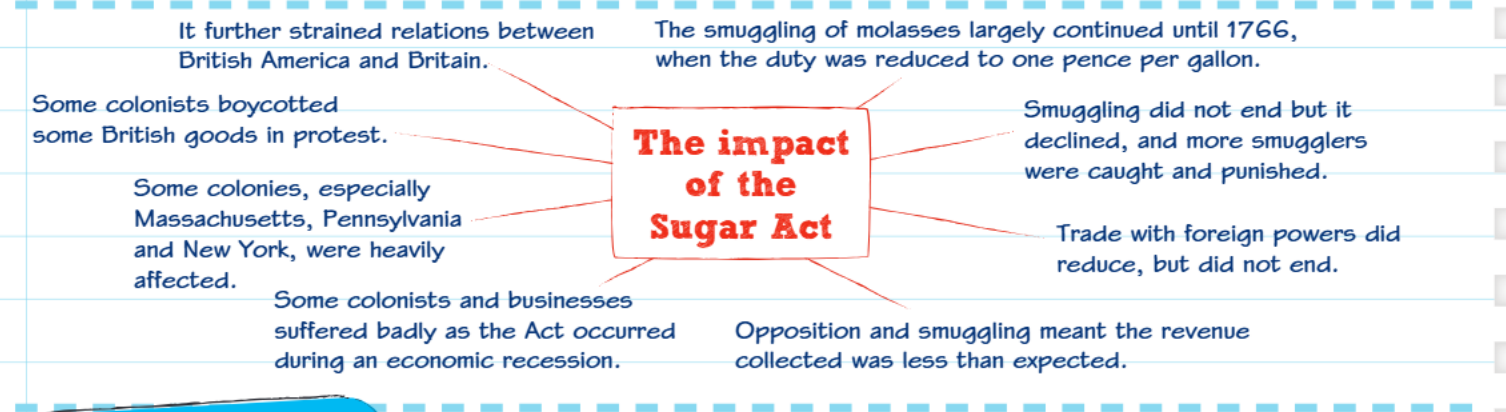
The Act significantly strained relationships between Britain and its American colonies, contributing to growing colonial resentment towards British rule. Some colonists organised boycotts of British goods in protest, while certain colonies, particularly Massachusetts, Pennsylvania, and New York, experienced severe economic difficulties.
Note
The timing of the Sugar Act proved particularly problematic. Implementing new taxes and trade restrictions during an economic recession when colonial businesses were already struggling intensified colonial opposition and made compliance even more difficult.
Despite British efforts to increase enforcement, smuggling continued to be a major problem. The illegal molasses trade largely persisted until 1766, when the government was forced to reduce the duty further to just one pence per gallon. Even then, smuggling did not end entirely, though enforcement efforts did result in more smugglers being caught and punished.
The Act failed to generate the revenue Britain had hoped for, collecting less money than expected due to continued opposition and smuggling. Trade with foreign powers was reduced but not eliminated, meaning British control over colonial commerce remained incomplete.
Timeline of key events
- 5 April 1764: Sugar Act (American Revenue Act) passed by British Parliament
- 1764-1766: Period of colonial opposition, boycotts, and continued smuggling
- 1766: Molasses duty reduced from three pence to one pence per gallon due to continued resistance
Example
Worked Example: Understanding the Molasses Tax Changes
The molasses tax underwent several changes:
- Original rate (pre-1764): 6 pence per gallon
- Sugar Act rate (1764): 3 pence per gallon (50% reduction)
- Final rate (1766): 1 pence per gallon (further reduced due to resistance)
This shows how colonial opposition forced Britain to continually lower the tax rate to maintain some revenue rather than none at all.
Summary
Key Points to Remember:
- The Sugar Act of 1764 marked the end of salutary neglect and Britain's first major attempt to raise revenue directly from American colonies
- The Act reduced molasses tax from six to three pence per gallon but introduced stricter enforcement through Royal Navy patrols and vice-admiralty courts
- Colonists opposed the Act due to unfair trial systems, payment difficulties, and loss of local judicial control
- James Otis's pamphlet "The Rights of the British Colonies Asserted and Proved" became an influential piece of opposition literature
- The Act failed to achieve its revenue goals due to continued smuggling and colonial resistance, ultimately straining British-American relations and contributing to growing colonial resentment