Religious revivals (Edexcel GCSE History): Revision Notes
📚Revision Notes
Religious revivals in British America (1742-64)
Introduction to religious revivals
Before 1720, most colonists in British America were Protestant Christians who followed traditional forms of worship. However, during the 1730s to 1750s, communities in the Middle Colonies and New England experienced significant religious changes through a series of spiritual awakenings known as religious revivals.
Note
These religious revivals represented one of the first major social movements to sweep across multiple American colonies simultaneously, helping to create a shared colonial American identity that transcended regional boundaries.
The Great Awakening (c.1730-50)
The Great Awakening represented a major religious revitalist movement that swept through British America during the first half of the 18th century. This spiritual movement introduced a completely different approach to Protestant Christianity, moving away from formal, structured worship towards more emotional and personal religious experiences.
This new form of Protestantism focused heavily on evangelical services, where passionate preachers worked to inspire people to either convert to Christianity or strengthen their existing faith. The movement attracted enormous crowds and fundamentally changed how many colonists experienced their religion.
Important
The Great Awakening marked a revolutionary shift in American religious life, challenging traditional church authority and introducing the idea that ordinary people could have direct, personal relationships with God without formal religious intermediaries.
Key figures of the Great Awakening
Jonathan Edwards emerged as one of the most influential revivalist preachers in Massachusetts. He played a crucial role in developing and spreading the Great Awakening throughout New England during the 1730s and 1740s. Edwards became famous for writing books and delivering powerful sermons that captured the spirit of this religious movement.
George Whitefield, an English revivalist preacher, made an extraordinary impact by touring British America between 1739-41 and again in 1744-48. His preaching drew massive crowds, with gatherings often exceeding 20,000 people. Whitefield's sermons were so popular that thousands of copies were published and distributed in 1739-45, spreading his influence far beyond those who heard him speak in person.
Note
Whitefield was one of the first "celebrity" preachers in American history, using innovative marketing techniques and widespread publicity to build his reputation. His ability to draw enormous crowds demonstrated the power of mass communication in the colonial period.
Differences between traditional and evangelical Protestant churches
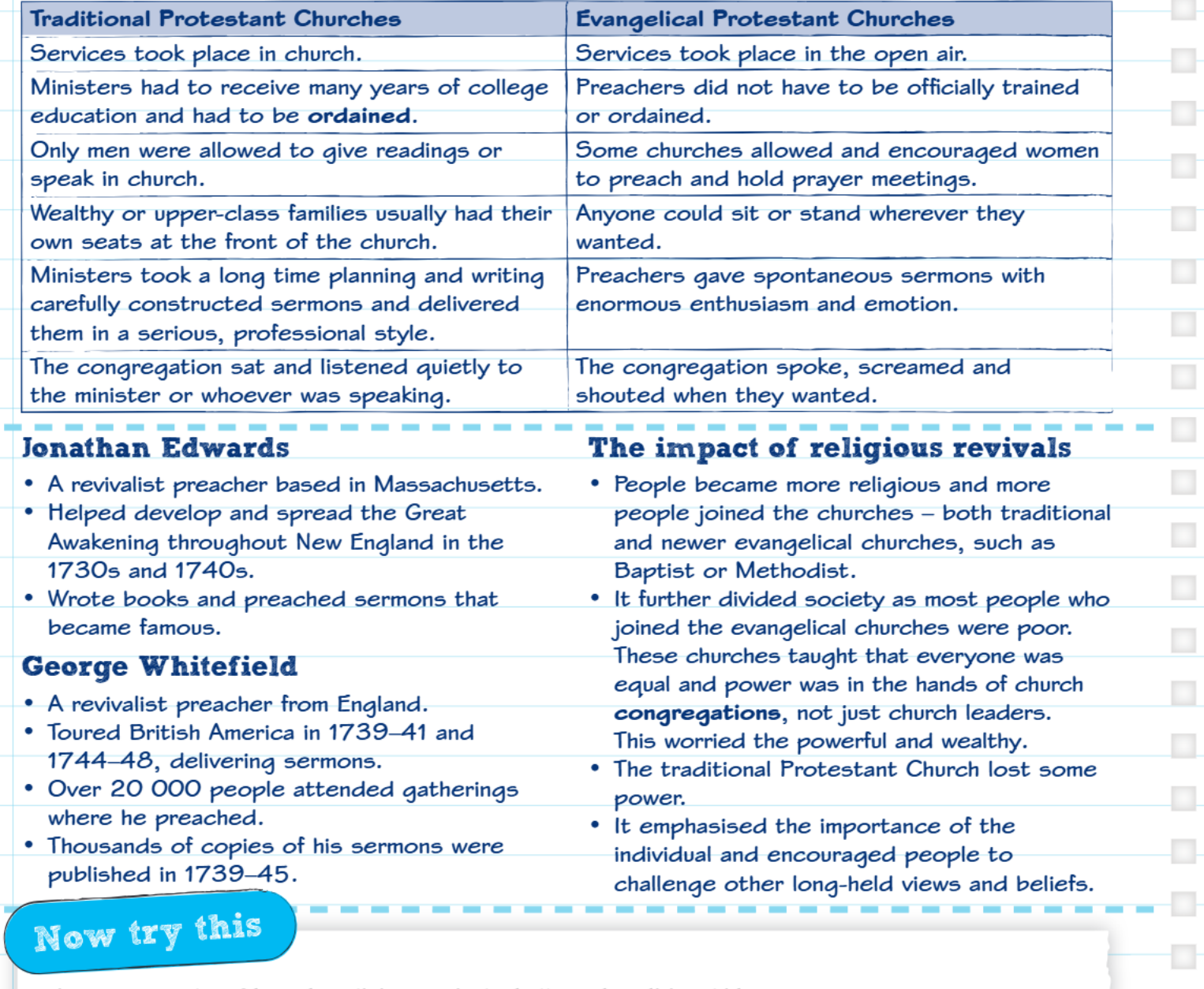
The Great Awakening created a clear divide between two distinct approaches to Protestant worship. Traditional Protestant churches maintained formal, structured practices that had been established for generations, while the new evangelical Protestant churches embraced a more spontaneous and emotional style of worship.
Traditional Protestant churches conducted their services within established church buildings, with ministers who had received formal education and official ordination from church authorities. These services followed strict protocols where only men were permitted to speak or give readings, and wealthy families typically occupied reserved seating at the front of the church. Ministers spent considerable time preparing carefully structured sermons, which they delivered in a serious, professional manner to congregations that remained quiet and respectful throughout the service.
Evangelical Protestant churches operated very differently, often holding their services outdoors to accommodate larger crowds. Their preachers frequently lacked formal theological training or official church ordination, relying instead on their passion and personal conviction. These churches were more inclusive, with some congregations encouraging women to preach and lead prayer meetings. Seating arrangements were informal, allowing anyone to sit or stand wherever they chose. The preaching style was dramatically different, featuring spontaneous sermons delivered with tremendous enthusiasm and emotion, while congregations actively participated by speaking out, screaming, and shouting during services.
Important
The contrast between these two approaches represented more than just different worship styles—it reflected fundamental disagreements about religious authority, social hierarchy, and who could legitimately speak for God in colonial society.
Impact of religious revivals on colonial society
The religious revivals of this period had profound and lasting effects on colonial American society. The movement successfully increased overall religious participation, drawing more people into active church membership and spiritual life than had been seen in previous decades.
However, these revivals also created significant social divisions within communities. Traditional churches, which typically attracted wealthy and established families, found themselves in opposition to the newer evangelical denominations such as Baptist and Methodist churches. These evangelical congregations primarily appealed to poorer members of society, creating class-based religious divisions.
The Great Awakening fundamentally shifted power dynamics within religious communities. The evangelical movement taught that spiritual authority came from personal faith rather than formal education or church appointment. This message particularly appealed to ordinary people who had previously been excluded from religious leadership roles.
Perhaps most importantly, the religious revivals emphasised individual spiritual experience and encouraged people to question long-established beliefs and traditions. This emphasis on personal judgement and individual challenge to authority would have lasting implications for colonial society, extending far beyond religious matters.
Important
The Great Awakening's emphasis on individual judgement and questioning authority helped lay the intellectual groundwork for later political movements, including the eventual challenge to British authority that would lead to the American Revolution.
Timeline of major events
- 1730s: Jonathan Edwards begins spreading the Great Awakening in New England
- 1739-41: George Whitefield's first major tour of British America
- 1739-45: Thousands of copies of Whitefield's sermons published and distributed
- 1744-48: Whitefield's second tour of the colonies
- 1750: End of the main Great Awakening period
Key vocabulary
Congregation: The group of people who attend a religious service together
Evangelical: An enthusiastic and emotional style of preaching designed to convert people to Christianity or strengthen their existing faith
Ordained: Officially appointed to religious office by established church authorities
Protestantism: One of the three main branches of Christianity, alongside Catholicism and Orthodox Christianity
Religious revival: A period of renewed religious interest and increased spiritual activity within a community
Summary
Key Points to Remember:
- The Great Awakening (1730-50) transformed Protestant Christianity in colonial America by introducing more emotional and personal forms of worship
- Key figures Jonathan Edwards and George Whitefield drew massive crowds and spread evangelical Christianity throughout the colonies
- Traditional churches maintained formal worship with educated ministers, while evangelical churches embraced outdoor services and spontaneous preaching
- The revivals increased religious participation but also created social divisions between wealthy traditional congregations and poorer evangelical denominations
- The movement emphasised individual spiritual experience and encouraged people to challenge established religious and social authority