Significance of the French and Indian War (Edexcel GCSE History): Revision Notes
📚Revision Notes
Significance of the French and Indian War
Overview of the war's end
The French and Indian War came to a decisive end with the Treaty of Paris in 1763, which also concluded the broader Seven Years' War. Britain emerged victorious, but their initial excitement about gaining new territories was quickly dampened by the Proclamation Act issued later that same year. This conflict fundamentally reshaped North America and had lasting consequences for British-colonial relations.
Note
The French and Indian War was the North American theatre of the larger Seven Years' War (1756-1763), which involved major European powers fighting across multiple continents. The war's end marked a complete transformation of the balance of power in North America.
Territorial changes from the Treaty of Paris, 1763
The treaty completely redrew the map of North America, creating a massive shift in European colonial power. The main territorial exchanges included several key transfers that would shape the continent's future.
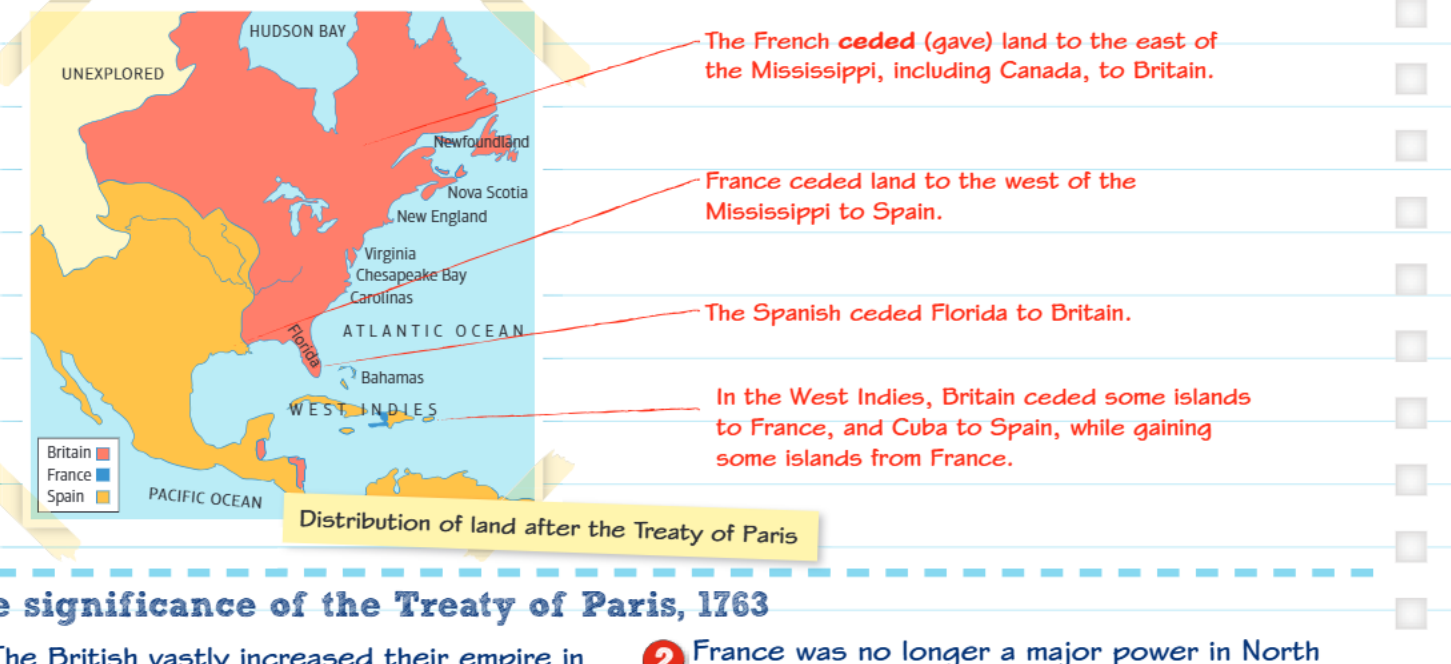
The French made significant territorial concessions, ceding all their lands east of the Mississippi River, including the valuable territory of Canada, directly to British control. Meanwhile, France transferred their western territories beyond the Mississippi to Spain, effectively removing themselves from mainland North America. Spain also participated in these exchanges, giving up Florida to Britain while gaining French territories in the west. In the Caribbean, Britain secured some islands from France while ceding others to Spain, along with gaining Cuba temporarily.
These changes meant that Britain now controlled the eastern half of North America, while Spain dominated the western territories and Florida changed hands to British rule.
The significance of the Treaty of Paris, 1763
British empire expansion and power
The treaty dramatically expanded British imperial reach in North America, bringing unprecedented territorial gains that increased both Britain's power and wealth. British American colonists suddenly found themselves with access to vast new lands where they could settle, fulfilling their long-held dreams of westward expansion. The victory also brought many new peoples under British rule, including French communities in Canada who now became British subjects.
This expansion meant that British colonists felt less dependent on Britain for protection, as the major French threat had been eliminated from their borders.
France's diminished role in North America
France's position as a major North American power came to an abrupt end with these territorial losses. Without their previous strongholds, French forces could no longer launch attacks against British colonies, removing a constant source of colonial anxiety. This change opened up profitable fur trading opportunities with Indigenous tribes that had previously been controlled by French traders.
Most importantly for Indigenous peoples, the removal of French protection left many tribes without their traditional European ally, fundamentally altering the balance of power on the frontier.
The Proclamation Act, 1763
Key provisions of the act
King George III issued the Proclamation Act on 7 October 1763, establishing new administrative structures for the conquered territories. The act created new British colonies from the former French and Spanish lands, including Quebec, East Florida, and West Florida.
However, the most significant aspect was the establishment of the Proclamation Line, which prohibited colonial settlement and land claims west of the Appalachian Mountains. This effectively reserved the Ohio Country for Indigenous peoples while also removing trading licenses that allowed colonists to trade directly with tribes.
Example
Worked Example: Impact of the Proclamation Line
Consider a Virginia colonist who had fought in the French and Indian War:
Before 1763: This colonist expected to settle in the Ohio Valley as a reward for military service, having been promised land grants in the region.
After the Proclamation Act: The same colonist found that settlement west of the Appalachian Mountains was now illegal, despite British victory opening up these territories.
Result: The colonist felt betrayed by the British government and might choose to settle illegally anyway, creating tensions with both Indigenous peoples and British authorities.
Impact on colonists and Indigenous relations
The Proclamation Act created a complex situation that pleased some groups while angering others. Colonists in Florida and Quebec benefited from the new colonial status, but many other colonists felt betrayed by the restriction on westward expansion, especially since they had fought in the war partly to gain access to these lands.
Important
The Proclamation Act represented an attempt by Britain to improve relationships with Indigenous peoples following conflicts like Pontiac's Rebellion. However, many colonists simply ignored the Proclamation Line and continued settling in restricted areas, leading to increased tensions and violated treaties.
The act represented an attempt by Britain to improve relationships with Indigenous peoples following conflicts like Pontiac's Rebellion. However, the reality proved more complicated, as many colonists simply ignored the Proclamation Line and continued settling in restricted areas. This led to increased tensions between colonists and Indigenous communities, as tribes were often deceived in their dealings with illegal settlers.
The restriction on trade also created friction, as colonists lost direct access to profitable relationships with Indigenous traders that they had developed during and after the war.
Timeline of major events
Note
Key Chronological Developments
This timeline shows how quickly the celebration of British victory turned into colonial frustration and ongoing conflict.
- 1763: Treaty of Paris signed, ending the Seven Years' War
- 7 October 1763: King George III issues the Proclamation Act
- 1763 onwards: Colonial settlement continues illegally west of the Proclamation Line
- 1763-1764: Indigenous-colonial tensions increase due to violated treaties and illegal settlement
Summary
Key Points to Remember:
-
The Treaty of Paris 1763 ended the French and Indian War, dramatically expanding British control in North America while eliminating French power east of the Mississippi River
-
Britain's territorial gains increased colonial confidence and reduced dependence on British protection, as the French threat was removed
-
The Proclamation Act of 1763 attempted to restrict colonial expansion westward, creating the Proclamation Line to reserve lands for Indigenous peoples
-
These changes created mixed results - some colonists benefited from new opportunities, but many felt betrayed by restrictions on westward settlement
-
Indigenous peoples lost French protection while facing continued pressure from illegal colonial settlement, leading to ongoing tensions despite British attempts at improved relations