‘Black Sam’ and ‘Blackbeard’ (Edexcel GCSE History): Revision Notes
📚Revision Notes
'Black Sam' and 'Blackbeard'
The golden age of piracy
The period from approximately 1715 to 1725 became known as the 'Golden Age' of piracy. During these years, large numbers of pirates launched devastating attacks against ships travelling around the West Indies and along the coast of British America. This era of maritime lawlessness had profound consequences for British colonial trade and settlement.
Note
The scale of pirate activity during this period was enormous. Historical records show that over 2,400 ships were either captured or completely destroyed by pirates. This represented a significant threat to British commercial interests and the safety of colonial shipping routes.
Impact of piracy on British America
Piracy created widespread disruption across multiple aspects of colonial life and commerce. The constant threat of pirate attacks led to several serious consequences for British America.
Insurance costs increased dramatically as shipping companies tried to protect themselves against potential losses. This made trading much more expensive and reduced profit margins for merchants. Additionally, millions of pounds worth of goods were stolen directly from ships, meaning that traders lost valuable cargo and essential supplies were delayed or never reached their destinations.
Important
The psychological impact was equally significant. Sailors lived in constant fear for their lives, knowing that encounters with pirates often ended in death or forced recruitment. Traders worried about losing their investments and livelihoods to pirate attacks.
Many people who found themselves on ships attacked by pirates faced terrible choices - they were often killed outright or forced to join the pirate crews against their will.
'Black Sam' Bellamy
Samuel Bellamy, known as 'Black Sam', operated as one of the most successful pirates during 1716 and 1717. His activities caused significant damage to trade networks and spread fear throughout the region by targeting over 50 ships that travelled between the West Indies and Massachusetts.
Bellamy's methods and ship
From March 1717, Bellamy commanded the captured slave ship Whydah, which he had seized and converted into his flagship. This vessel proved ideal for his purposes because it was fast enough to catch merchant ships but also large enough to carry substantial firepower.
Note
The Whydah was equipped with sufficient cannons to attack British Royal Navy warships that patrolled the coastal waters, making it a formidable weapon in Bellamy's arsenal.
Bellamy's career came to an abrupt end when the Whydah was destroyed during a violent storm in May 1717, killing the infamous pirate captain.
Bellamy's philosophy and crew relations
'Black Sam' distinguished himself from other pirates through his approach to sharing wealth and his justification for piracy. He distributed his stolen treasure among his crew members, and his men showed their loyalty by calling him 'Robin Hood'.
Important
Bellamy defended his criminal activities by arguing that he only stole from wealthy individuals who were themselves taking advantage of poor people. He claimed this made his actions morally acceptable, even though piracy remained illegal regardless of the victims' economic status.
Edward Teach ('Blackbeard')
Edward Teach, better known as 'Blackbeard', became perhaps the most notorious pirate of the Golden Age. His career began in 1713 when he joined the crew of Captain Hornigold, an established pirate leader operating from Nassau.
Rise to leadership
Teach remained loyal to Hornigold until other crew members abandoned the captain in 1716. At this point, Teach's dedication was rewarded when he was given command of his own ship in August 1717. He became captain of another vessel called Revenge, which he armed with additional guns and crew to increase its fighting capability.
By November 1717, Teach had achieved a major success by capturing a large French ship, which he renamed Queen Anne's Revenge. This became his most famous vessel and the base for his terrorising activities along the American coastline.
Blackbeard's reign of terror
For over a year, Teach terrorised the coastline of British America, becoming so feared that even the Royal Navy struggled to capture him. His criminal activities included multiple serious offences:
Example
Major Criminal Activities of Blackbeard:
- Stealing approximately £100,000 worth of valuable items while working with Hornigold
- Disrupting legitimate trade by attacking merchant vessels
- Stealing entire ships or burning them completely, leaving surviving crew members stranded on isolated islands
- Blockading Charleston harbour to prevent ships from entering or leaving
- Taking hostages and demanding ransom payments for their release
Blackbeard's appearance and tactics
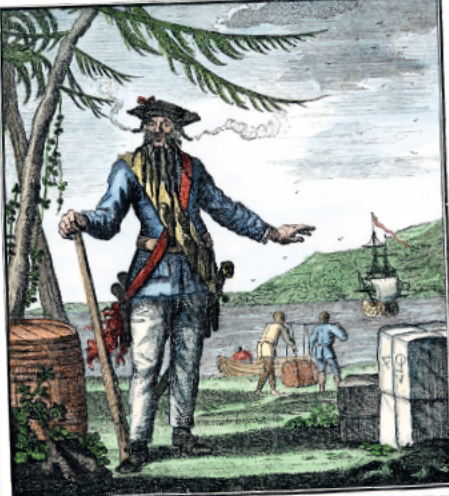
Teach became easily recognisable due to his distinctive long black beard, which gave him his famous nickname.
Note
He often set parts of his hair and beard on fire during battles to create a more terrifying appearance and intimidate his enemies. This psychological warfare tactic made him one of the most feared pirates of his era.
Blackbeard's downfall
Teach's success made him extremely wealthy, but it also led to his abandonment of many crew members to avoid sharing his treasure. He received support from corrupt local officials who accepted bribes in exchange for protection, and he purchased goods at prices below legal market rates.
The Governor of North Carolina allowed Teach to establish a base in July 1718, enabling him to continue his pirate activities. However, his reign of terror finally ended in November 1718 when he was killed during a battle with the Royal Navy.
Timeline of major events
- 1713: Edward Teach joins Captain Hornigold's pirate crew
- 1715: Beginning of the Golden Age of piracy
- 1716: 'Black Sam' Bellamy begins his most active period of piracy
- 1716: Hornigold's crew abandons him, Teach remains loyal
- March 1717: Bellamy captures and begins using the slave ship Whydah
- May 1717: Bellamy dies when Whydah is destroyed in a storm
- August 1717: Teach becomes captain of the ship Revenge
- November 1717: Teach captures French ship and renames it Queen Anne's Revenge
- July 1718: North Carolina Governor allows Teach to establish a base
- November 1718: Edward Teach (Blackbeard) killed by the Royal Navy
- 1725: End of the Golden Age of piracy
Summary
Key Points to Remember:
- The Golden Age of piracy (1715-1725) saw over 2,400 ships captured or destroyed, causing massive disruption to British American trade
- 'Black Sam' Bellamy operated 1716-1717, captured the Whydah, and shared his loot with crew members while justifying piracy as stealing from the rich
- Edward Teach (Blackbeard) began with Captain Hornigold in 1713, became an independent captain in 1717, and terrorised the American coastline until killed by the Royal Navy in 1718
- Piracy increased insurance costs, delayed essential supplies, and created widespread fear among sailors and traders
- Both pirates used fast, well-armed ships and employed different tactics - Bellamy focused on Robin Hood-style justifications while Blackbeard used intimidation and terror