The British colonies in 1713 (Edexcel GCSE History): Revision Notes
📚Revision Notes
The British colonies in 1713
Overview of British colonial expansion
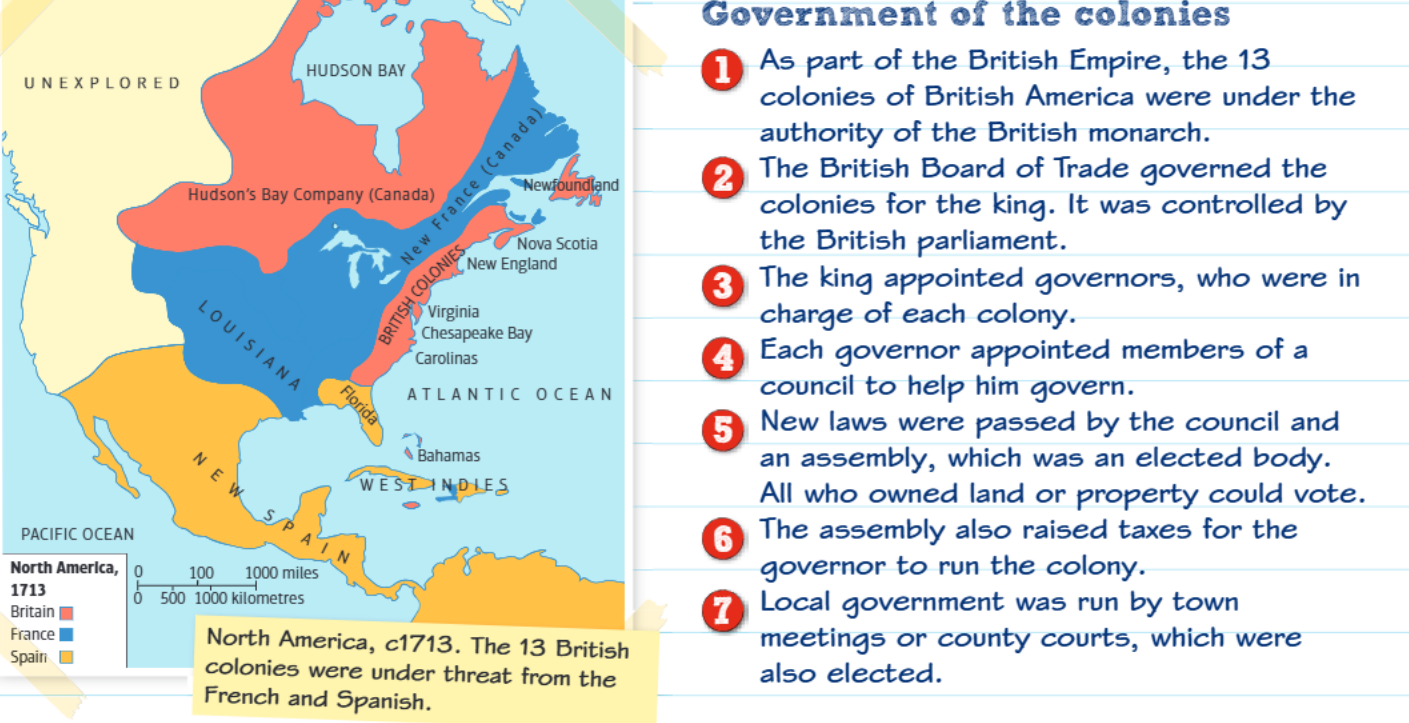
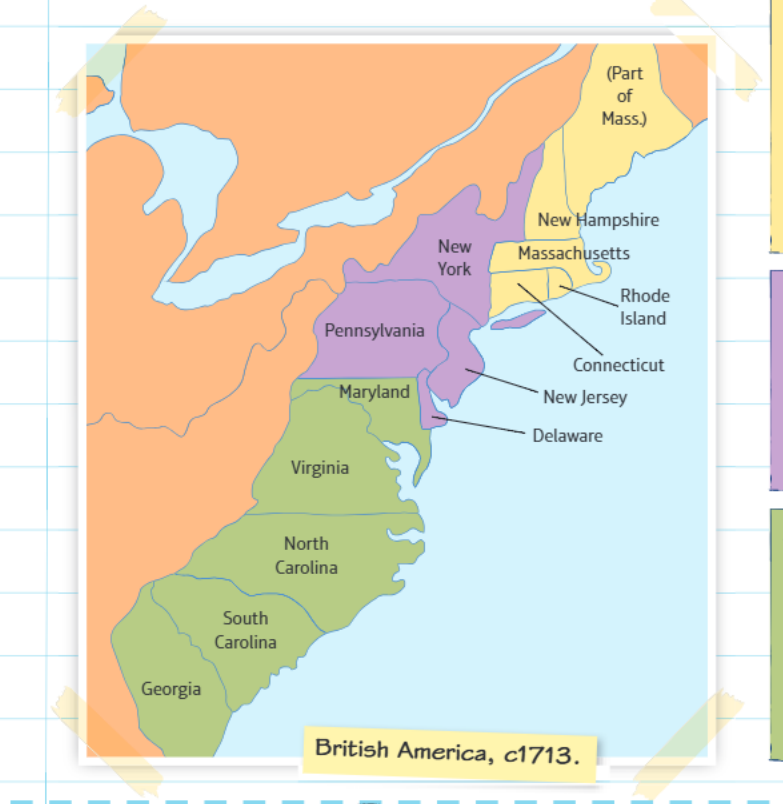
By 1713, Britain had established a significant presence in North America alongside other European powers. While Spain controlled territories in the south and west, and France held vast areas in the north and interior, Britain had secured thirteen colonies along the eastern seaboard of North America. These colonies represented a crucial part of the expanding British Empire and were all administered under the same governmental framework, though they developed distinct regional characteristics.
Note
The year 1713 marked a significant milestone in British colonial expansion, representing the completion of the initial phase of British settlement along North America's Atlantic coast. This coincided with the Treaty of Utrecht, which ended the War of Spanish Succession and solidified British territorial claims.
Government structure of the British colonies
The British colonies operated under a carefully designed administrative system that connected them directly to the crown while allowing for some degree of local governance. This hierarchical structure ensured British control while accommodating the practical needs of colonial administration.
At the top of this system sat the British monarch, who held ultimate authority over all colonial territories as part of the British Empire. The king delegated colonial oversight to the Board of Trade, a governmental body controlled by the British Parliament that managed colonial affairs from London.
Each colony was administered by a royal governor appointed directly by the king. These governors served as the monarch's representatives and held executive power within their respective territories. To assist in governance, each governor worked alongside an appointed council whose members were chosen to help administer colonial affairs.
Important
The system also incorporated democratic elements through colonial assemblies. These assemblies were elected bodies where property owners could vote to choose their representatives. This early form of democratic participation would later become a crucial foundation for American political development.
The elected assemblies had the important responsibility of passing new laws for their colonies and raising taxes to fund governmental operations. Local governance was handled through town meetings in some areas and county courts in others, both of which were elected by the colonists themselves. This multi-layered system created a balance between British imperial control and colonial self-governance that would prove significant in later decades.
Regional settlement patterns
The thirteen British colonies developed three distinct regional patterns of settlement, each shaped by geography, economic opportunities, and the backgrounds of their settlers.
New England colonies
The northern colonies of New England attracted primarily middle-class families who established close-knit communities centred around towns. Many of these settlers worked as farmers, taking advantage of the region's agricultural potential, while others turned to the sea as fishermen or engaged in skilled trades such as shipbuilding and woodworking.
The religious character of New England was heavily influenced by Puritan settlers, and by 1713, most colonists in the region were Congregationalists. This religious uniformity meant that people with different religious beliefs often faced discrimination and were not welcomed in many New England communities.
Note
New England's Town-Centered Society
The town-centered organisation of New England was unique among the colonial regions. These communities often featured a central common area surrounded by the meeting house, homes, and shops, creating tight-knit social and religious communities that emphasised collective decision-making.
Middle colonies
The middle colonies developed a more diverse economic foundation, with settlers engaging in both agricultural production and trade activities. Some colonists worked as servants, while others became successful farmers or merchants. A distinctive feature of this region was that land could be purchased in smaller plots, making it more accessible to ordinary settlers compared to the southern colonies.
Perhaps most significantly, the middle colonies practised religious tolerance, welcoming people of various faiths. This openness attracted a diverse population and contributed to the region's economic and cultural development.
Southern colonies
The southern colonies developed an economy based on large-scale agriculture, particularly the cultivation of tobacco and rice on extensive plantations. Land ownership in this region was expensive because it was typically sold in large portions suitable for plantation agriculture.
Important
The Reality of Southern Colonial Society
The social structure of the southern colonies was marked by extreme inequality. A small number of wealthy landowners controlled vast estates, while the majority of the population consisted of enslaved people who had been forcibly transported from West Africa to provide labour. In some southern colonies, enslaved people made up over fifty percent of the total population, highlighting the central role of slavery in the regional economy.
The economic foundation of these colonies depended heavily on enslaved labour, creating a social hierarchy that would have lasting impacts on American society.
Timeline
1713: By this date, Britain had established thirteen colonies along North America's Atlantic coast, forming a crucial part of the British Empire's expansion in the New World.
Key Takeaways
Summary
Essential Points to Remember:
-
Governmental hierarchy: The British colonies operated under a structured system from the monarch through the Board of Trade, royal governors, appointed councils, down to elected assemblies and local courts.
-
Three distinct regions: New England focused on towns and farming with Congregationalist communities, the middle colonies emphasised trade and religious tolerance, while southern colonies developed plantation agriculture with enslaved labour.
-
Democratic elements: Despite being part of an empire, the colonies included elected assemblies where property owners could vote, and local governance through elected town meetings and county courts.
-
Economic foundations: Each region developed different economic specialisations:
- New England: farming and fishing
- Middle colonies: mixed agriculture and trade
- Southern colonies: large-scale plantation agriculture
-
Social diversity: The colonies varied significantly in their social structures, from the relatively egalitarian New England towns to the highly stratified southern plantation society with its dependence on enslaved labour.