The Boston Tea Party (Edexcel GCSE History): Revision Notes
📚Revision Notes
The Boston Tea Party
What was the Boston Tea Party?
The Boston Tea Party was a crucial act of colonial defiance that occurred on 16 December 1773 in Boston Harbour. This dramatic protest became a turning point in the relationship between Britain and its American colonies, as colonists took direct action against what they saw as unfair British taxation and trade policies.
Background: the Tea Act of 1773
In 1773, the British Parliament passed the Tea Act, which significantly changed how tea was sold in the American colonies. The Act reduced the tax on tea from 12 pence to just three pence, but only for the British East India Company. This made the Company's tea much cheaper for colonists to buy.
However, the Act came with an important restriction: only official agents working for the East India Company were allowed to sell this imported tea. This gave the Company complete control over the colonial tea trade, creating a monopoly that would have serious consequences.
Note
A monopoly means that only one company can sell a particular product or service. In this case, the East India Company gained exclusive control over selling tea in the American colonies, eliminating competition from colonial merchants.
Impact of the Tea Act
Although the Tea Act made tea more affordable for ordinary colonists, it created major problems for colonial merchants and traders. The monopoly meant that colonists who had built businesses around buying and selling tea faced financial ruin unless they worked directly for the East India Company.
The Act also made it easier for smugglers to compete, since the official tea prices were now lower. This unfair advantage worried many colonists who saw it as another example of Britain interfering with their ability to make a living through fair trade.
Important
The Tea Act wasn't just about taxation - it threatened the livelihoods of colonial business owners. Even though tea became cheaper, many colonists opposed the Act because it destroyed local businesses and gave Britain even more control over colonial trade.
The Boston Tea Party event
The crisis began when the Dartmouth, the first ship carrying East India Company tea, arrived in Boston Harbour on 29 November 1773. Two more ships quickly followed, creating a tense standoff in the port.
The Boston Committee of Correspondence, which coordinated resistance activities throughout the colonies, demanded that the tea be returned to Britain without paying any duties. They organised guards around the harbour to prevent the cargo from being unloaded.
Governor Thomas Hutchinson refused to let the ships leave unless the duties were paid first, which created a deadlock. The situation reached a breaking point on 16 December, when approximately 5,000 concerned colonists gathered at Boston's Old South Church to discuss what should be done.
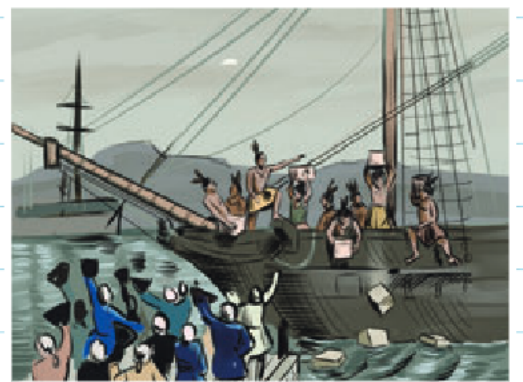
That same evening, around 60 members of the Sons of Liberty took decisive action. They disguised themselves as Indigenous Americans and quietly boarded the three ships anchored in Boston Harbour. Working efficiently through the night, they dumped 342 chests of tea into the sea. The destroyed tea was valued at approximately £10,000, representing an enormous financial loss for the time period.
Example
Timeline of the Boston Tea Party Crisis:
29 November 1773: Dartmouth arrives with East India Company tea
- Colonists demand the ship return to Britain
- Harbour guards prevent unloading
30 November - 15 December: Standoff continues
- Two more tea ships arrive
- Governor Hutchinson refuses to let ships leave without paying duties
16 December 1773: The Breaking Point
- 5,000 colonists meet at Old South Church
- Evening: 60 Sons of Liberty board ships
- 342 chests of tea (worth £10,000) dumped into harbour
British response: the Intolerable Acts of 1774
The British Parliament responded to the Tea Party with severe punishment through a series of laws known as the Intolerable Acts in 1774. These harsh measures were designed to make Boston an example to other colonies that might consider similar acts of rebellion.
Note
The Intolerable Acts included four main provisions:
- Boston Harbour closure - Harbour remained closed until the East India Company received full compensation
- Massachusetts Government Act - Colony's elected assembly disbanded and replaced with British-appointed officials
- Administration of Justice Act - Officials accused of crimes during riot suppression would be tried in Britain, not locally
- Quartering Act - British soldiers had the right to be housed in private colonial homes
The Acts included several devastating provisions: British troops closed Boston Harbour completely until the East India Company received full compensation for their losses. The Massachusetts governor was given much greater power, and the colony's elected assembly was disbanded and replaced with officials chosen directly by Britain.
The Acts also stated that anyone accused of crimes while suppressing colonial riots would not be tried locally, but would instead face trial in another colony or in Britain itself. Finally, British soldiers were given the right to be housed in private colonial homes, forcing families to accommodate troops against their will.
Significance and consequences
The Intolerable Acts and the events surrounding the Tea Party demonstrated that the relationship between Britain and the American colonies was rapidly deteriorating. The harsh British response affected all residents of Boston, not just those who had participated in the tea destruction, making it much harder for people to obtain basic goods and services.
This widespread punishment turned many previously neutral colonists against British rule. Although other colonies had not participated in the Boston Tea Party, they showed solidarity with Boston by sending supplies during the harbour blockade, revealing growing unity among the colonies.
The elimination of Massachusetts' elected government and the protection given to officials who used violence against colonists during riots alarmed Americans throughout the colonies. In response, they decided to organise the Continental Congress to coordinate their resistance to British policies and protect their rights.
Note
The Boston Tea Party had consequences far beyond Boston itself. The harsh British response actually helped unite the American colonies against Britain, as other colonies saw that they too could face severe punishment for resisting British policies.
Timeline of key events
- 1773: British Parliament passes Tea Act, creating East India Company monopoly
- 29 November 1773: The Dartmouth arrives in Boston Harbour carrying East India Company tea
- 16 December 1773: Boston Tea Party takes place - 342 chests dumped worth £10,000
- 1774: British Parliament passes Intolerable Acts as punishment
- 1774: Continental Congress convenes in response to British actions
Summary
Key Points to Remember:
- The Tea Act created a monopoly for the East India Company, making tea cheaper but destroying colonial merchants' businesses
- On 16 December 1773, 60 Sons of Liberty disguised as Indigenous Americans dumped 342 chests of tea worth £10,000 into Boston Harbour
- Britain responded with the harsh Intolerable Acts, which closed Boston Harbour and eliminated Massachusetts' self-government
- These events showed the complete breakdown of trust between Britain and the colonies
- The crisis led to greater colonial unity and the formation of the Continental Congress to coordinate resistance