Failure to recapture Jerusalem (Edexcel GCSE History): Revision Notes
📚Revision Notes
Failure to recapture Jerusalem
Overview
During the Third Crusade (1189-1192), King Richard I made determined efforts to reclaim Jerusalem from Muslim control under Saladin. Despite his military prowess and two separate attempts to march on the holy city, Richard ultimately failed to achieve this primary objective of the crusade. This failure had significant consequences for Christian control in the Holy Land.
Note
The Third Crusade is often called the "Kings' Crusade" because it was led by three major European monarchs: Richard I of England, Philip Augustus of France, and Frederick Barbarossa of the Holy Roman Empire.
The first march on Jerusalem (October 1191 - January 1192)
Following his victory at the Battle of Arsuf in September 1191, Richard began rebuilding the coastal defences at Jaffa. Although he initially wanted to attack Ascalon, he was persuaded by fellow crusade commanders to march directly towards Jerusalem instead.
The first attempt proved disastrous due to environmental challenges. The winter weather was exceptionally harsh, with persistent rain and mud making progress extremely difficult. These conditions destroyed vital supplies including food, clothing, and military equipment. The crusader army found movement almost impossible, and Richard was forced to make the difficult decision to retreat back to Ascalon without reaching Jerusalem.
Important
Environmental factors proved decisive in mediaeval warfare. The harsh winter of 1191-1192 demonstrated how weather conditions could completely derail military campaigns, regardless of the army's strength or leadership quality.
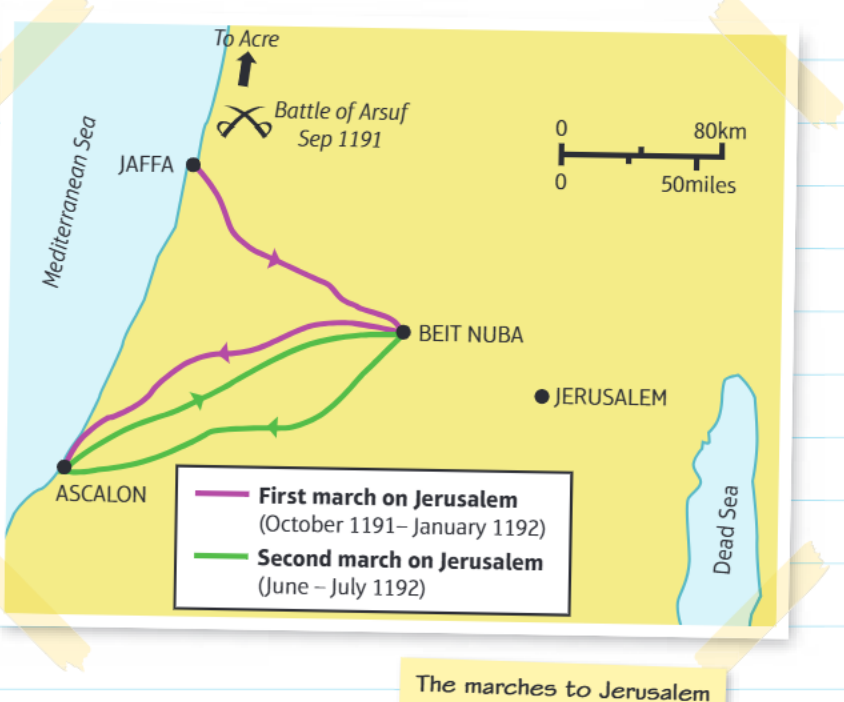
The second march on Jerusalem (June - July 1192)
By summer 1192, weather conditions had improved significantly, allowing the crusaders to make much faster progress. The army successfully advanced from the coast to Beit Nuba, bringing them tantalisingly close to their ultimate goal.
However, even this more successful advance ended in retreat. The summer heat created new challenges, particularly regarding water supplies. The crusaders became increasingly concerned about the availability of fresh water, especially since intelligence suggested that Saladin had contaminated wells around Jerusalem. After extensive debates among the leadership, Richard again decided to withdraw rather than risk a siege.
Note
Beit Nuba was strategically located only about 12 miles from Jerusalem - close enough that the crusaders could see the city's walls. This proximity made the decision to retreat particularly difficult and controversial among the crusader leadership.
Strategic reasons for avoiding Jerusalem
Richard's decision not to attack Jerusalem was based on several practical military considerations that reveal the complexity of mediaeval siege warfare:
Important
Critical Strategic Considerations
Supply line vulnerabilities: Advancing inland from the coast would leave the crusader army's supply lines exposed to Muslim attacks. Without secure access to food and reinforcements from their coastal bases, the army could be cut off and starved into submission.
Risk of encirclement: Moving away from the coast meant the crusaders could potentially be surrounded by Saladin's forces and attacked from multiple directions simultaneously, with no clear route of retreat.
Insufficient siege resources: Jerusalem was a heavily fortified city with strong walls and defensive positions. The crusaders lacked the necessary equipment, manpower, and financial resources to conduct a successful siege of such a well-defended location.
Time and money constraints: Extended siege warfare was extremely expensive and time-consuming. Richard was aware that his resources were limited and that political problems were developing back in England that required his attention.
Defending Jaffa
While Richard failed to capture Jerusalem, he demonstrated his military skills in defending the coastal city of Jaffa. After most crusaders had retreated to Ascalon following the second failed march, Saladin's forces attempted to retake Jaffa.
Richard responded with a surprise attack that successfully saved the city. His personal bravery and tactical skill during these battles were widely praised by both Christian and Muslim sources. This victory helped maintain crusader control over a crucial coastal stronghold, even though it could not compensate for the failure to reclaim Jerusalem.
Note
Richard's defence of Jaffa showcased his reputation as one of mediaeval Europe's finest military tacticians. Even Saladin's chroniclers acknowledged Richard's exceptional courage and battlefield leadership during these engagements.
The Treaty of Jaffa (1192)
Eventually, both Richard and Saladin recognised that continued fighting was unsustainable. Richard had received news that his lands in England and France were under threat, while Saladin was suffering from illness and running short of funds to maintain his armies.
Example
The Treaty of Jaffa: Key Provisions
The negotiated settlement established a practical compromise between Christian and Muslim interests:
Step 1: Territorial Control
- Muslim control: Jerusalem remained under Saladin's control
- Christian coastal territory: Christians retained control of the coastline between Acre and Jaffa
Step 2: Religious and Commercial Rights
- Pilgrimage rights: Christian pilgrims were guaranteed safe passage to visit holy sites in Jerusalem
- Trade agreements allowed peaceful commercial exchange between territories
Step 3: Military Arrangements
- Temporary peace: Both sides agreed to a three-year truce to end active hostilities
- Mutual recognition of territorial boundaries and sovereignty
Significance and consequences
Richard's failure to recapture Jerusalem marked a significant setback for Christian ambitions in the Holy Land. While the Third Crusade had achieved some military successes and maintained Christian presence along the coast, it fell short of its primary religious and political objective.
The treaty represented a compromise that allowed both sides to claim limited victories while acknowledging the practical limitations of continued warfare. For Richard, it provided an opportunity to return to his European territories, while for Saladin, it secured Muslim control over Islam's third holiest city.
Timeline
- September 1191: Battle of Arsuf - Richard defeats Saladin
- October 1191 - January 1192: First march on Jerusalem fails due to weather
- June - July 1192: Second march on Jerusalem reaches Beit Nuba but retreats
- July 1192: Richard successfully defends Jaffa
- September 1192: Treaty of Jaffa signed
- October 1192: Richard begins journey home
Summary
Key Points to Remember:
- Richard made two separate attempts to reach Jerusalem but failed both times due to practical military challenges
- Weather and supply problems were major factors in the first failure, while water shortages and strategic concerns caused the second retreat
- The Treaty of Jaffa allowed Muslims to keep Jerusalem while Christians retained coastal territories and pilgrimage rights
- Richard's defence of Jaffa showed his military skills even when the main crusade objective failed
- The failure to recapture Jerusalem meant the Third Crusade achieved only limited success compared to its ambitious goals